By Dr. Asnat Raziel, bariatric surgeon specializing in obesity treatment, metabolic health and healthy longevity; Director of the Multidisciplinary Center for Obesity Treatment, Assia Medical, Assuta Ramat HaChayal, Tel Aviv
What is slow weight loss?
Slow, safe weight loss is a gradual process in which the body loses mostly fat while holding on to muscle. The usual recommendation is about 0.5 to 1 kg per week. In this article, I explain what the research really says about slow weight loss, what matters even more than the pace, and how to build a process that lasts.
In my clinic, I meet many patients who have already tried everything. Most of them lost weight quickly and then gained it back. That is why the right question is not only “how fast?” but also “what am I losing?” and “can I keep this up for years?”
How fast is “slow”? The recommendations in numbers
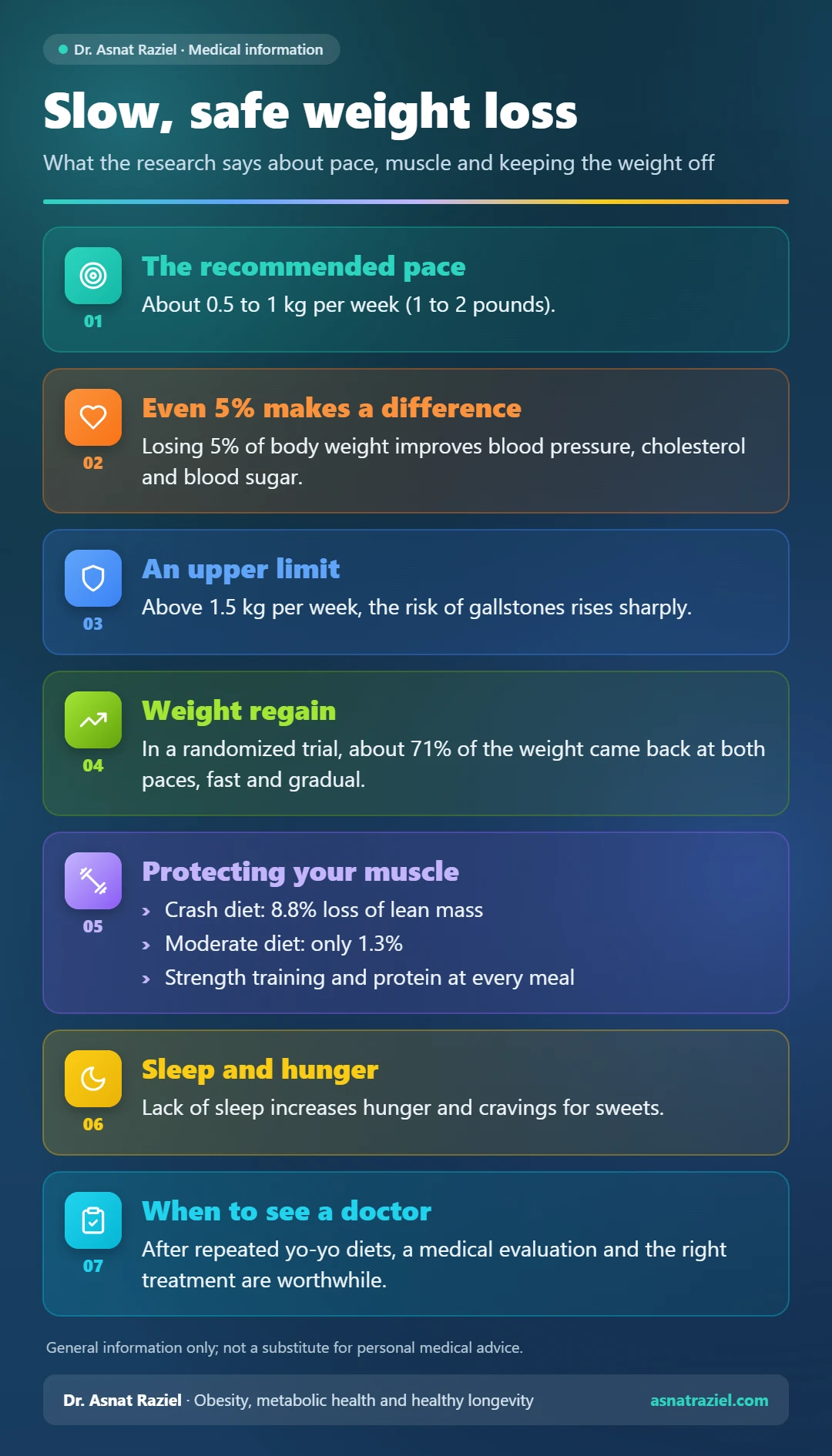
The U.S. Centers for Disease Control and Prevention (CDC) recommends a gradual, steady pace of 1 to 2 pounds per week. In other words, that is about 0.5 to 0.9 kg per week. According to the same source, losing even 5% of your body weight improves blood pressure, cholesterol and blood sugar levels. For example, a person who weighs 100 kg already benefits from losing 5 kg.
There is also an upper limit, for safety reasons. An analysis of studies on gallstones found that the risk of stones rises sharply once the pace exceeds 1.5 kg per week. Therefore, the researchers recommended not going above this average. I wrote about other risks in my article on the dangers of losing weight too fast.
Does slow weight loss prevent weight regain?
Here, the research is surprising. For years, people believed that what comes off fast comes back fast. However, a randomized trial from Australia tested exactly this question. In total, 200 participants with obesity followed either a fast 12-week program or a gradual 36-week program. Both programs aimed for a 15% weight loss.
In the fast program, 81% reached a weight loss of at least 12.5%, compared with 50% in the gradual program. Afterward, the participants moved on to a 144-week maintenance phase. By the end, both groups had regained about 71% of the weight they had lost. In other words, the pace itself did not determine weight regain.
So what does this mean in practice? The pace matters mainly for safety and for body composition. Long-term maintenance, on the other hand, depends on other factors: habits, sleep, biological hunger and, in some cases, medication.
What you lose along the way: fat or muscle
The number that really matters is what your body loses. A Dutch study compared 57 participants. One group ate 1,250 calories a day for 12 weeks. The second group ate 500 calories a day for 5 weeks. Both groups lost a similar amount of weight, 8.2 and 9.0 kg.
However, the composition of that loss was very different. In the crash-diet group, fat-free mass (everything that is not fat, mainly muscle) dropped by 8.8%, compared with only 1.3% in the gradual group. In addition, the more fat-free mass people lost, the more weight they regained later. That is why slow weight loss helps above all to preserve muscle, which is an important metabolic engine.
How to preserve muscle during slow weight loss
- Strength training two to three times a week.
- Protein at every meal. I covered this in detail in my article on getting the right amount of protein.
- A moderate calorie deficit, without long, extreme fasts.
Slow weight loss in everyday life
First, set a modest initial goal: 5% to 10% of your body weight. Reaching it already improves your health. Second, build a menu you can live with, not a menu for one month. Good weight management relies on consistent habits rather than willpower.
In addition, don’t underestimate sleep. Lack of sleep increases hunger and cravings for sweets. I wrote about this at length in my article on sleep and brain health. What’s more, regular daily movement, even walking, helps you keep the weight off.
It is also important to understand food noise, the constant, intrusive thoughts about food. For some people, it is a biological phenomenon, not a weakness. In such cases, the right treatment can change the picture.
A sample plate for slow weight loss
You don’t need a complicated menu. Half a plate of vegetables, a quarter of protein and a quarter of whole-grain carbohydrates make a good foundation. It is also worth choosing real food over processed products. Water, legumes and whole fruit add volume and fullness without many calories.
What about “free” meals? They are part of life, and there is no reason to give them up completely. What matters is what happens on most days, not one meal at a wedding. A flexible approach like this reduces guilt and, as a result, also reduces emotional eating.
When the scale stops moving
Almost everyone who loses weight hits a stall at some point. The body lowers its energy expenditure and increases hunger. This is natural and not a sign of failure. In my article on weight-loss plateaus, I explain what to do at this stage.
When to get medical help on the way to slow weight loss
After years of yo-yo dieting, many people feel they have no strength left. In this situation, it is worth seeking a medical evaluation. Obesity is a chronic disease, and there are proven treatments for it.
For example, medication for obesity may be a good fit for people for whom lifestyle changes alone were not enough. Even with medication, slow, safe weight loss remains the goal, supported by protein, strength training and medical follow-up. This way, you preserve muscle and reduce side effects. You can read about my approach to treatment on the About Dr. Asnat Raziel page.
The bottom line
Slow, safe weight loss, at a pace of about 0.5 to 1 kg per week, protects muscle and reduces risks such as gallstones. However, the pace alone does not prevent weight regain. What really counts is changing your habits over time, getting good sleep, preserving muscle mass and, in some cases, medical treatment.
The information in this article is general and does not replace personal medical advice.
Questions and answers
How many kilograms per week count as slow weight loss?
Usually 0.5 to 1 kg per week. In the first few weeks, the weight sometimes comes off much faster, mainly because of fluid loss.
If I lost weight fast, will I definitely gain it back?
Not necessarily. In the Australian study, the rate of regain was similar at both paces. Even so, very rapid weight loss increases the risk of gallstones and muscle loss.
How do I know I am losing fat and not muscle?
A body composition test gives a good picture. Also, maintaining your strength in workouts is a positive sign.
Can I lose weight slowly with weight-loss injections, too?
Yes, and that is the goal. The doctor increases the dose gradually. Alongside the treatment, it is important to focus on protein and strength training.
Sources
The effect of rate of weight loss on long-term weight management: a randomised controlled trial
The effect of rate of weight loss on long-term weight regain in adults with overweight and obesity




