By Dr. Asnat Raziel, bariatric surgeon specializing in obesity treatment, metabolic health and healthy longevity; Director of the Multidisciplinary Center for Obesity Treatment, Assia Medical, Assuta Ramat HaChayal, Tel Aviv
Wegovy weight loss: what a year of routine care teaches us
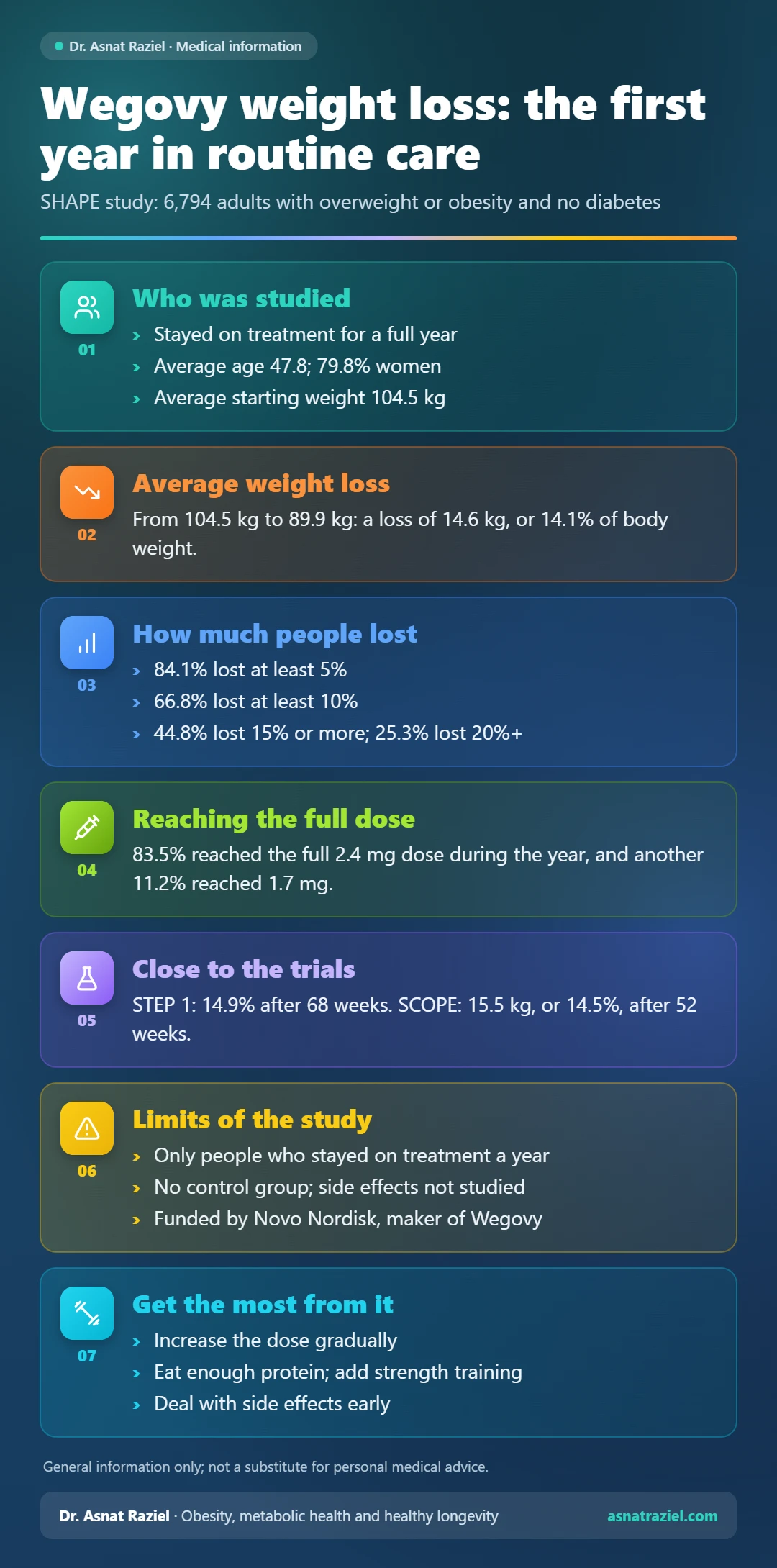
Wegovy weight loss is one of the first things my patients ask me about: “How much can I expect to lose?” The SHAPE study looked at this in 6,794 adults with overweight or obesity and no diabetes who stayed on treatment for a full year. On average, they lost 14.6 kg, or 14.1% of their body weight. In addition, 83.5% of them reached the full 2.4 mg dose.
Why it matters to test treatment outside clinical trials
Wegovy contains semaglutide, which mimics the satiety hormone GLP-1. In the STEP 1 trial, participants without diabetes lost an average of 14.9% of their body weight after 68 weeks. In a controlled trial, however, people get close follow-up, support and free medication. That is why it matters to check what happens in routine care, with ordinary patients. I reviewed this series of trials in my article on the STEP trials.
What the SHAPE study examined
The researchers used Komodo, a US database that pools insurance data and medical records. They included adults who started treatment between June 2021 and December 2023. All participants had obesity, or overweight with at least one related complication. On the other hand, the researchers excluded people with type 2 diabetes.
The study also set two important conditions. First, patients had to stay on treatment for a full year, with no break longer than 30 days. Second, they needed a recorded weight at the start of treatment and after one year. In the Wegovy group, the average age was 47.8, and 79.8% were women. The average starting weight was 104.5 kg.
Wegovy weight loss: the results after one year
After a year of continuous treatment, average weight dropped from 104.5 kg to 89.9 kg. In other words, patients lost 14.6 kg, or 14.1% of their body weight. Here is how the patients broke down by amount of weight lost:
- 84.1% lost at least 5% of their body weight.
- 66.8% lost at least 10%.
- 44.8% lost at least 15%.
- 25.3% lost at least 20%.
Put simply, about two-thirds of patients lost 10% or more. For comparison, a loss of just 5% to 10% already improves blood pressure, blood sugar and blood lipids. I described what changed in metabolic health after a year on Wegovy in a separate article. On the other hand, about one in six patients did not reach 5%. So the response to treatment varies from person to person, as I explained in my article on why the same injection works for one person and not another.
The full dose: most patients reached it
Wegovy starts at a low dose of 0.25 mg and increases gradually over about four months. In the SHAPE study, 83.5% of patients reached the full 2.4 mg dose during the year. Another 11.2% reached 1.7 mg, and only a few stayed on lower doses.
This finding matters because it shows that most patients tolerated the dose increases. Even so, not every patient needs the maximum dose. I discussed this question in my article on treating to target.
Wegovy weight loss compared with other studies
The SHAPE results are similar to those of the STEP 1 trial and of other real-world studies. For example, in the SCOPE study, 594 patients with weight data lost 15.5 kg, or 14.5%, after 52 weeks. In short, for people who stay on treatment, weight loss in routine care comes close to what we see in trials.
The SHAPE study also looked at patients on tirzepatide, the active ingredient in Mounjaro. They lost an average of 17.2 kg, or 16.5%. This comparison is descriptive only, and I analyzed it in depth in a separate article on Mounjaro versus Wegovy.
Limits of the study
First, the study included only people who stayed on treatment for a full year and had their weight recorded at the end. In practice, many patients stop early, so the average in the general population is likely to be lower. Second, this is a descriptive study with no control group. Third, insurance data can contain recording errors. In addition, the researchers did not look at side effects. Finally, Novo Nordisk, the maker of Wegovy, funded the study, and all of the researchers are company employees.
How to get the most out of treatment
The data highlight that sticking with treatment is a condition for success. That is why it pays to plan treatment ahead of time:
- Increase the dose gradually, under a doctor’s guidance, and don’t rush.
- Eat enough protein and add strength training to preserve muscle mass. Read more in my article on lean body mass.
- Deal with side effects early. Small meals and drinking enough fluids help a lot.
- Also measure success by your waist size, your blood tests and how you feel overall.
I wrote about why people stop treatment and how to stay on track in my article on persistence in obesity treatment.
Bottom line: Wegovy weight loss
In the SHAPE study, patients without diabetes who stayed on treatment for a year lost an average of 14.6 kg, or 14.1% of their body weight. Most patients reached the full dose, and about two-thirds lost 10% or more. Therefore, Wegovy weight loss in routine care is similar to that seen in trials, as long as people continue treatment. Ultimately, persistence and close medical support are what determine the result.
The information in this article is general information only and is not a substitute for personal medical advice. Before starting or changing any treatment, consult your doctor.
References
Once-Weekly Semaglutide in Adults with Overweight or Obesity
The SHAPE study was funded by Novo Nordisk, and all of the researchers are employees and shareholders of the company.




