By Dr. Asnat Raziel, bariatric surgeon specializing in obesity treatment, metabolic health and healthy longevity; Director of the Multidisciplinary Center for Obesity Treatment, Assia Medical, Assuta Ramat HaChayal, Tel Aviv
The STEP trials: what they are and why they matter
The STEP trials are a series of large clinical trials that tested Wegovy as a treatment for obesity. Its active ingredient is semaglutide, a medication in the GLP-1 family. In other words, it mimics a natural hormone that reduces hunger and increases fullness. These trials form the basis for the drug’s approval around the world, so it is worth understanding exactly what they showed.
In this article, I’ll explain what the main trials examined, what the results were in numbers, and what they mean for anyone considering medication treatment. I’ll also cover the limitations and the side effects.
How the STEP trials were designed
Most of the trials in the series followed the same design. Participants were randomly assigned to a weekly injection of either semaglutide 2.4 mg or a dummy injection (placebo). Neither the participants nor their doctors knew who was receiving what. All participants also received guidance on nutrition and physical activity.
The dose was increased gradually over 16 weeks to reduce nausea, after which participants continued on the full dose. Most of the trials lasted 68 weeks, or about a year and four months. Participants were adults with a BMI (body mass index) of 30 or more, or 27 or more with a related condition such as high blood pressure.
STEP 1: the first of the STEP trials
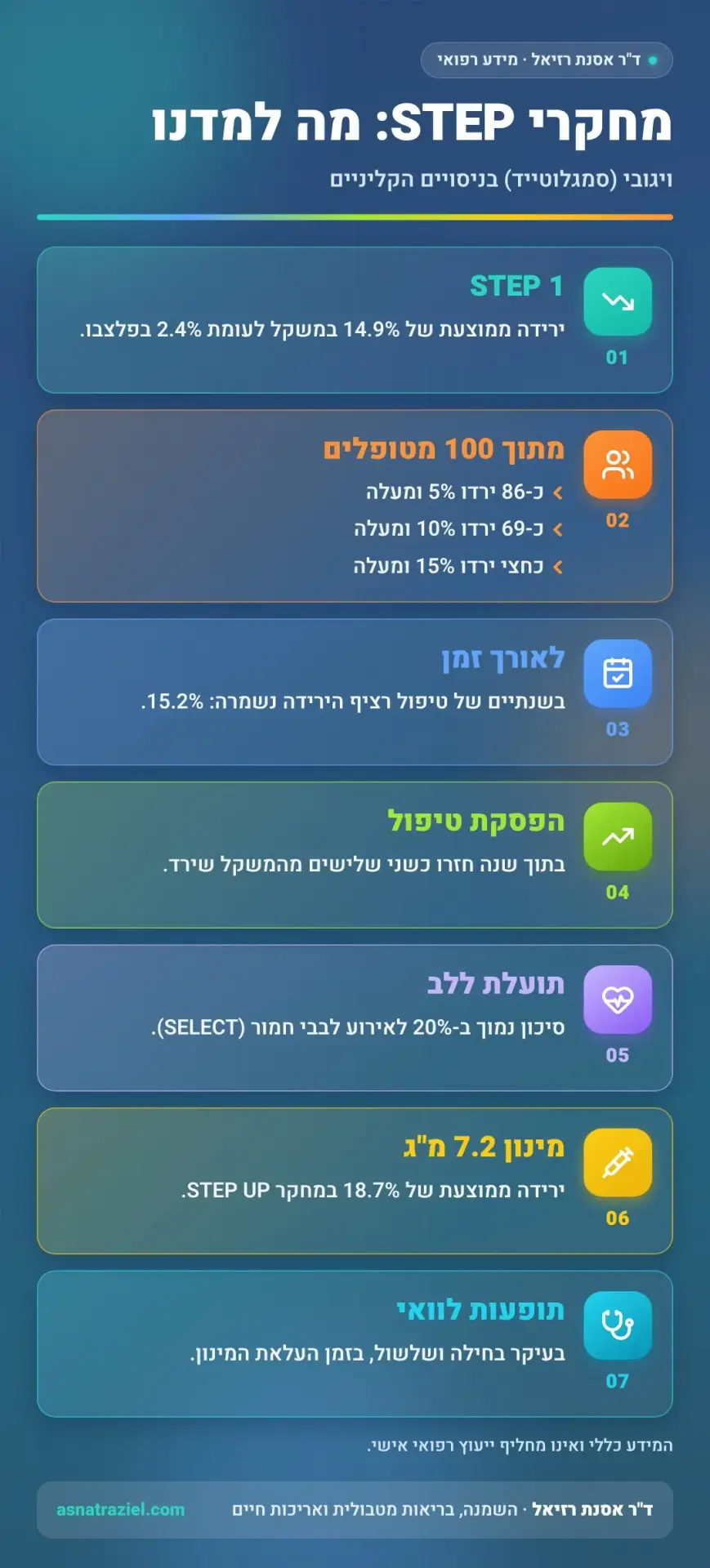
The STEP 1 trial enrolled 1,961 adults without diabetes. After 68 weeks, the semaglutide group had lost an average of 14.9% of their body weight, compared with just 2.4% in the placebo group. In concrete terms, the average loss was 15.3 kg versus 2.6 kg.
What does this mean for patients? Out of every 100 patients who received the medication, about 86 lost at least 5% of their weight. About 69 lost 10% or more, and about half lost 15% or more. Participants also saw improvements in cardiovascular risk factors and physical functioning.
The STEP trials in different populations
After STEP 1, the researchers wanted to know whether the results would hold up in other groups. So further trials were carried out, each with its own question.
Type 2 diabetes (STEP 2)
STEP 2 included 1,210 adults with obesity and diabetes. Weight loss reached 9.6%, compared with 3.4% on placebo. That is less than in STEP 1, which is a familiar pattern: people with diabetes generally find it harder to lose weight.
Intensive behavioral therapy (STEP 3)
STEP 3 combined the medication with 30 counseling sessions and a low-calorie diet for the first eight weeks. The medication group lost 16.0%, while the placebo group lost 5.7%. In other words, even very close support did not replace the effect of the medication, but it did add to it.
Adolescents (STEP TEENS)
The STEP TEENS trial enrolled 201 teenagers aged 12 to 18. BMI fell by 16.1% in the medication group, while it rose by 0.6% in the placebo group. The results were similar to those seen in adults.
The STEP trials: what happens when you stop the medication
One of the most important questions for patients is what happens after treatment ends. In the STEP 4 trial, all 803 participants first received semaglutide for 20 weeks and lost an average of 10.6%. Then some continued on the medication, while others were switched to placebo without knowing it. Those who continued lost a further 7.9%, whereas those switched to placebo regained 6.9%.
In addition, the STEP 1 extension study followed 327 participants for a year after they stopped treatment. Within that year, they regained about two-thirds of the weight they had lost. Most of the improvement in blood pressure and blood sugar also returned to baseline. The researchers’ conclusion is clear: obesity is a chronic disease, and it therefore requires ongoing treatment. I have also written about ways to limit weight regain after stopping GLP-1 medications.
The STEP trials over the long term and against another medication
STEP 5 tested two years of continuous treatment in 304 participants. After 104 weeks, weight loss stood at 15.2%, compared with 2.6% on placebo. So as long as treatment continues, the weight loss is maintained.
STEP 8 compared semaglutide with the older drug liraglutide, which is given as a daily injection. Semaglutide led to a 15.8% loss, compared with 6.4% for liraglutide. Fewer patients also stopped treatment on semaglutide.
Beyond weight: the heart, functioning and inflammation
The STEP trials also showed benefits that go beyond weight. The STEP-HFpEF trial enrolled 529 patients with obesity and a type of heart failure called HFpEF, in which the heart contracts well but has trouble filling. In these patients, the medication improved symptoms, walking distance and quality of life. At the same time, levels of CRP, a blood marker of inflammation, fell by 43.5%, compared with 7.3% on placebo.
What’s more, a separate trial called SELECT studied 17,604 people with heart disease and obesity but without diabetes. The medication reduced the risk of a major cardiovascular event by 20%. In absolute numbers, 6.5% of the medication group had such an event, compared with 8.0% on placebo.
The higher dose: the STEP UP trial
STEP UP tested a weekly dose of 7.2 mg in 1,407 adults over 72 weeks. Average weight loss reached 18.7%, compared with 15.6% on the 2.4 mg dose and 3.9% on placebo. However, unpleasant skin sensations, such as tingling or sensitivity, occurred in 22.9% of patients on the higher dose.
In March 2026, the FDA approved this dose in the United States; it had already been approved in the European Union.
Side effects and safety in the STEP trials
The most common side effects are nausea, diarrhea, constipation and vomiting. In most cases they are mild to moderate and appear mainly while the dose is being increased. In STEP 1, for example, 4.5% of patients on the medication stopped it because of digestive side effects, compared with 0.8% on placebo.
That’s why it is important to increase the dose gradually, eat small portions and drink enough fluids. Rapid weight loss can also cost muscle mass, so I recommend strength training and adequate protein.
What the STEP trials tell patients
First, the STEP trials show that the medication works well, but not equally well for everyone. Some patients lose more than 20%, while others lose less than 5%. Second, the medication reduces what is known as “food noise,” the constant, intrusive thoughts about food. That makes changing habits much easier.
Finally, it is important to know that other medications are available today. For example, the SURMOUNT trials tested tirzepatide (Mounjaro). The choice between medications depends on your health, side effects and personal preferences. At our clinic, we build a personal plan for each patient that includes nutrition, physical activity and follow-up.
The bottom line
The STEP trials showed that semaglutide 2.4 mg leads to an average weight loss of about 15% in people without diabetes. The medication also improves cardiovascular risk factors and day-to-day functioning. However, most of the weight returns after treatment stops. It is best seen as part of long-term treatment, not a quick fix.
The information in this article is general and does not replace personal medical advice.
Questions and answers
How much weight do people lose on average with Wegovy?
In STEP 1, the average loss reached 14.9% after 68 weeks. At the 7.2 mg dose in STEP UP, it was 18.7% after 72 weeks.
Does the weight come back after stopping treatment?
In most cases, yes. In the STEP 1 extension study, participants regained about two-thirds of their weight within a year of stopping treatment.
Is the medication suitable for teenagers?
The STEP TEENS trial studied adolescents aged 12 to 18 and showed a significant reduction in BMI. The decision to treat at this age is made together with a specialist.
What are the main side effects?
Nausea, diarrhea, constipation and vomiting, mainly while the dose is being increased. At the 7.2 mg dose, unpleasant skin sensations also occurred.
References
Once-Weekly Semaglutide in Adults with Overweight or Obesity
Two-year effects of semaglutide in adults with overweight or obesity: the STEP 5 trial
Once-Weekly Semaglutide in Adolescents with Obesity
Semaglutide in Patients with Heart Failure with Preserved Ejection Fraction and Obesity
Semaglutide and Cardiovascular Outcomes in Obesity without Diabetes
Novo Nordisk: FDA approval of Wegovy HD (semaglutide 7.2 mg)
The trials were funded by Novo Nordisk, the manufacturer of the medication.




