By Dr. Asnat Raziel, bariatric surgeon specializing in obesity treatment, metabolic health and healthy longevity; Director of the Multidisciplinary Center for Obesity Treatment, Assia Medical, Assuta Ramat HaChayal, Tel Aviv
Berberine and fatty liver: the promise and the reality
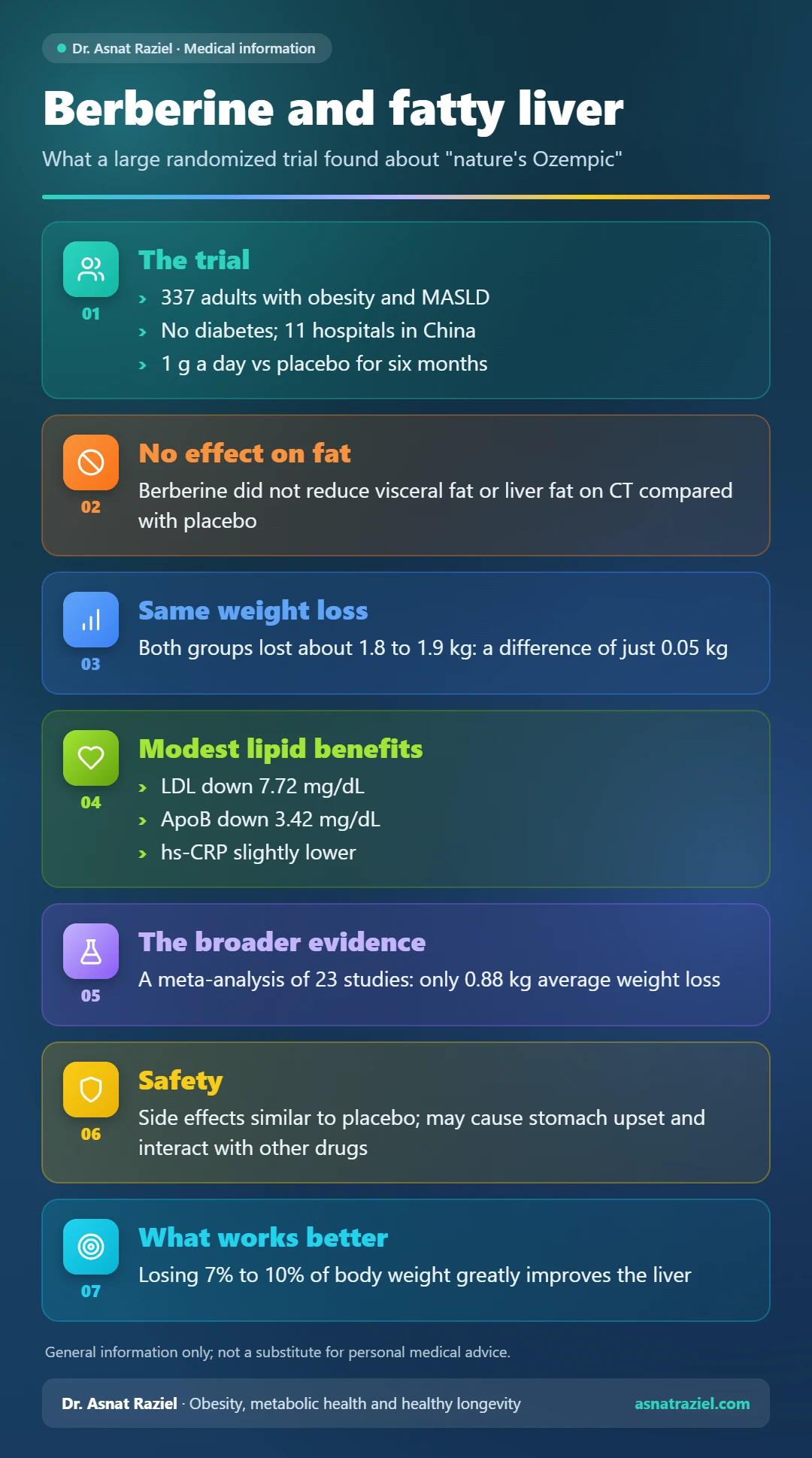
Berberine and fatty liver are a pairing that comes up again and again on social media. The supplement has even been nicknamed “nature’s Ozempic.” However, a large controlled clinical trial from 2026 gives a sober answer. Berberine is safe and slightly improves blood lipids and an inflammation marker. But it did not reduce deep belly fat, and it did not reduce liver fat.
Berberine is a plant-derived active compound with a long history in traditional Chinese medicine. Over the years, people have credited it with positive effects on blood sugar, lipids and inflammation. That is why many people with excess weight turn to it, hoping for a shortcut. The question is how well these promises hold up under modern research.
Why anyone expected berberine to make a difference
In laboratory studies, berberine activates an enzyme called AMPK. This is a kind of “energy sensor” in the cell that promotes fat burning and improves insulin sensitivity. Earlier small studies, mostly from China, also showed a slight drop in blood sugar and blood lipids. From there came the hypothesis that the supplement would also reduce the fat that builds up in the liver and abdomen. Yet results from the lab and from small studies don’t always hold up in a large controlled trial. That is exactly why researchers ran the new study.
The new study: who took part and how it worked
A randomized, double-blind trial published in JAMA Network Open included 337 women and men. All of them had obesity and metabolic dysfunction-associated steatotic liver disease (MASLD), the form of fatty liver linked to metabolic syndrome. None of them had diabetes. Their average age was 41.8 years, and 65.6% were men. The researchers recruited them at 11 hospitals in China.
The researchers randomly assigned participants to two groups. One group took berberine at a dose of 1 gram a day, given as half a gram twice daily. The other group received a placebo, or dummy pill. In addition, all participants received guidance on a healthy lifestyle. Follow-up lasted six months, and the trial registration is open to the public.
To measure fat, the researchers used CT scans, an accurate and objective method. They measured the area of visceral fat, the deep fat that wraps around the abdominal organs. At the same time, they measured the amount of fat in the liver. You can read more about the dangers of visceral fat in a separate article.
The main result: berberine and fatty liver, no shortcuts
The main result is clear. Compared with placebo, berberine did not reduce visceral fat or liver fat. In fact, both groups lost the same amount of weight, about 1.8 to 1.9 kg. The difference between them was just 0.05 kg. In other words, the weight loss came from lifestyle change, not from the supplement.
This finding matters a great deal. Visceral fat and liver fat drive the risk of future diabetes, heart disease and advanced liver disease. So anyone hoping to melt them away with berberine needs to reset their expectations. My comprehensive guide to diagnosing and treating fatty liver explains what does work.
Not all disappointment: a modest metabolic improvement
Although it had no effect on fat, the supplement did produce some positive changes. LDL, the “bad” cholesterol, dropped by 7.72 mg/dL compared with placebo. ApoB also fell, by 3.42 mg/dL. ApoB is the protein that carries harmful fat particles in the blood.
In addition, the inflammation marker hs-CRP decreased slightly. hs-CRP is a sensitive blood test that reflects silent chronic inflammation in the body. The most noticeable changes appeared in participants who had high inflammation levels at the start of the study. On the other hand, berberine did not change fasting blood sugar, blood sugar after meals or HbA1c (average blood sugar over the past three months).
What other studies say about berberine
The broader picture looks similar. A meta-analysis of 23 studies found an average weight loss of only 0.88 kg with berberine. The researchers also noted quality problems in the studies, such as a lack of blinding and missing details on product purity. For comparison, in the STEP 1 trial, patients on semaglutide (Wegovy) lost an average of 14.9% of their body weight. That is a gap of an entirely different magnitude.
Berberine and fatty liver: safety and tolerability
One reassuring point is safety. In the trial, side effect rates were similar in both groups, with no excess risk in the berberine group. Even so, the U.S. National Center for Complementary and Integrative Health lists several warnings. Berberine may cause stomach pain, constipation, diarrhea and nausea. It may also interact with other medications. Women who are pregnant or breastfeeding should not take it.
It is also worth remembering one more fact. The U.S. Food and Drug Administration (FDA) does not approve dietary supplements for safety and effectiveness before they reach the market. As a result, product quality and content vary widely between manufacturers.
Who might it suit, and who not?
The conclusion is balanced. Berberine is not a solution for significant weight loss or for reducing liver fat in people with obesity and fatty liver who do not have diabetes. Nor does it replace targeted medication, lifestyle change or advanced approaches to obesity treatment. For example, studies of Wegovy for fatty liver have shown real improvement in liver tissue.
That said, berberine may have a place as an add-on supplement. It can slightly improve lipid and inflammation profiles, mainly in patients with increased cardiometabolic risk. It is always best to use it as part of a broader treatment plan, in coordination with your doctor. If you are looking for evidence-based treatment, you can read my guide to obesity medications.
What should you actually do? First, check with your doctor whether you have fatty liver and how advanced it is. Second, remember that losing 7% to 10% of your body weight greatly improves the condition of the liver. Also, be sure to tell your doctor about every supplement you take, especially if you take regular medications. That way you can avoid drug interactions and choose a treatment that truly fits you.
The bottom line on berberine and fatty liver
In an era when dietary supplements get exaggerated publicity, this study is a reminder of how important controlled science is. Berberine and fatty liver are not a story of magic, but berberine is not worthless either. It is safe and has a gentle effect on metabolic markers. However, it does not treat the root problem of obesity and fatty liver. Ultimately, the path to real improvement runs through comprehensive, evidence-based care and long-term lifestyle medicine.
This article provides general information and is not a substitute for personal medical advice.
References
The effect of berberine on obesity indices: a systematic review and meta-analysis
Once-Weekly Semaglutide in Adults with Overweight or Obesity