By Dr. Asnat Raziel, bariatric surgeon specializing in obesity treatment, metabolic health and healthy longevity; Director of the Multidisciplinary Center for Obesity Treatment, Assia Medical, Assuta Ramat HaChayal, Tel Aviv
Grip strength: the simple measure longevity medicine is rediscovering
Grip strength is one of the simplest and cheapest predictors of future health. In an age of epigenetic clocks, genetic testing and artificial intelligence, that may come as a surprise. Yet many studies show that a weak grip is not just a sign of weak hands. It may reflect a decline in muscle mass, nervous system function and metabolic health. What’s more, it is linked to illness and to dying younger than expected.
Why the hand, of all things?
The muscles of the hand and forearm work in almost every daily task. Think of opening a jar, carrying shopping bags, getting up from a chair, holding a handrail or lifting a grandchild. That is why grip strength largely reflects the state of the entire muscular system, not just the strength of the hand.
When your grip weakens, it usually signals a broader decline in muscle strength and neuromuscular function. As a result, the body also becomes less able to cope with illness, injury and aging. For this reason, many longevity clinics now add a grip strength measurement to the initial health assessment.
What a major study found about grip strength and mortality
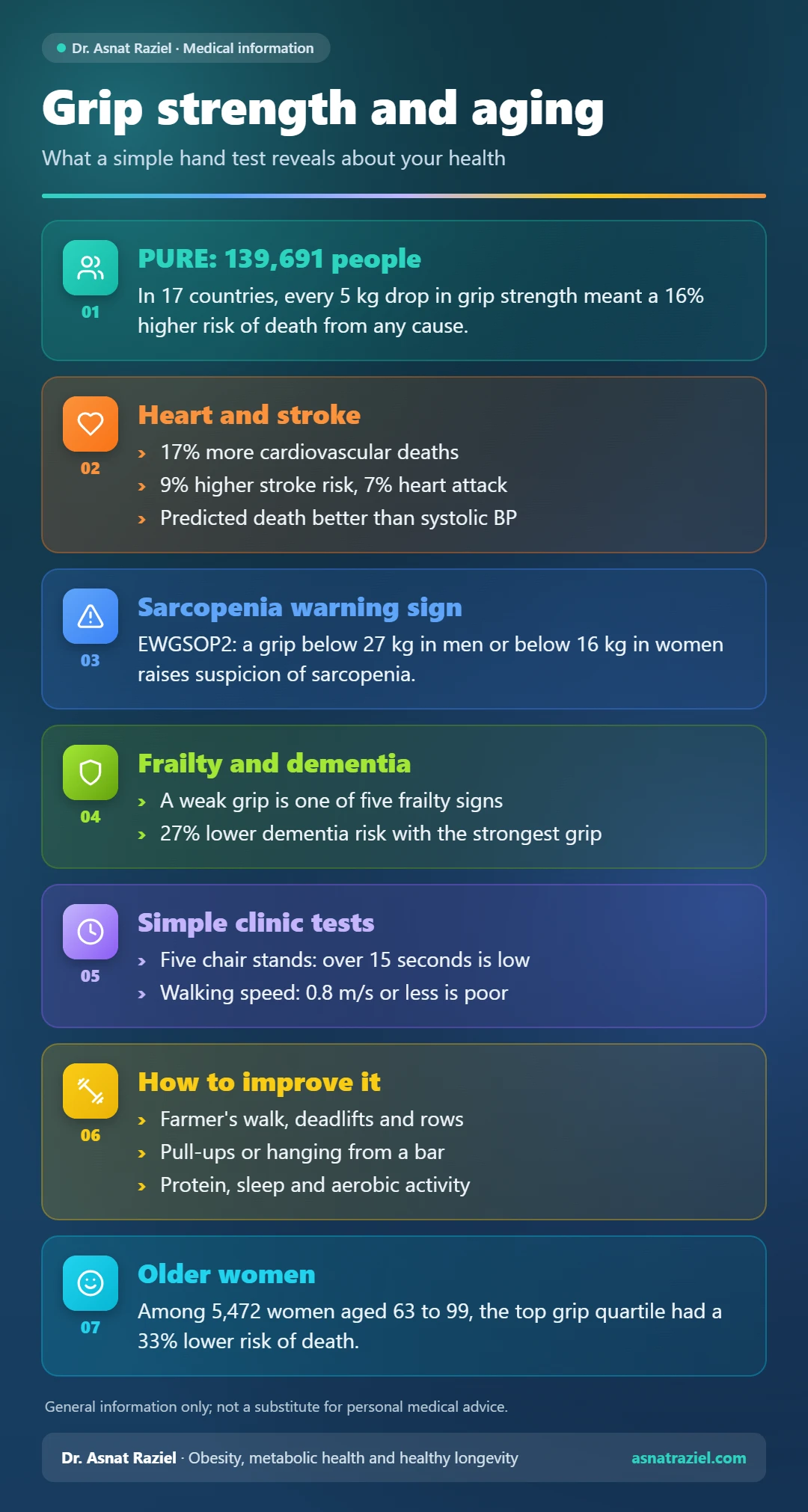
One of the most influential studies in the field is the PURE study, published in The Lancet. Researchers followed 139,691 participants aged 35 to 70 from 17 countries for an average of four years. Every 5 kg drop in grip strength was linked to a 16% higher risk of death from any cause. In addition, it was linked to a 17% rise in deaths from cardiovascular disease.
The risk of stroke also rose by 9%, and the risk of heart attack by 7%. The most striking finding was that grip strength predicted mortality better than systolic blood pressure. However, the researchers found no significant link to new-onset diabetes, falls or fractures in this study. In other words, the measure does not predict everything.
Not just how long you live, but how well
Other studies link a weak grip to poorer function and loss of independence. First, it is a key sign of sarcopenia, the loss of muscle mass and strength with age. The updated European definition, EWGSOP2, puts muscle strength at the center of the diagnosis. According to this definition, a grip below 27 kg in men or below 16 kg in women raises suspicion of sarcopenia. I have written about this in my article on sarcopenia and obesity.
Second, a weak grip is one of the five signs of frailty, a state of high vulnerability in older age. The study that defined frailty found that it predicts falls, declining function, hospital admissions and death. Third, a meta-analysis of 16 cohort studies found a 27% lower risk of dementia among people with the strongest grip. These are observational studies, so they show an association and not necessarily cause and effect.
Can you “train your hand” and live longer?
This is a common mistake on social media. The fact that grip strength predicts longevity doesn’t mean a hand gripper will extend your life. The measure is mainly a marker of overall health.
People with a strong grip tend to be active, with high muscle mass, good aerobic fitness and good metabolic health. Therefore, the right way to improve this measure is to strengthen the whole body. In my article on aerobic vs. strength training, I explain how to combine the two.
How is grip strength measured?
The most accurate method is a handheld dynamometer. You squeeze the device as hard as you can for a few seconds, and the result appears in kilograms. Usually, the test is repeated several times with each hand, and the best result is recorded.
In longevity clinics, the measurement is sometimes part of a broader assessment:
- Estimating biological age.
- Tracking muscle mass.
- Identifying the risk of frailty.
- Checking the response to a strength training program.
- Monitoring during treatment with weight-loss medications, which may also cause muscle loss.
That last point matters especially for my patients. In my article on weight-loss injections and muscle loss, I explain how to protect your muscles during treatment.
Complementary tests you can do in the clinic
Grip strength is only part of the picture. For this reason, the European definition recommends combining it with other simple tests. The first is the chair stand test: you stand up five times in a row without using your hands while someone times you. According to EWGSOP2, taking more than 15 seconds points to low leg strength.
The second test is walking speed over a short distance. A speed of 0.8 meters per second or less indicates poor physical performance. In addition, a body composition test shows how much muscle and fat you have. This helps clarify whether weakness stems from low muscle mass, poor muscle quality or another cause.
How can you improve grip strength?
The good news is that this measure improves when you strengthen your entire muscular system. Effective exercises include the farmer’s walk, which means walking while holding weights in your hands. In addition, deadlifts, pull-ups or hanging from a bar, rows and full-body resistance exercises all help a great deal.
It is also worth combining these with enough protein, good-quality sleep and regular aerobic activity. You can read more about the role of protein in healthy aging in my article on protein and longevity.
Grip strength in older women
In February 2026, a study in JAMA Network Open included 5,472 women aged 63 to 99. The researchers followed them for an average of 8.4 years. Women in the top quartile of grip strength had a 33% lower risk of death than those in the bottom quartile. Chair rise speed also predicted a longer life.
The association held even after accounting for physical activity measured by accelerometer, sitting time, walking speed and the inflammatory marker CRP. In other words, muscle strength appears to be an independent factor and not merely a reflection of physical activity.
The bottom line
Grip strength is not a magic test, and on its own it cannot predict a person’s future. Still, it offers a simple, fast and inexpensive window into the state of your muscles, nerves and overall health. Combine it with VO2max (maximal oxygen uptake), walking speed, the chair stand test, body composition and metabolic tests, and you get a broad, accurate picture of how fast you are aging. Ultimately, that picture helps you stay healthy and independent for longer.
The information in this article is general information only and is not a substitute for personal medical advice.
References
Muscular Strength and Mortality in Women Aged 63 to 99 Years
Sarcopenia: revised European consensus on definition and diagnosis




