By Dr. Asnat Raziel, bariatric surgeon specializing in obesity treatment, metabolic health and healthy longevity; Director of the Multidisciplinary Center for Obesity Treatment, Assia Medical, Assuta Ramat HaChayal, Tel Aviv
Healthspan and longevity: not just how many years, but how we live them
Healthspan and longevity are among the most fascinating fields in medicine today. Until not long ago, medicine focused mainly on extending life. The goal was to prevent disease and extend life expectancy as much as possible. Over the past decade, however, a real revolution has been underway. The question is no longer just how many years we will live, but how we will live them.
Will we reach 80 or 90 independent, active, sharp and strong? Will we keep our muscles, a clear mind and a healthy metabolism? From these questions, a new field was born: healthy longevity medicine.
Lifespan vs. healthspan
When people talk about longevity, many immediately think of an exceptionally long life. In fact, the idea is much broader. The goal is to extend not only the number of years, but also the number of years in which we are healthy and active. That is why scientists who study healthspan and longevity distinguish between two concepts:
- Lifespan: the total number of years a person lives.
- Healthspan: the number of years a person enjoys good health and optimal function.
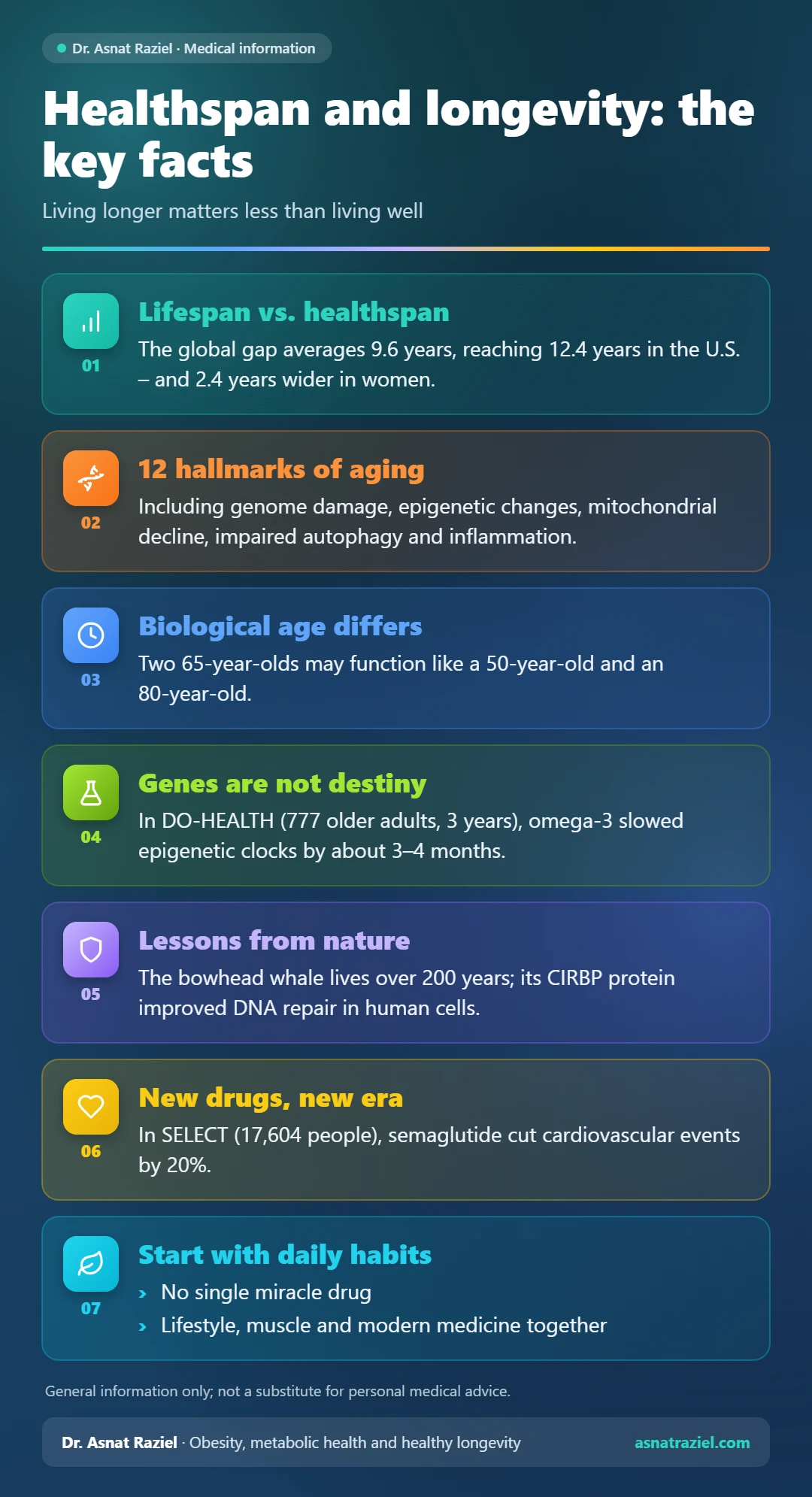
A person may reach the age of 90. But if they suffered from illness, frailty and dependence on others for the last twenty years, their healthspan was short. This gap between healthspan and longevity is real and measurable. A study of 183 countries found that, on a global average, the gap between lifespan and healthspan reached 9.6 years. In the United States, it reached 12.4 years. In addition, the gap was on average 2.4 years wider in women than in men.
What is rejuvenation?
One of the most intriguing concepts in the field is rejuvenation. This does not mean turning a 70-year-old into a 20-year-old. Rather, the goal is to help the body work efficiently, flexibly and healthily again. In other words, not to turn back time, but to strengthen the body’s natural capacity for repair and renewal.
Science shows that the cells and tissues in our body renew themselves throughout life. Skin cells are replaced, new blood cells form and the lining of the gut renews itself constantly. The challenge is that these repair mechanisms weaken with age. A landmark review in the journal Cell listed 12 hallmarks of aging. Among them are genome damage, epigenetic changes, declining mitochondrial function, impaired autophagy and chronic inflammation. Rejuvenation is about switching these repair mechanisms back on.
Your chronological age is not your real age
One of the most fascinating ideas in the field is biological age. Two 65-year-olds share the same age on paper. Biologically, however, one may function like a 50-year-old and the other like an 80-year-old. The difference stems from many factors: diet, physical activity, sleep, stress, smoking and environmental pollution. Muscle mass, metabolic health, relationships and a sense of purpose also play a part.
Healthspan and longevity: genes are not destiny
For years, people believed that our genes decide our fate. Today we know the picture is far more complex. Epigenetics, which can simply be described as genetic flexibility, teaches us that genes are not destiny. They are the instruction manual, but lifestyle determines how those instructions are read and carried out.
Physical activity, a healthy diet, quality sleep and social connections affect gene expression. These include genes linked to inflammation, aging, DNA repair and metabolic health. For example, an analysis of the DO-HEALTH trial included 777 older adults over three years. Omega-3 slowed several “epigenetic clocks,” which measure aging at the DNA level. The combination of omega-3, vitamin D and exercise added benefit on one of the measures. The effect was modest, about 3 to 4 months, but it shows that change is possible. The message is encouraging: we have far more control over our health than we once thought.
What can we learn from nature?
Nature offers remarkable examples of the capacity for renewal and repair. Sequoia trees live for thousands of years. Some animals can regenerate tissues and even whole organs. And the bowhead whale, which lives for more than 200 years, has exceptional DNA repair mechanisms.
A study published in Nature in 2025 found that the whale’s cells repair DNA breaks with high efficiency and accuracy. In addition, their mutation rate is low. The researchers identified a protein called CIRBP that appears at high levels in the whale’s cells. When they transferred the protein into human cells, it improved DNA repair. In other words, the whale does not get rid of damaged cells but repairs them faithfully. Modern research is trying to understand how to harness mechanisms like these for human health.
New drugs are opening a new era for healthspan and longevity
The field of drug therapy is also advancing quickly. The new drugs for obesity and diabetes act on the body’s natural satiety hormones. They reduce weight, but they also improve chronic inflammation, metabolic health and heart function. For example, the SELECT trial included 17,604 people with heart disease and obesity, without diabetes. Semaglutide, the active ingredient in Wegovy, lowered the risk of cardiovascular events by 20%. You’ll find more on this direction in my article on GLP-1 drugs and anti-aging.
At the same time, treatments are being developed to improve mitochondrial function and reduce oxidative damage. Others encourage autophagy, the cell’s self-cleaning mechanism. Preserving muscle mass is also especially important in older age. The key message is that there is no single miracle drug. True rejuvenation is built from a combination of lifestyle, advanced medicine and new technologies.
The greatest innovation is actually the oldest
Perhaps the most surprising thing of all is that the idea of rejuvenation is not new at all. Thousands of years ago, the Book of Psalms (103:5) already contained the verse: “Who satisfieth thy mouth with good things; so that thy youth is renewed like the eagle’s.” The verse describes the renewal of strength, vitality and youth.
The author of Psalms, of course, knew nothing about genes, mitochondria or epigenetics. Yet, remarkably, he expressed an idea that science is only beginning to understand today. Our bodies contain mechanisms of renewal, repair and recovery. The challenge is to learn how to activate them and preserve them over the years. If you want to start with what’s on your plate, read my article on the longevity diet.
The bottom line on healthspan and longevity
Longevity medicine is not looking for eternal life. Instead, it is about extending the good years. Its goal is to increase healthspan, preserve independence and function, nurture genetic flexibility and encourage natural rejuvenation. That is why healthspan and longevity begin with today’s habits.
Perhaps the great revolution of the coming years will not be the ability to live many years. It will be the ability to live well, for a long time. And perhaps, as the ancient verse hints, this ability has always been within us, simply waiting for us to rediscover it.
This article provides general information and is not a substitute for personal medical advice.
References
Global Healthspan-Lifespan Gaps Among 183 World Health Organization Member States
Hallmarks of aging: An expanding universe
Evidence for improved DNA repair in the long-lived bowhead whale
Semaglutide and Cardiovascular Outcomes in Obesity without Diabetes




