By Dr. Asnat Raziel, bariatric surgeon specializing in obesity treatment, metabolic health and healthy longevity; Director of the Multidisciplinary Center for Obesity Treatment, Assia Medical, Assuta Ramat HaChayal, Tel Aviv
Lifestyle medicine for obesity in the era of new medications
Lifestyle medicine for obesity faces a new question today: if the medications are so effective, do we still need it? The answer from the current literature is clear. The medications do not replace lifestyle; they make it more important than ever. Even with the most advanced treatment, long-term success depends on deep behavioral change.
The past few years have brought a genuine revolution. GLP-1 medications such as semaglutide and tirzepatide achieve significant weight loss. However, the studies keep repeating the same message. Nutrition, physical activity, sleep and behavioral support remain the cornerstone of treatment.
Obesity as a chronic disease: why weight loss is not enough
Obesity is not simply the result of excess calories. It is a chronic, systemic disease with biological, hormonal, environmental and behavioral components. It disrupts how fat tissue works and shifts the body’s metabolic “set point.”
In practice, the body “defends” the higher weight. After weight loss, hunger rises and the body burns less energy. That is why most patients regain weight after a diet. This is where lifestyle medicine comes in. It does not focus only on the number on the scale, but on changing the whole system: hunger, fullness, sleep, stress and behavior.
The six pillars of lifestyle medicine for obesity
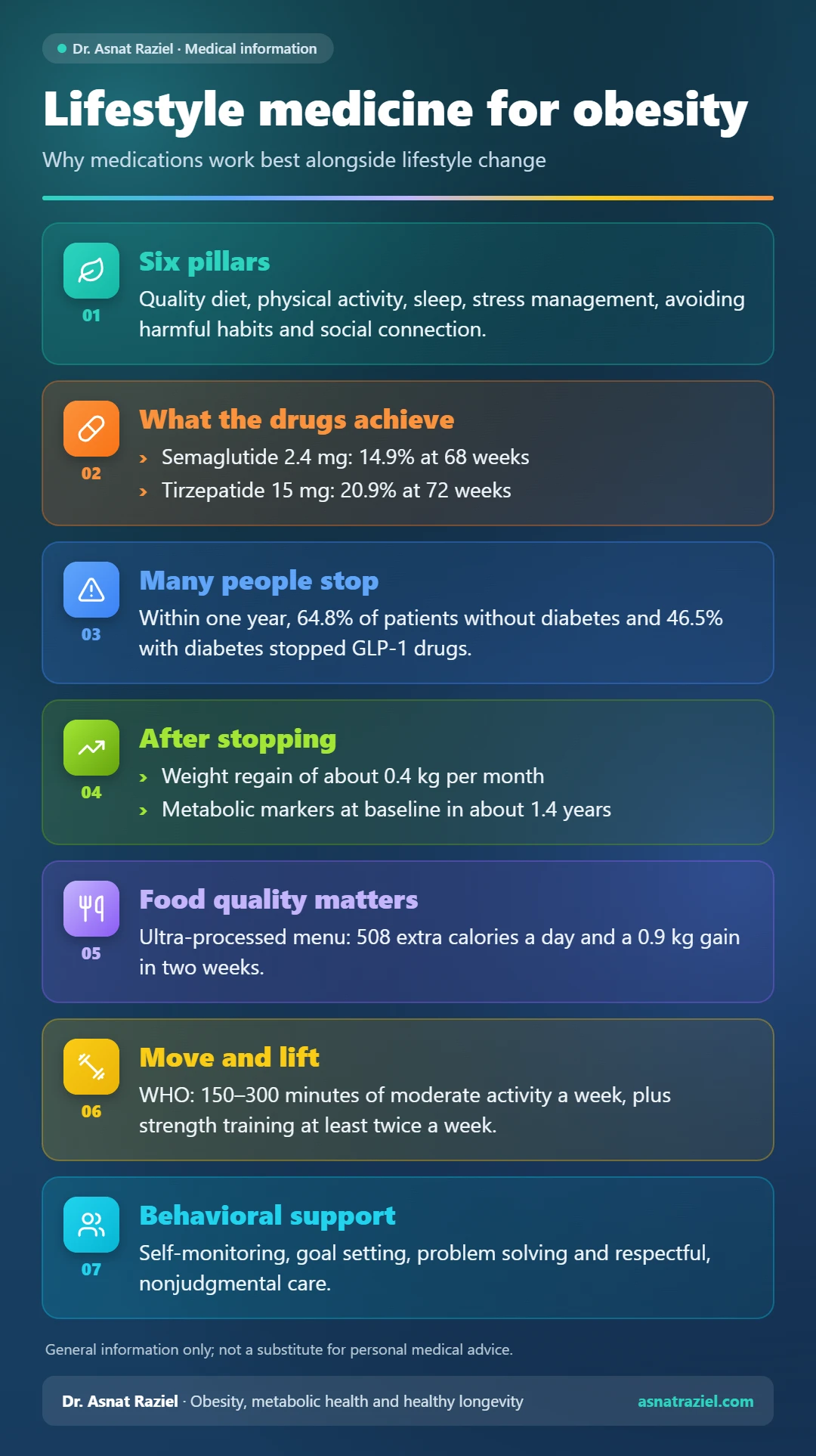
Lifestyle medicine for obesity rests on six principles: a high-quality diet, physical activity, enough sleep, stress management, avoiding harmful habits and strengthening social connections. The power of this approach lies in combining them. In other words, this is not a single piece of advice, but an intensive, multidisciplinary treatment program.
Clinical experience shows that structured programs with regular sessions achieve especially good results. In fact, simply taking part in a structured process is a key factor in success. At times, it matters even more than the makeup of the diet itself.
GLP-1 medications: a breakthrough, but not the only answer
There is no doubt that these medications have transformed the field. In the STEP 1 trial, semaglutide 2.4 mg injections led to an average weight loss of 14.9% after 68 weeks. In the SURMOUNT-1 trial, tirzepatide at the 15 mg dose reached 20.9% weight loss after 72 weeks. Still, three points are important to understand.
First, regulators approved these medications as an add-on to diet and physical activity, not as a replacement for them. The World Health Organization’s first guideline on the topic, from December 2025, supports long-term use of the medications. At the same time, it recommends offering patients an intensive behavioral program of diet and physical activity.
Second, many people stop treatment. A large US study followed 125,474 adults who started a GLP-1 medication. Within one year, 64.8% of patients without diabetes and 46.5% of patients with diabetes had stopped. You can read more about this in my article on staying on treatment.
Third, stopping without changing habits brings back both the hunger and the weight. A meta-analysis published in the BMJ in January 2026 included 37 studies and 9,341 participants. After people stopped the medications, weight rose by an average of 0.4 kg per month. Metabolic markers are expected to return to baseline within about 1.4 years. What’s more, the regain was faster than after stopping a behavioral program. I describe how to handle this stage in an article on stopping GLP-1 and weight regain.
Nutrition: not just how much you eat, but what and how
The basis of weight loss is an energy deficit. Even so, in lifestyle medicine for obesity, diet quality matters just as much. A diet of whole foods, vegetables, fruit, legumes and whole grains is linked to weight loss and good metabolic health. Ultra-processed food, by contrast, disrupts the body’s satiety mechanisms.
In a controlled trial at the US National Institutes of Health, 20 participants ate each diet for two weeks at a time. The researchers matched the menus for calories offered, sugar, fat and fiber. On the ultra-processed menu, participants ate 508 calories a day more than on the unprocessed menu, and they gained 0.9 kg. You can read about how these foods affect the brain in my article on ultra-processed food and the brain.
In addition, protein preserves muscle mass and increases fullness, especially during weight loss. According to the protein leverage hypothesis, people keep eating until they reach an adequate amount of protein. So a low-protein diet may lead to eating extra calories. I cover this in more detail in my guide to protein intake for weight loss.
For patients taking GLP-1 medications, preventing nutritional deficiencies deserves extra attention. These drugs slow stomach emptying and reduce how much people eat. Small, frequent meals, easy-to-digest foods and enough fluids help reduce nausea and bloating.
Physical activity beyond weight loss
Physical activity is not just a tool for burning calories. Aerobic exercise improves insulin sensitivity, reduces visceral fat (the fat around the abdominal organs) and improves heart function. It is worth knowing that these benefits appear even without major weight loss.
Strength training is especially important during treatment with weight loss medications. Part of the weight lost is lean body mass, and resistance training is the most effective tool to preserve it. I wrote about this in my guide to preserving muscle mass during weight loss. The World Health Organization guidelines recommend 150 to 300 minutes a week of moderate-intensity activity for adults. They also recommend strength training at least twice a week.
Behavior change: the heart of lifestyle medicine for obesity
A modern approach does not stop at giving instructions. It builds a process of habit awareness, identifying triggers for emotional eating, realistic goals and ongoing support. The main tools are self-monitoring, goal setting and problem solving. In addition, motivational interviewing and cognitive behavioral therapy strengthen motivation and persistence.
Weight stigma also has a cost. It undermines adherence to treatment and leads people to avoid seeing a doctor. That is why respectful language and an empathetic, nonjudgmental approach are an integral part of care. They strengthen the bond between clinician and patient, as well as persistence with the process.
Keeping the weight off: the real challenge
Losing weight is only the first stage. The main challenge is maintaining the result for years. Several mechanisms work together to make this possible: regular physical activity, adequate protein intake, behavioral support and medical follow-up.
In my experience, the people who keep the weight off are usually those who keep moving a lot. Sometimes they reach 200 to 300 minutes of activity a week or more. At the same time, programs with continuous follow-up and behavioral support greatly improve the chances of maintaining weight.
The bottom line on lifestyle medicine for obesity
In this new era, there is no longer a choice between medications and lifestyle. The leading approach is integrative: advanced medications, the right nutrition, physical activity, behavior change and multidisciplinary support. Lifestyle medicine for obesity helps the medications work well, reduces side effects and maintains results over time. Ultimately, the future of treatment is not just weight loss, but a healthy, balanced and stable system for years to come.
The information in this article is general and does not replace personal medical advice.
References
Once-Weekly Semaglutide in Adults with Overweight or Obesity
Tirzepatide Once Weekly for the Treatment of Obesity
WHO issues global guideline on the use of GLP-1 medicines in treating obesity
World Health Organization 2020 guidelines on physical activity and sedentary behaviour