By Dr. Asnat Raziel, bariatric surgeon specializing in obesity treatment, metabolic health and healthy longevity; Director of the Multidisciplinary Center for Obesity Treatment, Assia Medical, Assuta Ramat HaChayal, Tel Aviv
Benefits of obesity drugs: what came up at the ECO congress
The benefits of obesity drugs in the new generation reach far beyond the number on the scale. That was the message of one of the most practical sessions at the European Congress on Obesity, ECO. The panel asked what patients really want to achieve. In addition, it examined how treatment changes quality of life, physical function, heart health and the sense of control over food.
The session featured Dr. Sean Wharton, Prof. John Wilding and Dr. Katrina Timper. They answered three questions: what the new studies teach us, which benefits of obesity drugs we already see in practice, and how to apply all this in the clinic. In this article, I’ve summarized the main points, with updates as of October 2026.
Does high-dose semaglutide come close to the results of surgery?
One of the central topics was the STEP UP trial. It tested semaglutide at a dose of 7.2 mg, compared with the standard 2.4 mg. The background came from the SURMOUNT-5 study. There, patients on tirzepatide lost 20.2% of their body weight, compared with 13.7% on semaglutide. That is a gap of 6.5 percentage points. So the researchers asked whether the 2.4 mg dose taps the drug’s full potential.
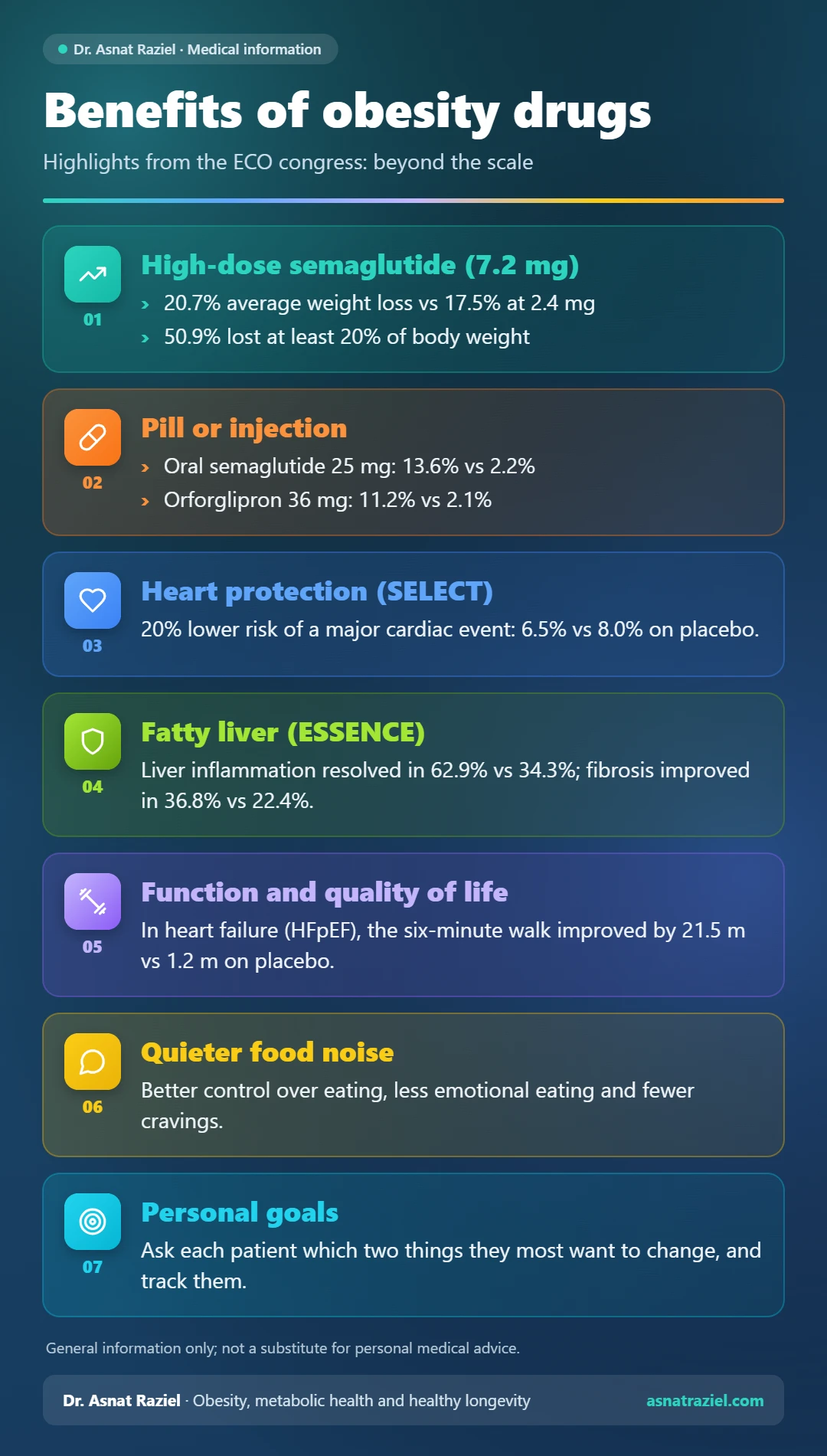
The STEP UP trial included 1,407 patients, randomized 5:1:1 to 7.2 mg, 2.4 mg or placebo. Among those who stayed on treatment, the average weight loss was 20.7% at the high dose, compared with 17.5% at 2.4 mg. In the analysis of all participants, the figures were 18.7% and 15.6%. The gap looks small, but when it comes to substantial weight loss, the picture is very different.
Half of the patients on the high dose, 50.9%, lost at least 20% of their body weight. In addition, 33.2% lost more than 25%, a range that approaches the results of bariatric surgery. For a patient, the difference between 17% and 25% can be the difference between knee pain and getting back to walking and hiking. Since the congress, the FDA approved Wegovy at the 7.2 mg dose, in March 2026.
Side effects at the high dose
Despite the higher dose, the safety profile remained reasonable. At 7.2 mg, 3.3% stopped treatment because of digestive side effects, compared with 2.0% at 2.4 mg. However, digestive side effects occurred in 70.8% of patients on the high dose, compared with 61.2% on the standard dose. In addition, 22.9% reported changes in skin sensation, an effect that almost never appeared on placebo.
The researchers explained that most side effects of GLP-1 drugs appear during the dose-escalation phase. Therefore, a further increase does not necessarily cause a sharp jump in side effects.
Pill or injection?
Another part of the session dealt with pill-based treatments. In the OASIS 4 study, participants lost 13.6% of their body weight on oral semaglutide at 25 mg, compared with 2.2% on placebo. The Wegovy pill was approved in the United States in December 2025 and in Europe in July 2026.
At the same time, the panel presented orforglipron, a new non-peptide pill. In the ATTAIN-1 study, weight loss at the 36 mg dose reached 11.2%, compared with 2.1% on placebo. Since then, the FDA approved the drug in April 2026 under the name Foundayo, and it has been available in Israel since September 2026. I compare the two pills in my article on the Wegovy pill and Foundayo.
The panel also discussed who will prefer a pill and who an injection. The answer is clear: there is no one-size-fits-all solution. Some patients like the routine of a morning pill. Others prefer a weekly injection, especially when traveling or on a busy schedule.
How to take oral semaglutide
The researchers reviewed the key instructions. Take the pill in the morning, on an empty stomach, with a little water. Then wait before eating and before taking other medications. Patients who take levothyroxine need monitoring of their thyroid function, because the prescribing information notes a possible change in absorption.
Benefits of obesity drugs for quality of life
One of the most important messages came from Prof. John Wilding. He suggested replacing the term “weight loss” with “health gain.” In other words, the question is not how many kilograms you lost, but how much your life has changed.
In the STEP 1 study, patients reported improvements in physical function and quality of life. For example, it became much easier for them to bend down, walk and climb stairs. In addition, the STEP-HFpEF study enrolled patients with obesity and HFpEF, heart failure with preserved ejection fraction. There, the six-minute walk distance improved by 21.5 meters with semaglutide, compared with 1.2 meters on placebo.
The brain’s “food noise” quiets down
One of the most fascinating benefits of obesity drugs discussed was food noise, the recurring, nonstop thoughts about food. The studies presented showed better control over eating and less emotional eating. In addition, patients reported fewer cravings for sweet and salty foods. At the same time, they described greater life satisfaction and a stronger sense of self-efficacy.
Benefits of obesity drugs for the heart and liver
The SELECT study enrolled 17,604 people with obesity and heart disease, without diabetes. Semaglutide reduced the risk of a major cardiac event by 20%. Such an event occurred in 6.5% of patients on the drug, compared with 8.0% on placebo. The researchers stressed that the effect appeared early, even before major weight loss. So it seems that other mechanisms are at work beyond weight loss. I cover this in more depth in my article on the SELECT trial.
The ESSENCE study also drew interest. It tested semaglutide in MASH, an inflammatory form of fatty liver disease. Liver inflammation resolved in 62.9% of patients, compared with 34.3% on placebo. In addition, fibrosis, meaning scarring of the liver, improved in 36.8%, compared with 22.4%. Following the study, Wegovy was approved for treating MASH, as I describe in my article on Wegovy for fatty liver.
Martina’s story: when the goal isn’t a number
One of the most moving moments was the story of “Martina,” 59, with a BMI of 44. She suffered from severe high blood pressure, knee pain and emotional eating. When asked what her most important goal was, she didn’t say “to lose weight.” She said, “I want to get back to riding my horses.”
The team built a multidisciplinary plan for her: nutrition counseling, tailored physical activity, psychotherapy, drug treatment and emotional support. After switching from liraglutide to semaglutide, she reached a BMI of 25. In addition, her blood pressure stabilized and she stopped her blood pressure medications. Most important of all, she went back to riding. Later, she even founded a support group for women with obesity.
What clinicians can take from the benefits of obesity drugs
The panel’s message was clear: obesity is a chronic, multisystem disease, and treating it is not just about “eating less.” The doctors called for a shift from a focus on weight to a focus on personal goals. For example, walking without pain, playing with the grandchildren, sleeping well or no longer thinking about food all day. Therefore, they recommended asking each patient which two things they most want to change, and tracking them.
In addition, they emphasized adequate protein and strength training to preserve muscle, along with a non-blaming approach. Still, many questions remain open. For example, can patients later move to a lower dose, or from an injection to a pill? Ultimately, the benefits of obesity drugs are measured in health, function and quality of life, not just in kilograms.
The information in this article is general and does not replace personal medical advice.
References
Tirzepatide as Compared with Semaglutide for the Treatment of Obesity
Oral Semaglutide at a Dose of 25 mg in Adults with Overweight or Obesity
Orforglipron, an Oral Small-Molecule GLP-1 Receptor Agonist for Obesity Treatment
RYBELSUS (semaglutide) tablets – Prescribing Information
Semaglutide in Patients with Heart Failure with Preserved Ejection Fraction and Obesity
Semaglutide and Cardiovascular Outcomes in Obesity without Diabetes
Phase 3 Trial of Semaglutide in Metabolic Dysfunction-Associated Steatohepatitis
Most of the studies were funded by the drug manufacturers.