By Dr. Asnat Raziel, bariatric surgeon specializing in obesity treatment, metabolic health and healthy longevity; Director of the Multidisciplinary Center for Obesity Treatment, Assia Medical, Assuta Ramat HaChayal, Tel Aviv
Switching to the Wegovy pill: does the weight loss continue?
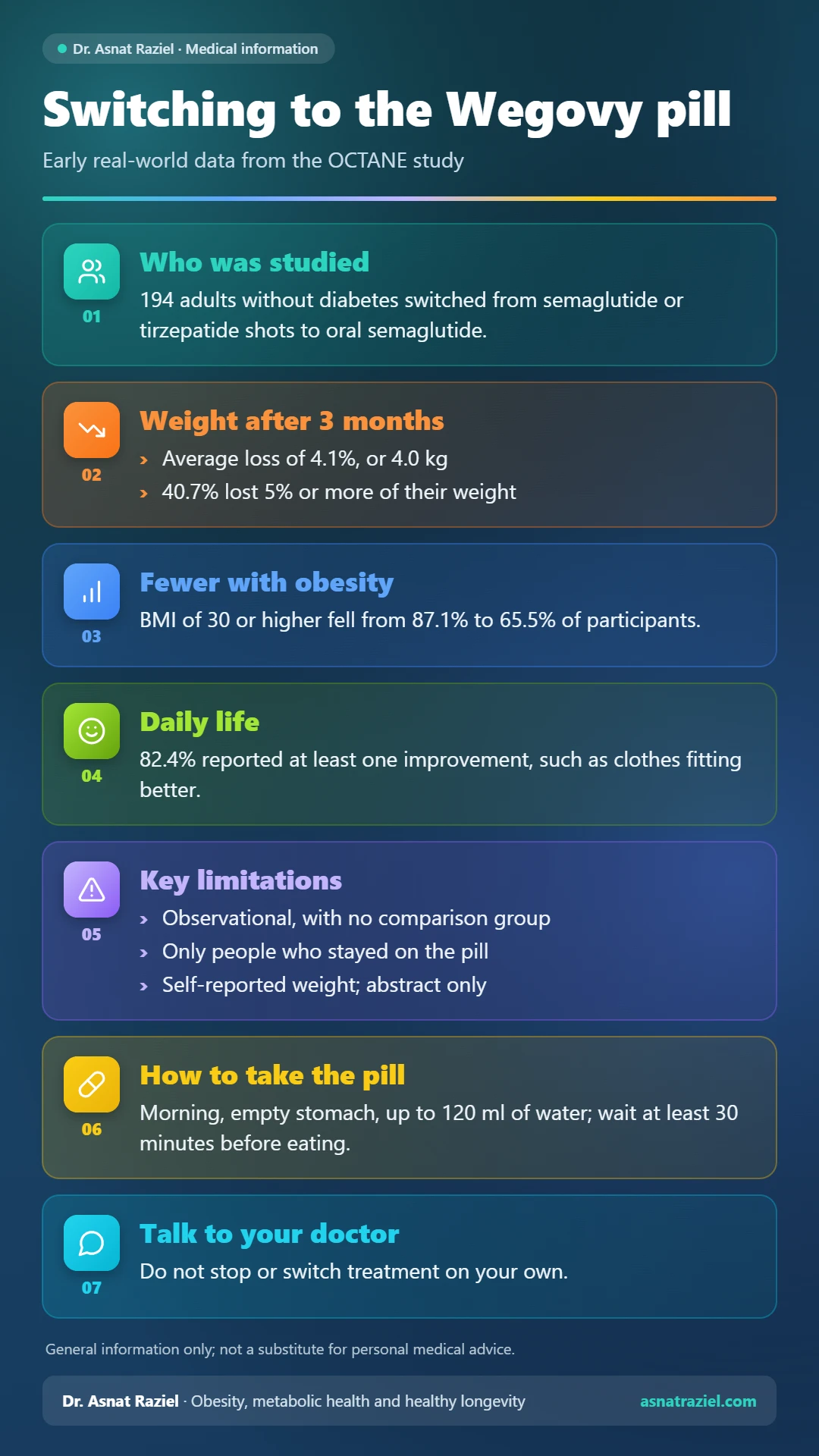
Switching to the Wegovy pill from a weekly injection is a question that comes up in almost every obesity clinic today. Many patients are happy with their weekly shot, but they would gladly give up the needle. Now we have the first real-world data: the OCTANE study, presented in Milan at the annual meeting of the European Association for the Study of Diabetes (EASD 2026), followed patients who swapped an injection for the oral form of Wegovy. Within three months, they lost an average of 4.1% of their body weight. However, this is a short observational study, so we should read the results with caution.
Why do patients want to give up the needle?
Weekly injections have transformed obesity treatment. The best known are semaglutide, the active ingredient in Wegovy, and tirzepatide, the active ingredient in Mounjaro. Both are drugs based on GLP-1, a satiety hormone the gut releases after a meal.
Even so, not everyone likes to inject. Some patients struggle with a fear of needles. Others prefer a pill because of their lifestyle, or simply out of personal preference. These are also the reasons Novo Nordisk, the drug’s manufacturer, listed in its announcement.
The pill itself, oral semaglutide 25 mg once daily, already showed good results in the OASIS 4 trial. There, patients lost an average of 13.6% of their body weight after 64 weeks, compared with 2.2% on placebo. But what happens to people who are already on an injection and want to switch? Until now, there were almost no data on that.
The OCTANE study: how switching to the Wegovy pill was tested
OCTANE is a real-world evidence study, meaning it uses data from routine care rather than from a controlled trial. The researchers looked back at de-identified data from Ro, a US telehealth platform. It is the first analysis from a collaboration between Ro and Novo Nordisk.
The sample included 194 adults with obesity, or with overweight and at least one obesity-related condition: high blood pressure, abnormal blood lipids, sleep apnea or cardiovascular disease. None of them had diabetes, and none had undergone bariatric surgery. All of them switched from injectable semaglutide or tirzepatide to oral semaglutide between January 5 and February 7, 2026.
The average starting weight was 100.5 kg, and the average body mass index (BMI) was 34.5. On average, 36.8 days passed between the last injection prescription and the start of the pill. Participants started the pill an average of 5.2 months after joining the platform. In addition, the researchers included only people who stayed on the pill for three months, with no break longer than 30 days. Participants reported their own weight at the start and end of follow-up. On the other hand, the researchers did not require a minimum length of prior injection treatment, nor any prior weight loss.
The results: 4.1% less in three months
Three months after switching to the pill, participants had lost an average of 4.1% of their body weight, or 4.0 kg (p<0.001). Moreover, 40.7% of them, two in every five, lost 5% or more of their weight.
The rate of obesity in the sample also fell. At the start of follow-up, 87.1% of participants had a BMI of 30 or higher, the threshold that defines obesity. After three months, this share had dropped to 65.5%. That is a decline of 21.6 percentage points (p<0.001).
Patients also described changes in daily life. Among those who provided this information, 82.4% reported at least one improvement. For example, about 69% said their clothes fit better than before, and about 51% reported eating more healthily than before.
Dr. Louis Aronne, director of the Comprehensive Weight Control Center at Weill Cornell Medicine and one of the study’s authors, summed it up this way. In his view, switching to oral semaglutide may be a viable path for the right patient, with real weight loss and lifestyle improvements within the first three months. He added that the next step is to see long-term results.
What can’t the study tell us yet?
Caution is needed here, especially on the part of health professionals. First, this is an observational study. Real-world evidence studies identify associations, but they do not prove cause and effect. That is why the randomized controlled trial remains the gold standard.
Second, the study had no comparison group of patients who stayed on the injection. Therefore, we cannot tell whether switching is better than, equal to or worse than continuing the injections.
Third, the study included only people who stayed on the pill for three months. Those who stopped partway, for example because of side effects, were left out of the analysis. This is selection bias, and it may make the picture look better than it is.
In addition, the weight data came from self-reports. Data collected during routine telehealth care are also uneven in timing and completeness. The researchers themselves note that the results cannot be generalized to the whole population.
Finally, the announcement leaves out several details that matter to clinicians. For instance, it does not say what injection dose participants were on, how much weight they lost before switching or what pill dose they actually took. The average gap of 36.8 days raises the possibility that some reached the pill after a break in treatment. In that case, part of the weight loss may reflect a return to treatment rather than an advantage of the pill. Also, the data were presented as a conference abstract, not as a full peer-reviewed paper.
Switching to the Wegovy pill in practice: how is it done?
Taking the pill requires care. According to the US prescribing information, you take it in the morning on an empty stomach with only a little water: up to 4 ounces, about 120 ml. Then you wait at least 30 minutes before eating, drinking or taking other medicines.
The prescribing information also explains how to switch. Patients on Wegovy 2.4 mg by injection can move to the 25 mg pill once daily, one week after stopping the injection. By contrast, people starting the pill as a new treatment increase the dose gradually: 1.5 mg, 4 mg, 9 mg and finally 25 mg. Each of the first three steps lasts 30 days.
Keep in mind that the label covers only switching from injectable Wegovy to the Wegovy pill. It gives no guidance for people coming from tirzepatide. In that case, the treating doctor decides how to switch and at what dose.
Safety and side effects
The OCTANE announcement includes no new safety data from the study itself. Thus, the known safety profile of semaglutide still applies, for the pill as for the injection. The common side effects are nausea, diarrhea, vomiting, constipation and abdominal pain. Alongside them come headache, fatigue, dizziness, changes in skin sensation and hair loss. The announcement also mentions indigestion, bloating, belching, gas, heartburn and gastroenteritis, as well as low blood sugar in people with type 2 diabetes.
In addition, the US label carries a Boxed Warning, the most serious level of drug warning, about possible thyroid tumors, including cancer. For this reason, the drug must not be used by people with a personal or family history of medullary thyroid carcinoma (MTC) or multiple endocrine neoplasia syndrome type 2 (MEN 2).
Where is the pill available today?
According to the company, the Wegovy pill is already on the market in the United States, the United Arab Emirates, the United Kingdom and Germany. Launches in more countries are expected in the coming quarters. Israel is not on this list at this stage. Meanwhile, it is worth understanding how the pill compares with the injection in terms of effectiveness.
Who might switching to the Wegovy pill suit?
The data suggest that switching is possible and that weight loss can continue without a needle. So it may suit people who respond well to treatment but find the injection hard. On the other hand, a daily pill requires a fixed morning routine, and not everyone will stick with it.
It is important to remember that obesity is a chronic disease and that its treatment is long term. Therefore, choosing between a pill and an injection is part of personalized treatment. It depends on the patient’s preferences, lifestyle, side effects, other medical conditions and the availability of the drug.
The bottom line
The OCTANE study offers a first, encouraging glimpse. People who swapped an injection for the pill and stuck with it kept losing weight, 4.1% on average over three months. Still, these are early, short-term data without a comparison group. That is why switching is not a decision to make on your own. Anyone considering it should consult their treating doctor and should not stop or change treatment by themselves.
The information in this article is general only and is not a substitute for personal medical advice.
References
3-month real-world weight outcomes among patients with overweight or obesity after switching from injectable semaglutide or tirzepatide to oral semaglutide for weight management: the OCTANE study
Oral Semaglutide at a Dose of 25 mg in Adults with Overweight or Obesity
Wegovy (semaglutide) Prescribing Information
Randomized Trials vs Real-world Evidence: How Can Both Inform Decision-making?
Disclosure: the OCTANE study is a collaboration between Novo Nordisk, the maker of Wegovy, and the Ro platform. The data in this article are based on the company’s announcement and on a conference abstract.