By Dr. Asnat Raziel, bariatric surgeon specializing in obesity treatment, metabolic health and healthy longevity; Director of the Multidisciplinary Center for Obesity Treatment, Assia Medical, Assuta Ramat HaChayal, Tel Aviv
Gut barrier and aging: when digestive enzymes escape
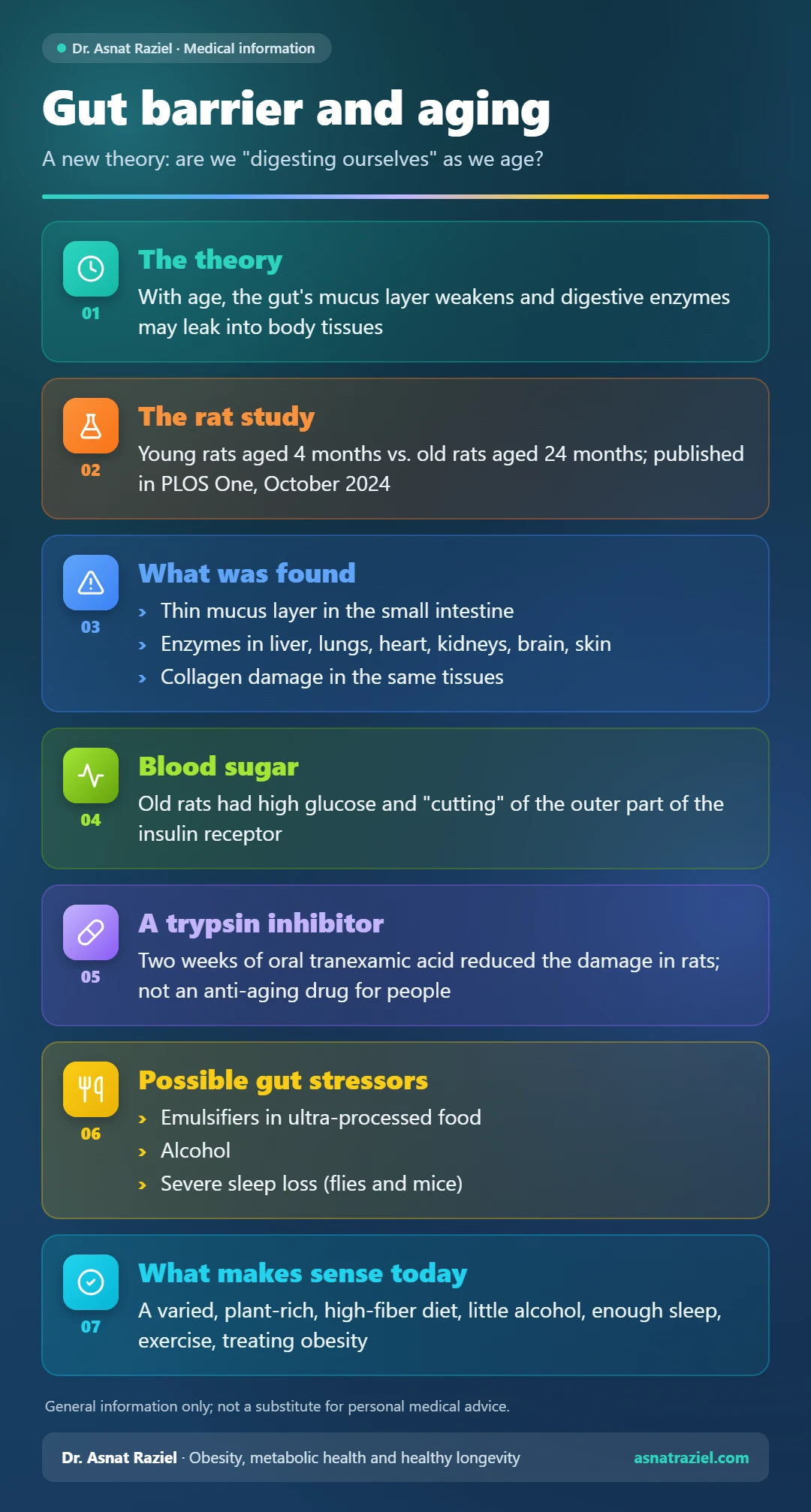
The link between the gut barrier and aging lies at the heart of an intriguing new theory. According to this theory, the gut’s protective layer weakens with age, and digestive enzymes “leak” into the body’s tissues. There, they may contribute to damage, inflammation and declining function. It is important to say right away that the key study involved rats, so the road to proof in humans is still long.
We usually explain aging through DNA damage, oxidative stress, changes in the mitochondria, the buildup of “old” senescent cells and changes in the immune system. However, this theory adds an unexpected player: the digestive system itself.
Enzymes that are meant to digest food
The pancreas makes powerful enzymes that break down proteins, fats and carbohydrates. These include trypsin, elastase, lipase and amylase. Some of them start out in an inactive form and become active only inside the gut.
The problem is that these enzymes cannot “tell the difference” between protein from food and the proteins of our own tissues. That is why the body developed protective systems. One of the most important is the mucus layer, which covers the gut’s lining cells and separates them from the contents of the digestive tract.
What did the rat study find?
The key study, “Aging by autodigestion,” appeared in October 2024 in the journal PLOS One. Researchers from the University of California San Diego compared young rats, aged 4 months, with old rats, aged 24 months.
In the old rats, the mucus layer in the small intestine was thin. In addition, the researchers detected trypsin passing through the tips of the intestinal villi, in areas where the mucus had thinned. They also found trypsin, elastase, lipase and amylase accumulating in the liver, lungs, heart, kidneys, brain and skin. In those same tissues, they found damage to collagen, the protein that holds tissue structure together.
Another interesting finding involved blood sugar. The old rats had high glucose levels, and the researchers detected “cutting” of the outer part of the insulin receptor. In other words, the enzymes may also impair the cells’ ability to respond to insulin. According to the university’s announcement, the researchers see this as a possible mechanism of aging, not a final conclusion.
Gut barrier and aging: is it linked to chronic inflammation?
The proposed chain is simple: the gut barrier weakens, enzymes enter the tissues, damage occurs, the immune system responds, and chronic inflammation develops. This mechanism fits the concept of “inflammaging,” meaning chronic low-grade inflammation that increases with age. It is one of the central features of aging. I have written about the links between inflammation, the microbiome and obesity in my article on obesity and inflammation.
In addition, the theory offers an interesting explanation for a familiar phenomenon. In older age, many systems weaken together: blood vessels, skin, lungs, kidneys and liver. Instead of seeing each organ as a separate problem, the researchers raise the possibility of a shared mechanism.
Gut barrier and aging: the researchers managed to limit the damage
Next, the researchers gave the old rats an oral trypsin inhibitor for two weeks. The treatment reduced the buildup of trypsin in the organs and the damage to collagen. What’s more, it lowered blood sugar levels and reduced the cutting of the insulin receptor.
But we need caution here. The substance is tranexamic acid, a prescription drug that affects blood clotting and that doctors use to reduce bleeding. There is no justification for using it as an anti-aging treatment. So we should not conclude from this study that people ought to take it.
What about ultra-processed food?
This raises a broader question: what weakens the mucus layer? One area under study is emulsifiers, additives that improve the texture and shelf life of processed food. In a mouse study, carboxymethylcellulose (CMC) and polysorbate 80 caused low-grade inflammation and changes in the microbiome. Later, a small human trial showed that CMC changed the makeup of gut bacteria and reduced their diversity. In two participants, the bacteria even penetrated the inner mucus layer.
The long-term effect in humans is still unclear. Even so, this is one more reason to cut back on ultra-processed food, on top of the familiar metabolic reasons.
Alcohol, sleep and fasting
Alcohol is a known factor that increases gut permeability and damages the protective layer. From the perspective of longevity medicine, this is another reason to treat alcohol as anything but neutral, especially with frequent drinking.
Sleep also enters the picture. A study in flies and mice showed that severe sleep deprivation causes free radicals, and oxidative stress, to build up specifically in the gut. The researchers ask whether such stress also speeds up the weakening of the barrier. For now, this is only a theoretical connection.
As for intermittent fasting, the question remains open. Enzyme release follows meals, so some have suggested that fewer eating hours might reduce exposure. However, there is currently no proof in humans that fasting extends life this way. The paper’s authors present this as a question for future research.
Gut barrier and aging: what can you do today?
There is a link between a healthy gut barrier and both diet and the microbiome. Researchers are also looking at nutrients such as glutamine, vitamin A and zinc. However, most of the data come from animal studies or from specific clinical conditions. Therefore, there is no justification for starting a “supplement cocktail” based on this theory.
A sensible approach is far more basic:
- A varied diet, rich in plant foods and dietary fiber.
- Less ultra-processed food.
- As little alcohol as possible.
- Enough sleep and regular physical activity.
- Treating obesity and metabolic disease.
These are not targeted treatments for “enzyme leakage.” Still, they fit well with what we already know about the microbiome and biological age. I also wrote about a weight loss drug that may protect the intestinal lining.
Have we found “the cause of aging”? Not yet
Aging is a process that involves many systems. Genetics, DNA repair, epigenetics, mitochondria, the immune system, hormones and lifestyle all shape it. That is why there is no basis for claiming that enzyme leakage is “the cause” of aging. Even so, this may reveal an important piece of the puzzle. Another piece involves damaged proteins, which I discussed in my article on a protein repair enzyme. If you want to dig deeper, you can watch a lecture on autodigestion.
Bottom line on the gut barrier and aging
The “autodigestion” theory, self-digestion by the digestive system’s own enzymes, offers a new explanation for some of the damage and inflammation of older age. The evidence is fascinating, but most of it comes from animals. As a result, no drug or supplement today can prevent this process in humans.
Until we know more, the practical message is not revolutionary, but it is important. Our understanding of the gut barrier and aging reinforces what we already know: real food, little alcohol, good sleep, movement and treating metabolic disease protect the body over the years. Longevity medicine requires us to distinguish carefully between an intriguing discovery and a treatment that has already been proven.
The information in this article is general and does not replace personal medical advice.
References
Digestive Enzyme Escaping from the Gut and into Many Organs May Cause Aging in Rats
Inflammaging: a new immune-metabolic viewpoint for age-related diseases
Dietary emulsifiers impact the mouse gut microbiota promoting colitis and metabolic syndrome
Sleep Loss Can Cause Death through Accumulation of Reactive Oxygen Species in the Gut
A grant from the US National Institutes of Health (NIH) supported the rat study.




