By Dr. Asnat Raziel, bariatric surgeon specializing in obesity treatment, metabolic health and healthy longevity; Director of the Multidisciplinary Center for Obesity Treatment, Assia Medical, Assuta Ramat HaChayal, Tel Aviv
Semaglutide and the gut: what did the new study find?
Semaglutide and the gut are a pair few people connect. We know semaglutide, the active ingredient in Ozempic and Wegovy, mainly as a drug for weight loss and blood sugar control. However, a new study in the journal Cell Reports Medicine shows that the gut hormones the drug is based on also protect the intestinal lining. In mice, semaglutide and another drug called teduglutide reduced inflammatory damage in the gut. What’s more, combining the two drugs brought the structure of the lining back close to normal.
It is important to say right at the start: this is a study in mice only. So it opens an intriguing research direction, but it is not a treatment recommendation.
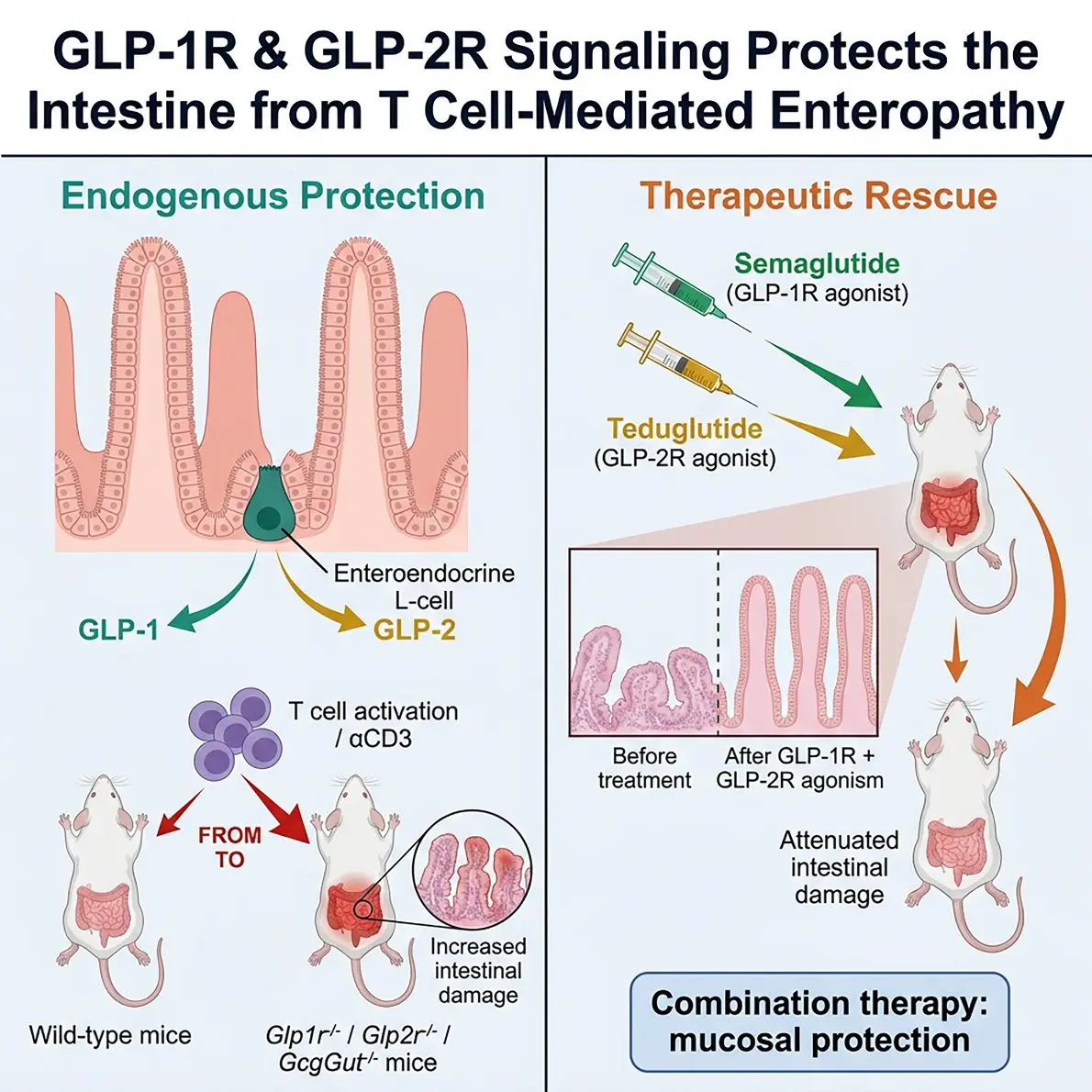
Study illustration: On the left, the natural protection that GLP-1 and GLP-2 from intestinal L cells provide. On the right, semaglutide and teduglutide reduce gut damage after immune cell activation. Source: Koehler et al., Cell Reports Medicine, 2026, under a CC BY-NC-ND 4.0 license, unmodified.
Two gut hormones, two different roles
Special cells in the gut, called L cells, release two hormones from the same parent protein, proglucagon. The first is GLP-1, the well-known hormone from the world of satiety hormones. It boosts insulin release according to blood sugar levels, slows stomach emptying and increases the feeling of fullness. The second is GLP-2, the hormone that looks after the gut. It promotes growth of the intestinal lining, improves nutrient absorption and strengthens the gut barrier.
In other words, each hormone has its own receptor and its own role. Semaglutide activates the GLP-1 receptor. Teduglutide, by contrast, activates the GLP-2 receptor, and doctors already use it to treat short bowel syndrome.
The experiment: how the researchers tested semaglutide and the gut
The research team from the University of Toronto, led by Prof. Daniel Drucker, used male mice aged 12 to 16 weeks. The researchers injected them with an antibody that activates T cells, a type of immune cell. This activation causes acute inflammation and damage to the intestinal lining, which usually resolve within four to five days.
In the first stage, the researchers compared normal mice with three genetically deficient groups. One group lacked the GLP-1 receptor. A second group lacked the GLP-2 receptor. In the third group, the gut produced almost none of either hormone. In the second stage, the researchers gave the drugs, each on its own and also together.
Missing hormones make gut damage worse
In all three genetically deficient groups, the gut damage got worse. However, the damage looked different in each group.
In mice without the GLP-1 receptor, the researchers found especially strong inflammation. Levels of the inflammatory molecules IL-1β and IL-6 rose, and many inflammatory cells built up in the gut wall. In mice without the GLP-2 receptor, on the other hand, structural damage stood out. The villi, the tiny projections that absorb food, became shorter. The researchers also saw a large loss of Paneth cells, which protect the gut against bacteria.
The third group, without either hormone, suffered the most severe damage. Their intestines shortened, the gut wall became leaky, and recovery was delayed. Most normal mice began to regain weight on day four. In contrast, the mice without the hormones only began to recover on day five. Moreover, 3 of the 12 mice in this group kept losing weight on day five, and the researchers had to euthanize them under the study rules.
Semaglutide and the gut: what did the drugs do?
After understanding the natural role of the hormones, the researchers tested whether the drugs could make up for the deficiency. They deliberately chose low doses so as not to add weight loss.
Teduglutide: preserving the structure of the lining
The researchers gave teduglutide at a dose five times lower than the one usually used in lab studies. Even so, it limited the loss of crypts, the pits in the lining that house the gut’s stem cells. It also lowered IL-1β and IL-6 levels in gut tissue and greatly reduced the number of inflammatory cells. However, it did not improve the leakiness of the gut wall.
Semaglutide: less inflammation in the blood and partial repair
Semaglutide lowered inflammatory markers in the blood. In addition, it partly restored crypt density and reduced the tissue damage score. For example, in mice without the hormones, it increased the activity of Paneth cell genes. Importantly, at this dose semaglutide caused no additional weight loss and did not slow stomach emptying. So its protective effect on the gut does not appear to come from weight loss.
The combination: semaglutide for the gut alongside teduglutide
The most intriguing finding came from the combination. When the researchers gave both drugs together, inflammatory markers in the blood dropped as early as three hours after immune cell activation. After three days, crypt density returned to the level seen in normal mice that had gone through the same injury. In addition, the intestine did not shorten any further, and the damage score also fell to the level of the normal mice.
Still, we need to be precise. The study did not prove that the combination beats each drug alone on every measure. The logic is that GLP-1 mainly calms inflammation, while GLP-2 rebuilds the lining. In other words, these are two mechanisms that complement each other.
What does this mean for inflammatory bowel disease?
In Crohn’s disease and ulcerative colitis, the immune system attacks the gut wall and the lining struggles to heal. That is why the researchers see these findings as a basis for further research in humans. There are already early hints. An early trial of teduglutide in 100 patients with Crohn’s disease showed a trend toward higher response and remission rates compared with placebo. In addition, a meta-analysis of 11 studies with 16,242 patients found fewer surgeries and hospitalizations among patients taking GLP-1 drugs. Now a phase 3 trial is also testing tirzepatide, the active ingredient in Mounjaro, together with a biologic drug in patients with Crohn’s disease and excess weight.
This topic is close to my heart, because inflammatory bowel disease and obesity occur together in quite a few of my patients. These findings also add to what we know about how GLP-1 affects chronic inflammation.
Study limitations
First, the researchers worked with mice and with a model of acute inflammation, which is very far from chronic disease in humans. Second, the genetic deficiency also blocked other gut hormones, so they may play a role as well. Third, treatment lasted only a few days, and there are no data on long-term treatment. Finally, a better-looking tissue sample does not yet equal fewer flare-ups or fewer surgeries.
Semaglutide and the gut: the bigger picture
GLP-1 drugs started as a treatment for diabetes and became a cornerstone of obesity treatment. Today we are learning about heart protection, liver benefits and even effects on skin inflammation in psoriasis. The current study adds the gut to the list. It presents the gut not only as a digestive organ but also as an organ that senses inflammation and takes part in repair. This knowledge also ties in with research on the gut barrier and aging.
Bottom line
The link between semaglutide and the gut is broader than we thought. In mice, the gut hormones GLP-1 and GLP-2 protected the lining from immune damage, and the drugs that mimic them reduced the damage. However, only clinical trials in humans will tell us whether this could become a new treatment for inflammatory bowel disease. In the meantime, do not change any treatment based on this study.
The information in this article is general only and does not constitute personal medical advice. Any treatment decision should be made together with your doctor.
References
Gut-derived glucagon-like peptides attenuate T cell-induced intestinal injury
Study disclosure: The study was funded by Canadian research grants and by funds associated with Novo Nordisk. The lead investigator has received consulting fees from pharmaceutical companies, including Eli Lilly, and speaker fees from Novo Nordisk.




