By Dr. Asnat Raziel, bariatric surgeon specializing in obesity treatment, metabolic health and healthy longevity; Director of the Multidisciplinary Center for Obesity Treatment, Assia Medical, Assuta Ramat HaChayal, Tel Aviv
Morning back pain: sleep quality matters as much as sleep length
Morning back pain bothers a lot of people, even those who get a full seven hours of sleep. We tend to measure sleep in numbers: how many hours we slept, how often we woke up and what score our smartwatch gave us. However, new research paints a more complex picture. How well we feel we slept may be just as closely linked to morning pain as the data on our wrist.
In other words, you can sleep seven hours and get an excellent sleep score. Even so, your back may hurt the moment you get out of bed. So what is going on?
Your watch says you slept well, but your body disagrees
A Japanese study published in 2025 followed 36 patients with chronic pain for seven days. The researchers combined two ways of measuring sleep. The first was actigraphy, an objective measurement taken with a motion sensor worn on the wrist. The second was a sleep diary, in which participants rated their own sleep quality and pain intensity.
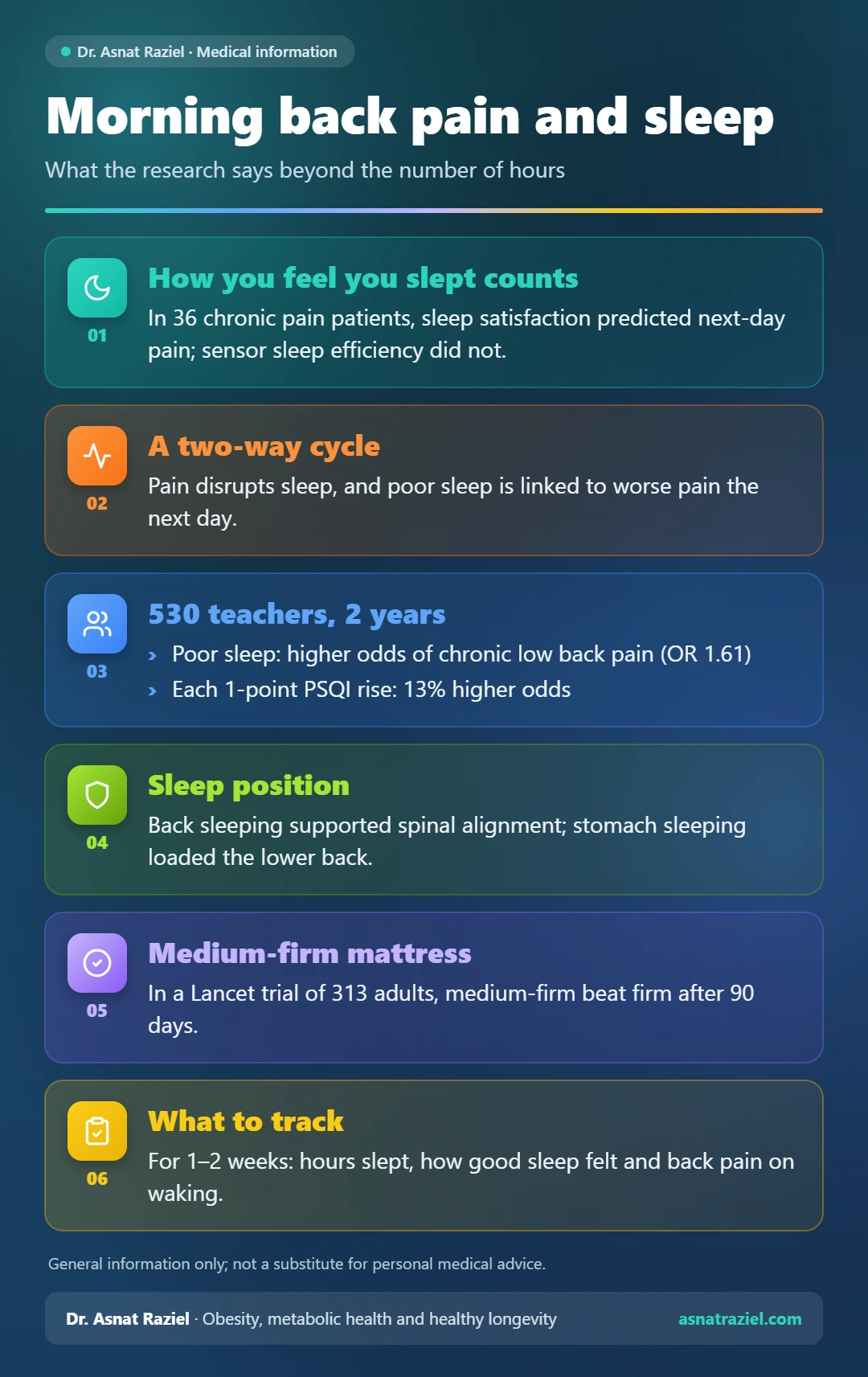
The sensor tracked total sleep time, time to fall asleep, time awake during the night and sleep efficiency. The result was surprising. Sleep efficiency, as the sensor measured it, did not affect pain the next day. In contrast, satisfaction with sleep did. On days when participants felt they had slept well, their pain after sleep was much milder.
That is why the question “How many hours did you sleep?” is not enough. It is also worth asking, “How did you sleep?”
Sleep and pain: a two-way cycle
The link doesn’t run only from sleep to pain. Pain disrupts sleep, and poor sleep is linked to worse pain. In the same study, on nights when pain before bed was mild, sleep efficiency was high. At the same time, sleep that felt good led to milder pain in the morning.
As a result, a cycle can form: pain disrupts sleep → sleep feels poor → pain the next day is stronger → the following night suffers too.
In addition, a systematic review in the journal SLEEP looked at sleep as a predictor of low back pain. The review included 14 studies with 19,170 participants. The researchers found that poor sleep was linked to more severe pain and a lower chance of recovery. Still, they rated the quality of the evidence as low to very low. You can read more about the broader effects of sleep in my article on how good sleep protects your weight and metabolism.
What happens over the years?
Another larger and longer study strengthens the link. A cohort study from Brazil followed 530 schoolteachers for two years. The researchers measured sleep quality with the PSQI (Pittsburgh Sleep Quality Index), a standard questionnaire in sleep research.
Poor sleep at the start of the study raised the odds of chronic low back pain two years later (OR 1.61). Moreover, every one-point rise in the PSQI score, meaning worse sleep, came with a 13% rise in the odds of chronic back pain. Here, too, the link worked both ways. Teachers who had chronic back pain at the start went on to sleep poorly.
An important caveat: this is an observational study. Therefore, we can’t conclude that improving your score by one point will lower your risk by 13%. The figure describes a statistical association, not proof of cause and effect.
Morning back pain and sleep position
Sleep quality also has a mechanical side. A 2025 systematic review examined the link between sleep positions and low back pain. In the six studies it included, sleeping on your back supported spinal alignment and came with lower rates of pain. On the other hand, sleeping on your stomach put more load on the lower back and raised the risk of pain.
Side sleeping is the most common position. It isn’t necessarily good or bad; it all depends on support and body alignment. So if you keep waking up with morning back pain, take a look at your position, your pillow and your mattress.
What about the mattress?
An old belief says that “a firm mattress is good for your back.” The research doesn’t support this rule. A randomized controlled trial published in The Lancet included 313 adults with chronic low back pain. After 90 days, a medium-firm mattress led to better results than a firm one. The benefit showed up in pain in bed, pain on getting up and functional disability.
Building on this, a systematic review published in July 2026 included 47 studies published between 1999 and 2023. It also favored a medium-firm mattress over a very firm or very soft one. Such a mattress was linked to better pressure distribution, better sleep, and less morning stiffness and back pain.
That said, no single mattress suits everyone. Body weight, body build, age, sleep position and personal preference all affect the choice.
What to do about morning back pain
If you sleep seven or eight hours and still wake up tired and stiff, don’t rely on your smartwatch data alone. For a week or two, write down three things each morning: how long you slept, how good your sleep felt and how strong your back pain was on waking.
At the same time, check your sleep position. For example, sleeping on your back or on your side with good support is usually more comfortable than sleeping on your stomach. Also, take a look at your mattress, especially if it is old, sagging or very firm, or if the pain eases once you start moving.
Beyond that, sleep quality depends on the whole picture. Regular physical activity and strength training alongside aerobic exercise help both sleep and the back. Daylight, regular sleep hours, less alcohol in the evening and a dark, quiet room also help. It is also worth paying attention to when you exercise in the day. Finally, significant sleep disorders need proper evaluation and treatment.
The bottom line
Seven hours of sleep are not necessarily seven hours of good sleep. The research shows that the link between sleep and pain isn’t only about how long you sleep. The feeling that you slept well, unbroken sleep, your position, your bedroom and your mattress are all part of the picture.
What’s more, the link works both ways: pain disrupts sleep, and poor sleep may feed the pain. So if you keep waking up with back pain, ask yourself not only “How many hours did I sleep?” but also “Did I really sleep well?”
This article provides general information and is not a substitute for personal medical advice.
Questions and answers about morning back pain
Is seven hours of sleep enough?
For many adults, this is an accepted range. However, sleep length alone does not guarantee good, restorative sleep.
Which sleep position is best for back pain?
The evidence leans toward sleeping on your back or on your side with good support. By contrast, sleeping on your stomach may strain the lower back in some people.
Is a firm mattress better for back pain?
Not necessarily. In fact, studies point to an advantage for a medium-firm mattress over a very firm one.
Does my smartwatch know whether I slept well?
Your watch gives useful information about your sleep patterns, but not the whole story. In the study of patients with chronic pain, satisfaction with sleep predicted morning pain. In contrast, the sensor measurements did not.
References
Relationship Between Sleep Posture and Low Back Pain: A Systematic Review
Mattress impact on lifestyle and back pain: a 25-year orthopedic literature review guideline




