By Dr. Asnat Raziel, bariatric surgeon specializing in obesity treatment, metabolic health and healthy longevity; Director of the Multidisciplinary Center for Obesity Treatment, Assia Medical, Assuta Ramat HaChayal, Tel Aviv
Body image after weight loss: why the reflection does not change overnight
Body image after weight loss is a topic that surprises many patients. The weight goes down, the clothes get smaller and the test results improve, yet the old figure still appears in the mirror. This is a familiar and common experience, not a sign of failure. In this article, I will explain why it happens, what the studies show and which tools help the brain “catch up” with the new body.
What body image after weight loss is, and why it lags behind
Body image is our inner picture of our body. It includes what we see, how we feel about it and what we think about it. This picture forms over many years, so it changes much more slowly than weight does. After rapid weight loss, especially following bariatric surgery or drug treatment, the gap between the body and the inner picture stands out even more.
“Phantom fat”: when the brain still sees the old body
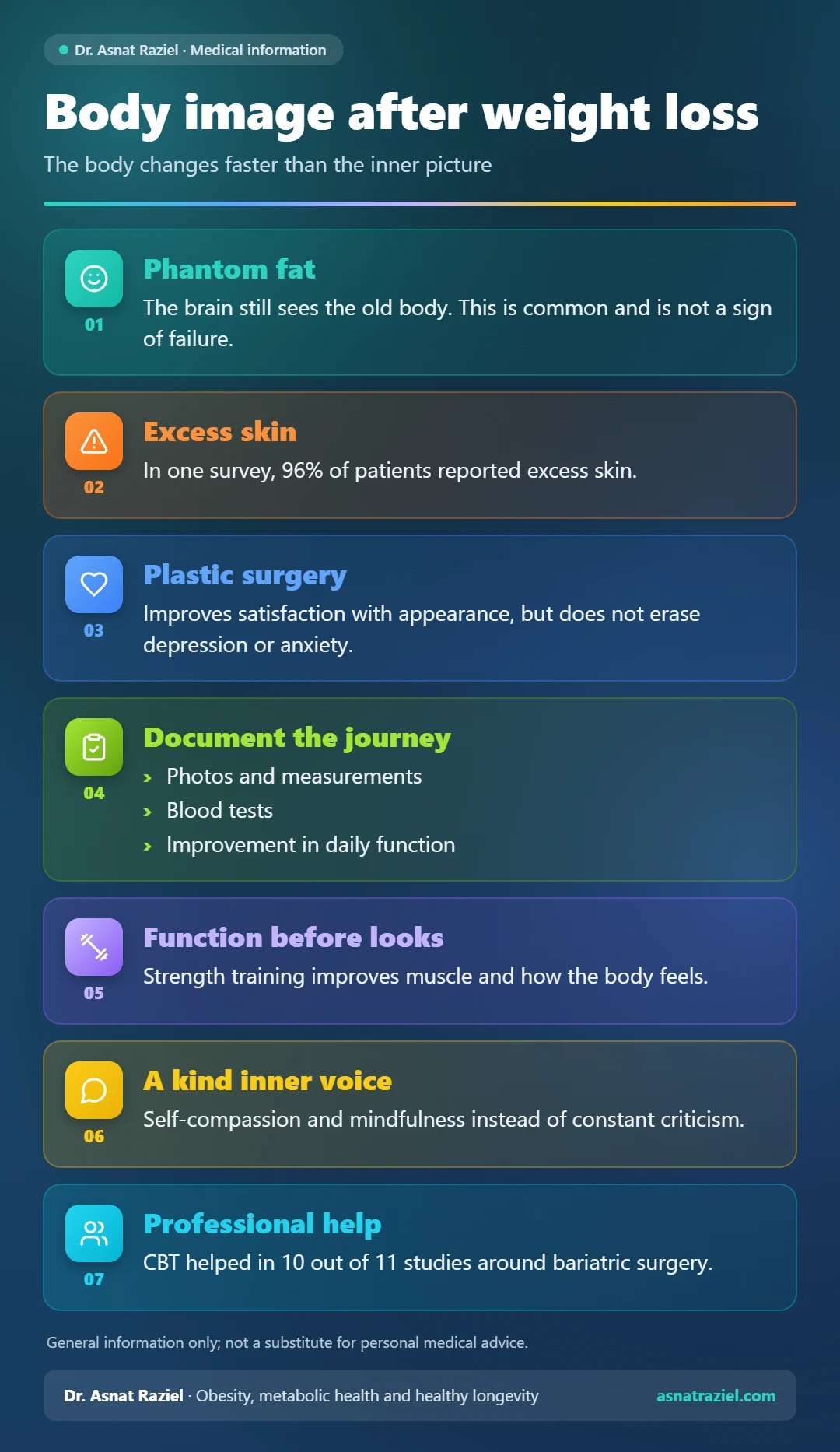
Patients describe picking a size that is too big in the store. Others avoid walking through a narrow doorway or sit down carefully, as if their body were still wide. In a systematic review of 15 studies, the researchers wrote that for many surgical patients, body image did not change after the operation. As they put it, a “self-perception of a person with obesity” remains. In addition, dissatisfaction with weight is sometimes replaced by dissatisfaction with excess skin.
Body image after weight loss and excess skin
Excess skin is the most tangible source of frustration. In a survey of 252 patients after gastric bypass surgery, 96% reported excess skin. The skin caused irritation, itching and difficulty with exercise and finding clothes. Even so, 90% of women and 88% of men rated their appearance as satisfactory or better. In other words, you can be pleased with the change and still struggle with certain parts of your body. I wrote about similar changes in the face in my article on facial appearance during weight loss.
What we know about reconstructive plastic surgery
In a study on body image and quality of life from Germany, the researchers compared three groups. The first included 79 patients before bariatric surgery. The second included 252 patients after surgery, and the third included 62 patients who also had body contouring plastic surgery. Before bariatric surgery, 71.8% had significant symptoms of depression. After surgery, the rate was 30.8% in the group without plastic surgery and 27.4% in the group that had it. Plastic surgery improved how patients rated their appearance and their satisfaction with body areas. However, it did not reduce depression or anxiety.
A systematic review of 24 studies found that most patients want such surgery. In practice, only 18.5% had it, mainly because of the cost. So keep this in mind: plastic surgery can help, but it does not replace work on your inner perception.
When it is more than a passing feeling
For most people, the inner picture updates gradually, over months and years. But sometimes preoccupation with appearance takes over a central place in life. Body dysmorphic disorder is a mental health condition in which a small or imagined flaw in appearance causes severe distress. It is worth seeing a professional if any of these signs sound familiar:
- Checking the mirror for hours a day, or avoiding it completely.
- Constantly comparing yourself with others and hiding your body even in hot weather.
- Skipping social gatherings, the beach, the pool or intimacy because of how you look.
- Going back to extreme diets, binge eating or vomiting.
- Low mood, anxiety or distressing thoughts.
Practical tools to improve body image after weight loss
1. Document the journey
Before and after photos, body measurements and blood tests give the brain facts instead of feelings. Look at them from time to time, especially on hard days. You can also write down what has changed in how you function: climbing stairs, a long walk or better sleep.
2. Shift the focus from appearance to function
A body is not just an image. That is why a question like “What can my body do today?” helps more than examining details in the mirror. Strength training builds muscle, improves posture and changes how your body feels. You can read about the link between body composition and health in my article on why body composition matters more than weight.
3. Choose clothes that fit the body you have today
Many people keep wearing loose clothes out of habit. Trying on the right size, even if it feels scary at first, is an important exercise. Over time, it teaches the brain your new measurements.
4. Work on your inner voice
Critical self-talk reinforces the old picture. By contrast, self-compassion and mindfulness help you look at your body without judgment. It also helps to relearn how to trust your body again, including its signals of hunger, fullness and fatigue.
Body image after weight loss: when and how to get professional help
Cognitive behavioral therapy (CBT) is a treatment method that identifies inaccurate thoughts and gradually changes them. In a literature review of CBT around bariatric surgery, ten out of 11 studies showed a benefit. Participants improved their eating patterns and mental state, and sometimes their weight as well. In addition, a synthesis of 33 qualitative studies highlighted the need for long-term psychological and nutritional support.
Patients on GLP-1 medications also benefit from emotional follow-up. I wrote about this at length in my article on GLP-1 and mental health. At our clinic, we ask about body image as a routine part of follow-up, alongside weight and test results.
Body image after weight loss, self-confidence and lifestyle
For many people, weight loss improves mood and quality of life. Still, it does not solve every emotional difficulty on its own. I discussed this further in my article on weight loss and self-confidence. Ultimately, sleep, movement and balanced nutrition are part of a healthy lifestyle, and they also affect how you feel in your body.
The bottom line
Body image after weight loss changes much more slowly than the number on the scale. The feeling that “I’m still big” is very common, and it usually updates with time. Documenting your progress, focusing on function, wearing clothes that fit and kinder self-talk all help the process. When preoccupation with appearance harms your life, focused psychological treatment is effective and worth exploring.
The information in this article is general and does not replace personal medical advice.
Questions and answers
How long does it take to improve body image after weight loss?
There is no fixed timeline. For some people it happens within months, while for others it takes years. For many, psychological support shortens the process.
Will surgery for excess skin make me feel better?
Studies show improved satisfaction with appearance and better physical function. However, the surgery did not reduce depression or anxiety, so it is wise to combine it with emotional support.
Who should I turn to?
You can start with a conversation with your doctor. After that, you may see a psychologist experienced in obesity care, a dietitian and, if needed, a plastic surgeon. For details on my approach, see Dr. Asnat Raziel.
Sources
The role of body image in obese identity changes post bariatric surgery
After massive weight loss: patients’ expectations of body contouring surgery
Patient experiences of outcomes of bariatric surgery: a systematic review and qualitative synthesis