By Dr. Asnat Raziel, bariatric surgeon specializing in obesity treatment, metabolic health and healthy longevity; Director of the Multidisciplinary Center for Obesity Treatment, Assia Medical, Assuta Ramat HaChayal, Tel Aviv
Mounjaro for diabetes: the question patients ask me every week
Mounjaro for diabetes raises a recurring question in my clinic: is it better than Wegovy or Ozempic? A large real-world study from the United States looked at exactly that. The researchers followed adults with diabetes who started one of the two medications. After a year, Mounjaro patients saw bigger drops than semaglutide patients, in both blood sugar and weight.
The two medications being compared
Mounjaro is the brand name of tirzepatide. It is a weekly injection that acts on two natural gut hormones, GLP-1 and GIP. By contrast, semaglutide acts on only one hormone, GLP-1. Injectable semaglutide is the active ingredient in both Ozempic and Wegovy. For diabetes, doctors usually prescribe Ozempic, while Wegovy, at a higher dose, is used to treat obesity. The study did not separate the brand names and looked at injectable semaglutide as a whole. I wrote in detail about the differences between the drugs and how to tailor treatment in my article Mounjaro: who is it right for?
What is a real-world study?
Most data on medications come from controlled trials, with carefully selected patients. A real-world study, or real-world evidence, looks at what happens to ordinary patients in routine care. That means people with other health conditions, with difficulty sticking to treatment, and with prescriptions from many different doctors. Therefore, studies like this complement clinical trials and show how a drug performs in everyday life.
How the study was designed
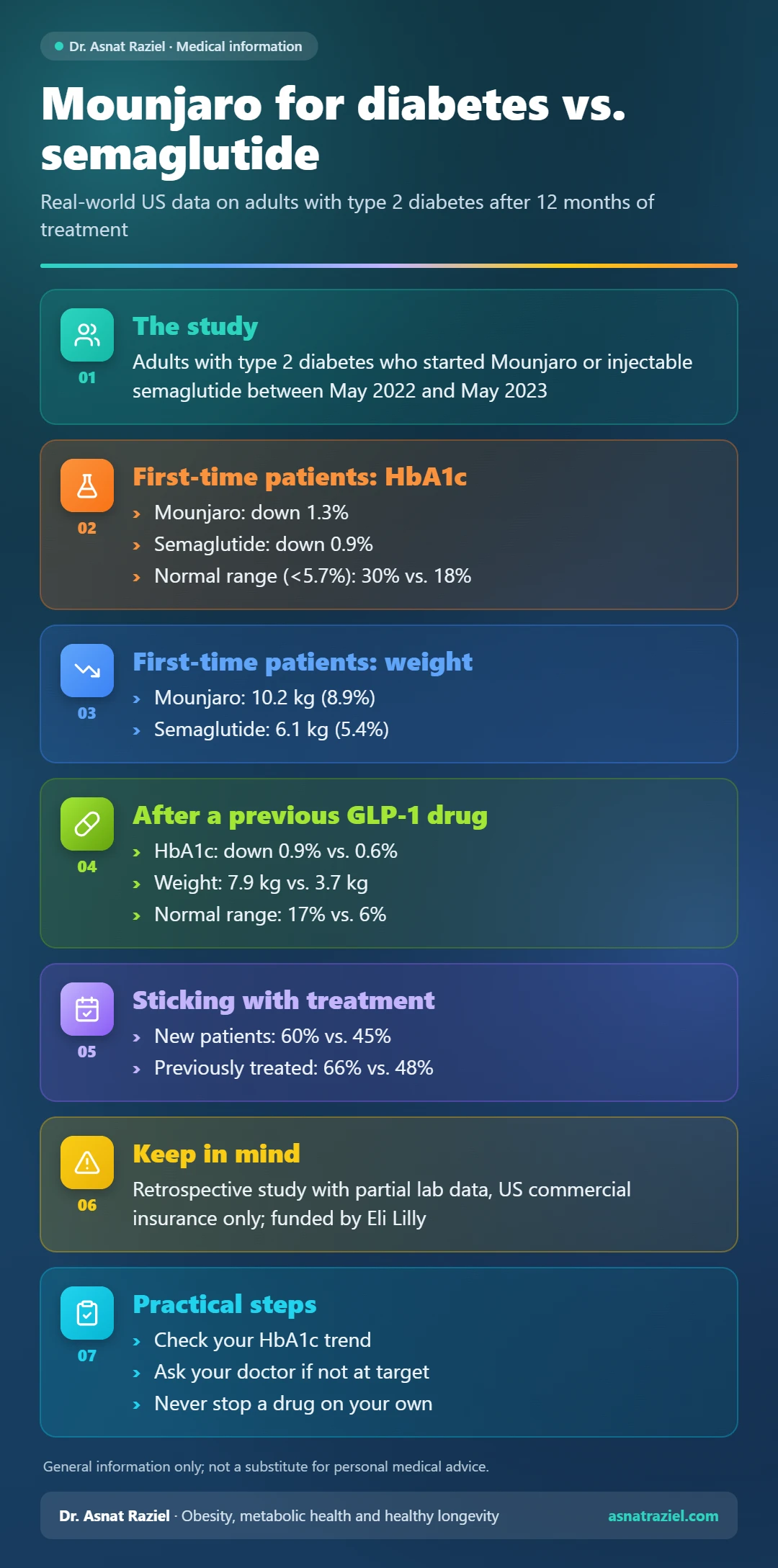
The study, published in the journal Diabetes Therapy, drew on a large US health insurance database. The researchers included adults with type 2 diabetes who started Mounjaro or injectable semaglutide between May 2022 and May 2023. In addition, they used statistical matching so that the groups would be similar in age, other conditions and other measures.
The researchers divided the patients into two separate groups. The first included “naive” patients, meaning those who had never taken a GLP-1 medication before. The second included patients who had taken such a drug in the previous six months. In both groups, they looked at the change in HbA1c and weight after 12 months.
What is HbA1c?
HbA1c, or glycated hemoglobin, is a blood test that reflects your average blood sugar over the past three months. A value of 6.5% or higher is diagnostic of diabetes. A value below 5.7% is considered the normal range.
Mounjaro for diabetes results in first-time patients
Among patients starting this type of treatment for the first time, baseline HbA1c was 7.8% in both groups. Average starting weight was 112.4 kg in the Mounjaro group and 110.7 kg in the semaglutide group. After one year, these were the results:
- HbA1c fell by 1.3% with Mounjaro, compared with 0.9% with semaglutide.
- Weight fell by 10.2 kg with Mounjaro (8.9% of body weight), compared with 6.1 kg with semaglutide (5.4%).
- 67% of Mounjaro patients reached an HbA1c of 6.5% or less, compared with 54% of semaglutide patients.
- 30% of Mounjaro patients reached a normal value, below 5.7%, compared with 18%.
Put simply: out of every 100 patients who started Mounjaro, 30 reached a blood sugar level in the normal range. With semaglutide, by contrast, 18 out of 100 got there. The differences in blood sugar and weight were statistically significant.
Mounjaro for diabetes after switching from another drug
Here comes one of the most interesting findings. Even patients who had previously taken a GLP-1 medication responded well to Mounjaro. In this group, HbA1c fell by 0.9% with Mounjaro, compared with 0.6% with semaglutide. Weight fell by 7.9 kg (7.1%) with Mounjaro, compared with 3.7 kg (3.3%) with semaglutide.
In addition, 49% of Mounjaro patients in this group reached an HbA1c of 6.5% or less, compared with 33%. Likewise, 17% reached the normal range, compared with only 6%. In other words, even people who have already “tried” a drug from this family may benefit from switching. However, the decision to switch medications is always personal and should be made together with your doctor. I wrote about adjusting the dose over time in my article should you increase your tirzepatide or semaglutide dose?
Sticking with treatment: an easy-to-miss finding
The researchers also looked at how many patients stuck with treatment, meaning they had the medication on hand on at least 80% of days. Among new patients, 60% of Mounjaro patients stayed on treatment, compared with 45% of semaglutide patients. Among previously treated patients, the figures were 66% versus 48%. Persistence matters a great deal, because a medication works only when you take it regularly.
What the Mounjaro for diabetes study cannot tell us
It is important to read these findings with caution. First, this is a retrospective study, meaning the researchers analyzed existing data rather than running a controlled trial. So factors that were not measured, such as doctor preferences or lifestyle, cannot be fully ruled out. Second, lab and weight data were available for only some patients. Third, the study included people with commercial health insurance in the US, so the picture may differ in other populations. Also, the researchers did not separate the different doses. Finally, the study was funded by Eli Lilly, the maker of Mounjaro.
Still, the findings are consistent with the SURPASS-2 trial, in which Mounjaro showed an advantage over semaglutide in a controlled setting. I have also written an article comparing Mounjaro and high-dose Wegovy in people with obesity.
Mounjaro for diabetes: what this means for you
In this study, Mounjaro for type 2 diabetes led to greater improvement than semaglutide, in both blood sugar and weight. However, the right medication depends on you: your other health conditions, side effects, availability and cost. For example, some patients have nausea on one drug and feel fine on the other. To learn about possible side effects, read my guide to the side effects of weight-loss medications.
A few practical steps:
- Check your HbA1c and how it has trended over the past year.
- If you are already on a GLP-1 medication and haven’t reached your target, ask your doctor about your options.
- Combine treatment with a tailored diet and physical activity to preserve muscle mass.
- Don’t stop a medication on your own. It’s also worth reading how to stop Mounjaro or Wegovy without regaining it all.
Bottom line on Mounjaro for diabetes
In this real-world study, Mounjaro for type 2 diabetes led to greater reductions in HbA1c and weight than semaglutide after one year. The advantage held both for people starting treatment for the first time and for those who had already taken a GLP-1 medication. Ultimately, the choice between these drugs should be personal and based on each patient’s full clinical picture.
The information in this article is general information only and is not a substitute for personal medical advice. Before making any change to your treatment, consult your doctor.
References
Tirzepatide versus Semaglutide Once Weekly in Patients with Type 2 Diabetes
The real-world study was funded by Eli Lilly. Four of the researchers are employees and shareholders of the company.




