By Dr. Asnat Raziel, bariatric surgeon specializing in obesity treatment, metabolic health and healthy longevity; Director of the Multidisciplinary Center for Obesity Treatment, Assia Medical, Assuta Ramat HaChayal, Tel Aviv
Fast food and GLP-1: a new menu and a new mindset
Fast food and GLP-1 medications are meeting at a surprising point. In this article, I look at it from the diner’s side: what McDonald’s is changing, how people on these drugs actually eat, and how to order a quick meal wisely during treatment. I have written separately about how GLP-1 drugs are reshaping the food industry as a whole.
When McDonald’s changes its menu, it is not just a technical adjustment to supply chains or prices. It is a sign of a deep shift in eating habits around the world. Consumers are changing, and so is their appetite. The big news is not only “less junk.” Rather, it is a new conversation about protein quality, nutritional value, metabolic awareness and the medical treatment of obesity.
What exactly is happening at McDonald’s
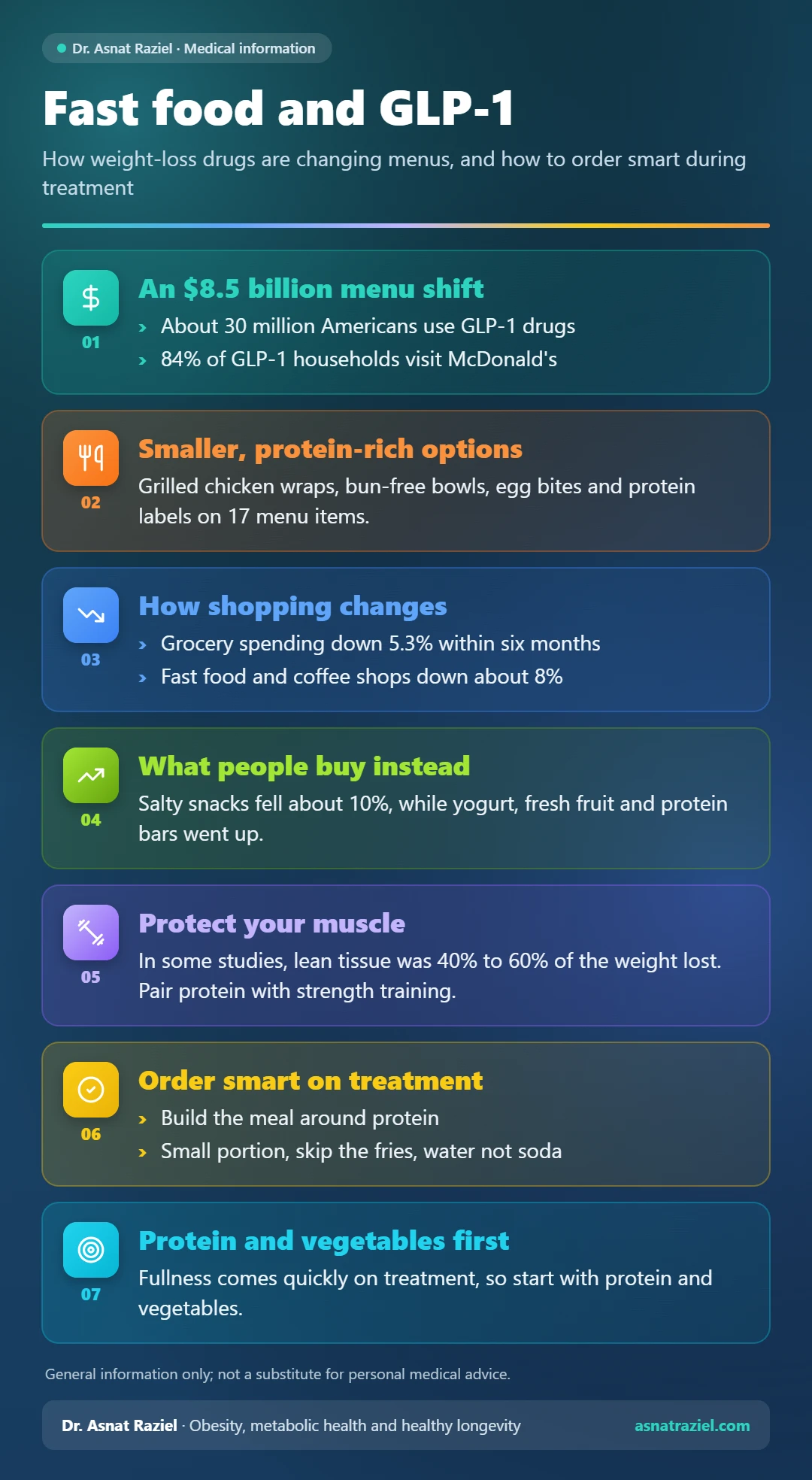
In September 2026, McDonald’s presented investors with an $8.5 billion investment plan for the coming decade. A central part of it is a new menu. According to the president of McDonald’s USA, about 30 million Americans use GLP-1 drugs. In addition, according to the company’s research, 60 million Americans are actively looking for added protein.
So the chain is testing small, flexible portions. Examples include sandwiches and wraps with grilled chicken, chicken and burger bowls without a bun, and baked egg bites for breakfast. Back in April 2026, the chain added protein labeling to 17 menu items in its app and ordering kiosks. According to the company, 84% of households with a GLP-1 user visit the chain. In other words, McDonald’s is not looking for new customers. It is trying not to lose the ones it has.
What the data show about fast food and GLP-1
A Cornell University study, published in December 2025, tracked the purchases of tens of thousands of US households. Within six months of starting treatment, grocery spending dropped by 5.3% on average. Spending at fast food chains and coffee shops fell by about 8%.
The biggest drop was in salty snacks, at about 10%. Sweets, pastries and cookies fell by a similar amount. By contrast, purchases of yogurt, fresh fruit and protein bars went up. In other words, people are not just eating less. They are choosing differently.
People want satiety and nutritional value
In recent years there has been a clear trend: less enthusiasm for empty calories and more interest in quality protein. Quality protein provides essential amino acids. It also helps preserve muscle, increases satiety and helps balance blood sugar levels. You will find practical tips in my guide to protein intake.
During weight loss, preserving muscle is especially important. A 2024 scientific review found a wide gap between studies. In some, lean tissue made up 40% to 60% of the weight lost. In others, it made up about 15% or less. That is why the new conversation is not about “less food,” but about “smart food,” alongside strength training.
GLP-1 drugs are changing the rules
Alongside the menu changes, a medical revolution is under way. Drugs such as Ozempic, Wegovy and Mounjaro have changed how people experience hunger and fullness. They act on the hormone GLP-1, and sometimes also on GIP. They reduce appetite, prolong satiety and affect the brain’s reward centers. The result is not only weight loss, but a change in food preferences.
Many patients report less craving for foods high in sugar and fat. Instead, they are drawn to simple food, often rich in protein. When millions of people experience a change in appetite, food chains feel it too. There is also a direct link to ultra-processed food, which I described in my article on ultra-processed food and the brain.
A healthy lifestyle is no longer a trend
Today it is clear that obesity is a chronic disease. So modern treatment does not stop at cutting calories. As I explain in my article on surgery, medication and whole-person care, it combines several components:
- Personalized nutrition.
- Adequate protein intake.
- Physical activity with an emphasis on strengthening muscle.
- Enough sleep.
- Medication when needed.
The changing menus around the world reflect a public that understands the problem. People are looking for plenty of protein and fewer empty carbohydrates. They want transparency and less over-processing.
Not a war on junk food, but a conscious choice
This is not about a total ban. Even with a healthy lifestyle, you can occasionally enjoy a quick meal. The question is frequency, composition and context. When your diet is based on quality protein, vegetables, good fats and fiber, the body works differently. Insulin levels stay stable, muscles keep their strength and hunger stays moderate.
For patients on GLP-1 drugs, this matters even more. If your appetite is smaller, every bite should count. This is a window of opportunity to improve body composition, not just the number on the scale. You will find practical guidance in my nutrition guide for weight-loss injections.
Fast food and GLP-1: how to order smart
A smaller appetite does not mean you can never grab a quick meal. Based on the points above, here is how to make it work for your body:
- Check the protein labeling on the menu and build the meal around protein.
- Choose a small portion, or a bowl without the bun.
- Skip the fries, and swap the sugary drink for water.
- Start with the protein and vegetables, because fullness comes quickly on treatment.
- Pair your eating plan with strength training to protect muscle.
This way, even fast food can support your treatment instead of working against it.
Fast food and GLP-1 in Israel
In Israel, too, demand for obesity medication and advanced nutritional counseling is rising sharply. The public now understands that obesity is not a personal failure, but a biological condition. Most of the big chains operate here as well, so a strategic shift at headquarters usually reaches the Israeli branches too. Maybe this is not the end of the hamburger era. But it is certainly the end of the era of unawareness.
What does this mean for you? First, check the protein labeling on the menu and choose a dish built around it. Second, you can order a small portion, skip the fries or swap the sugary drink for water. In addition, people on medication will feel full quickly. So it is better to start with the protein and vegetables, and only then move on to the rest. This way, even a quick meal becomes a conscious choice.
The future: protein, precision and smart metabolism
We are entering a new era. Consumers read food labels, drug treatment is precise and nutrition is becoming a therapeutic tool. The conversation is shifting from calories to quality, and from weight to body composition. It is also shifting from a personal struggle to evidence-based science.
Bottom line on fast food and GLP-1
The link between fast food and GLP-1 drugs shows how far the impact of obesity treatment reaches beyond the clinic. When McDonald’s adds protein dishes and smaller portions, it is responding to a real change in the appetite of millions. Ultimately, the important decisions are made on our own plates. Conscious choices, quality protein and professional guidance are the foundation for long-term success.
The information in this article is general and does not replace personal medical advice.
References
More tech and hand-breaded chicken coming to McDonald’s as part of $8.5 billion modernization push
McDonald’s is exploring an $8.5 billion bet on a fast food wave led by protein-maxxing and GLP-1s
Egg Bites, Burger Bowls: McDonald’s Aims to Draw GLP-1 Users
Ozempic is changing the foods Americans buy
Changes in lean body mass with glucagon-like peptide-1-based therapies and mitigation strategies




