By Dr. Asnat Raziel, bariatric surgeon specializing in obesity treatment, metabolic health and healthy longevity; Director of the Multidisciplinary Center for Obesity Treatment, Assia Medical, Assuta Ramat HaChayal, Tel Aviv
Mounjaro weight loss timeline: what to know before you start
Mounjaro for obesity is currently one of the most effective drug options for significant weight loss. In the large trials, patients on the highest dose lost about 20% of their body weight on average. However, this is a serious medication that requires careful selection, dosing and follow-up. In this article, I walk you through the Mounjaro weight loss timeline: how the drug works, what happens in the first weeks, what the trials showed at 36 and 72 weeks, and what happens when treatment stops.
How Mounjaro works in the body
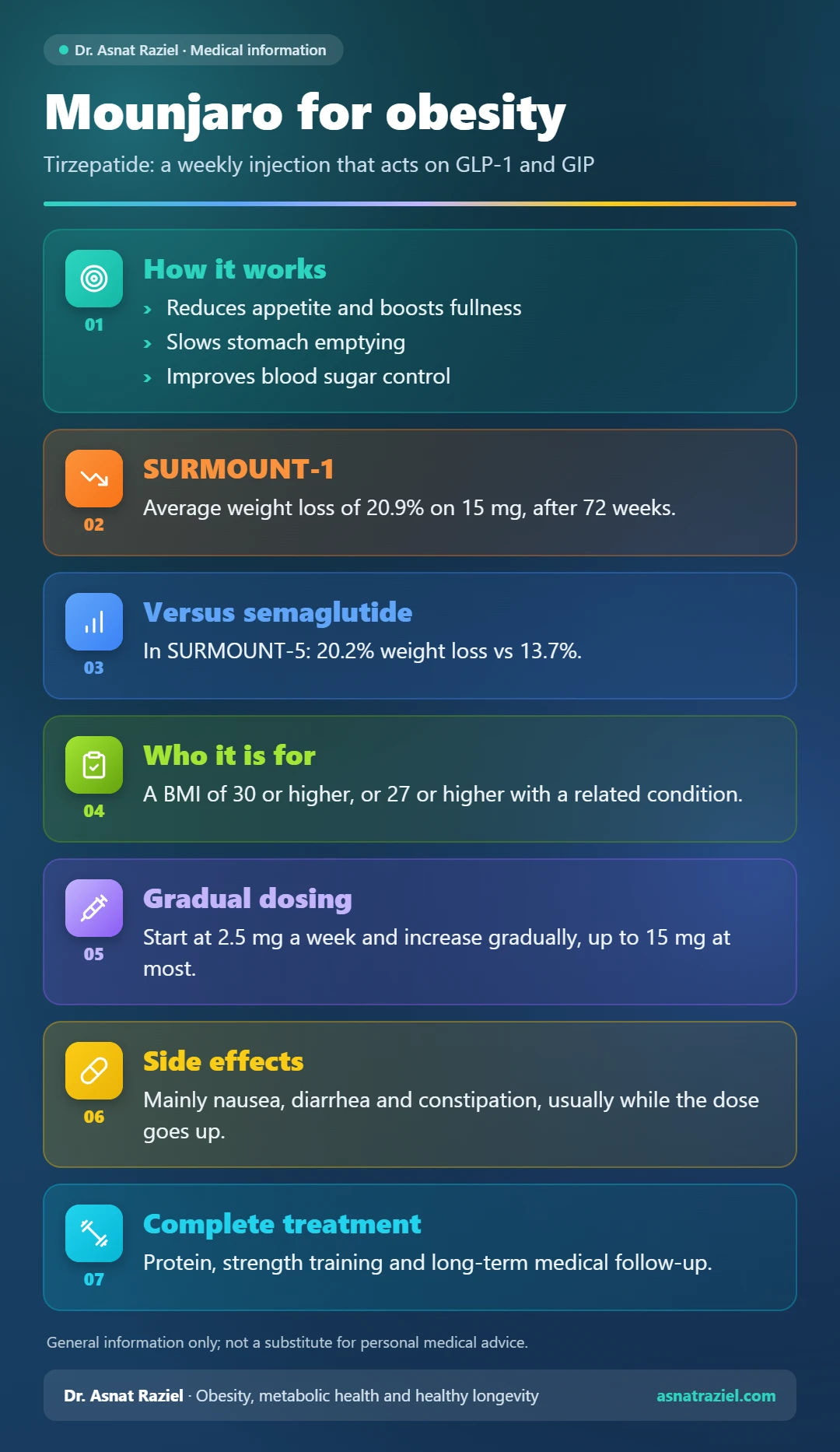
The active ingredient in Mounjaro is tirzepatide. It is a subcutaneous injection given once a week. Unlike the older GLP-1 drugs, tirzepatide acts on two receptors: GLP-1 and GIP. These are two natural hormones that the gut releases after a meal.
In practice, the effect shows up on several levels. First, the drug acts on the hunger and fullness centers in the brain, so appetite drops. In addition, it slows stomach emptying, so the feeling of fullness lasts longer. Many patients also describe less “food noise,” meaning the intrusive thoughts about food. Finally, the drug improves blood sugar control and insulin sensitivity.
The Mounjaro weight loss timeline at a glance
Here is how treatment usually unfolds, based on the dosing schedule and the trial results described below:
- Weeks 1–4: a low starting dose of 2.5 mg once a week. Many people notice less appetite within the first few weeks.
- After week 4: the dose goes up gradually, by 2.5 mg at a time, according to need and tolerance. Side effects appear mainly during this stage.
- Maintenance: 5, 10 or 15 mg a week. The maximum is 15 mg, and not everyone needs it.
- Week 36: in SURMOUNT-4, participants had lost 20.9% of their weight by this point.
- Week 72: in SURMOUNT-1, average weight loss reached 15.0% to 20.9%, depending on the dose.
- The following year: in SURMOUNT-4, those who continued lost another 5.5%, while those who stopped regained 14.0%.
For practical tips on the first injections and each dose increase, see my guide to starting Mounjaro and building a weekly routine.
The research behind the Mounjaro weight loss timeline
SURMOUNT-1: average loss of up to 20.9%
The SURMOUNT-1 trial included 2,539 adults with obesity and without diabetes. Participants received tirzepatide or a placebo injection for 72 weeks. On 15 mg, they lost an average of 20.9% of their body weight. On 10 mg, the loss was 19.5%, and on 5 mg, 15.0%. By contrast, the placebo group lost only 3.1%. What’s more, 57% of patients on 15 mg lost 20% of their weight or more.
SURMOUNT-5: head to head with semaglutide
In the SURMOUNT-5 trial, researchers compared tirzepatide directly with semaglutide, the active ingredient in Wegovy. The trial included 751 participants with obesity and without diabetes. After 72 weeks, patients on tirzepatide had lost an average of 20.2% of their weight, compared with 13.7% on semaglutide. Waist circumference also fell much more: 18.4 cm versus 13.0 cm. You may also want to read about the difference between Mounjaro and Wegovy.
SURMOUNT-4: the Mounjaro weight loss timeline after stopping
Obesity is a chronic disease, so the Mounjaro weight loss timeline does not end when the weight comes off. It is important to understand what happens after stopping. In the SURMOUNT-4 trial, 670 participants first lost 20.9% of their weight over 36 weeks. After that, some continued treatment and some switched to a placebo injection. Over the following year, those who continued lost another 5.5%. On the other hand, those who stopped regained 14.0%.
Who is Mounjaro for obesity suitable for?
According to the FDA approval of tirzepatide for weight management, treatment is intended for adults with a BMI of 30 or higher. It is also suitable for people with a BMI of 27 or higher and at least one related condition. Examples include high blood pressure, type 2 diabetes or high blood lipids. You can check your own number with a BMI calculator.
That said, BMI is only a starting point. In our clinic, we also look at medical conditions, regular medications, eating habits and personal goals. You can read more in my article on who Mounjaro may be suitable for.
When the drug should not be used
Do not use the drug if you have a personal or family history of medullary thyroid cancer, or if you have MEN2 syndrome. In addition, it has not been studied in patients with past pancreatitis or severe digestive disease. It is not used during pregnancy or breastfeeding. It is also important to know that tirzepatide may reduce the effectiveness of birth control pills, mainly at the start of treatment and after a dose increase.
Dosing along the Mounjaro weight loss timeline
Treatment starts at a low dose of 2.5 mg once a week for four weeks. After that, the dose goes up gradually, by 2.5 mg at a time, according to need and tolerance. The maintenance doses are 5, 10 or 15 mg a week, and the maximum dose is 15 mg. This gradual increase is very important, because it reduces nausea and vomiting. So there is no rush, and not every patient needs to reach the maximum dose.
Side effects along the Mounjaro weight loss timeline
The common side effects affect the digestive system: nausea, diarrhea, constipation, vomiting and abdominal pain. In most cases they are mild to moderate, and they appear mainly during dose increases. In SURMOUNT-1, between 4.3% and 7.1% of patients stopped treatment because of side effects, compared with 2.6% in the placebo group.
Alongside these, there are rare side effects worth knowing about. For example, pancreatitis, gallstones and kidney injury due to dehydration. Severe abdominal pain that does not go away requires immediate medical attention. You’ll find a detailed guide in my article on Mounjaro side effects.
Protecting your muscles
With rapid weight loss, the body also loses muscle mass. To limit this, I recommend protein at every meal and strength training two to three times a week. It is also important to drink enough and to eat small, balanced meals.
Mounjaro for obesity in Israel: availability and cost
Mounjaro has been available in Israel since September 2024, both for type 2 diabetes and for obesity. At present, it is not included in the national health basket for the obesity indication. As a result, people buy it privately or with a co-payment through supplementary insurance. For example, Maccabi, one of Israel’s health funds (HMOs), notes on its website a co-payment through its supplementary insurance, with prior approval. The details at each health fund change from time to time, so it is worth checking with yours. I have gathered the information in my article on Mounjaro in Israel’s health funds.
Mounjaro as part of complete treatment
The drug is a powerful tool, but it does not work alone. The best results come when it is combined with a tailored diet, physical activity, good sleep and close support. That is why I prefer a multidisciplinary approach, with a doctor, a dietitian and sometimes a psychologist. You can find broad information on all the options on my page about drug treatment for obesity and in my Mounjaro guide to obesity treatment.
The bottom line
Mounjaro for obesity leads to an average weight loss of about 20% at the high dose, which is more than semaglutide in a direct comparison. However, it is a medication for the long-term treatment of a chronic disease. The Mounjaro weight loss timeline depends on personal tailoring, gradual dose increases and medical follow-up. If you are considering treatment, it is worth consulting a doctor who specializes in obesity. You can find more about Dr. Asnat Raziel and the clinic on this site, along with more information about the drug Mounjaro.
The information in this article is general and does not replace personal medical advice.
Frequently asked questions
How much weight do people lose with Mounjaro for obesity?
In SURMOUNT-1, the average loss was 15.0% to 20.9% after 72 weeks, depending on the dose. The response varies from person to person.
Can I stop the treatment?
You can, but the weight tends to come back. In SURMOUNT-4, those who stopped regained an average of 14.0% over the following year. Therefore, plan any break together with your doctor.
Is Mounjaro also suitable for people without diabetes?
Yes. The SURMOUNT-1 and SURMOUNT-5 trials were carried out in patients with obesity and without diabetes.
When do you feel the effect on the Mounjaro weight loss timeline?
Many people feel a drop in appetite within the first few weeks. Weight loss then continues over months as the dose goes up.
References
Tirzepatide Once Weekly for the Treatment of Obesity
Tirzepatide as Compared with Semaglutide for the Treatment of Obesity
FDA Approves New Medication for Chronic Weight Management
Injections for the treatment of obesity and diabetes – Maccabi Healthcare Services (in Hebrew)




