By Dr. Asnat Raziel, bariatric surgeon specializing in obesity treatment, metabolic health and healthy longevity; Director of the Multidisciplinary Center for Obesity Treatment, Assia Medical, Assuta Ramat HaChayal, Tel Aviv
Metabolic health in women can be summed up in five numbers: waist size, blood pressure, fasting blood sugar, triglycerides and HDL cholesterol. In this article, I focus on those numbers. You will learn what each one means, how to check them and how they shift through the stages of a woman’s life. For a broader look at weight and obesity at every age, see my overview of obesity in women across the life cycle.
Metabolic health in women: why your numbers matter
Metabolic health in women matters far beyond the number on the scale. It shapes your risk of diabetes, heart disease, fatty liver and some types of cancer. International Women’s Day is a good opportunity to talk about it openly. After all, knowing our bodies gives us control, and control is real empowerment.
Many women take care of everyone else and push their own health to the bottom of the list. As I wrote about Israeli women and their place in leadership, health is also an area where it pays to lead, not just react.
The five markers of metabolic health in women
The term describes how well your body manages energy, sugar and fats. In practice, doctors check five simple markers: waist circumference, blood pressure, fasting blood sugar, triglycerides and HDL cholesterol, the “good” cholesterol. When several of them fall outside the normal range, the risk of chronic disease goes up.
When three or more of these conditions occur together, doctors call it metabolic syndrome, as Mayo Clinic explains. This cluster raises the risk of heart disease, stroke and type 2 diabetes.
How to check your five numbers
Most of these numbers are easy to get. First, your waist: you can measure it at home with a tape measure. Next, blood pressure is measured at a routine checkup. Finally, a simple blood test covers the rest:
- Waist circumference: measured at the level of the navel, at the end of a normal breath out. For most women, the goal is under 88 cm.
- Blood pressure: obesity sharply raises a woman’s risk of high blood pressure, so it is worth checking regularly.
- Fasting blood sugar, triglycerides and HDL cholesterol: part of a periodic blood test, together with liver function tests.
In other words, a tape measure, a blood pressure cuff and one blood test give you a clear picture.
According to the US Office on Women’s Health, more than two out of three women in the United States have overweight or obesity. Still, weight is only part of the picture. A woman of normal weight can have belly fat and high blood sugar. On the other hand, a woman with a higher weight can have good markers.
On a personal note, I also wrote about being a woman in surgery.
Why women store fat differently
Before menopause, estrogen directs fat mainly to the hips and buttocks. This pattern is called gynoid fat distribution, and it is considered less harmful metabolically. In contrast, belly fat, and especially the fat that wraps around the internal organs, promotes inflammation and insulin resistance.
That is why, for metabolic health in women, waist size matters as much as weight. The usual recommendation for most women is a waist circumference under 88 cm (35 inches). It is a simple measure that any woman can take at home with a tape measure.
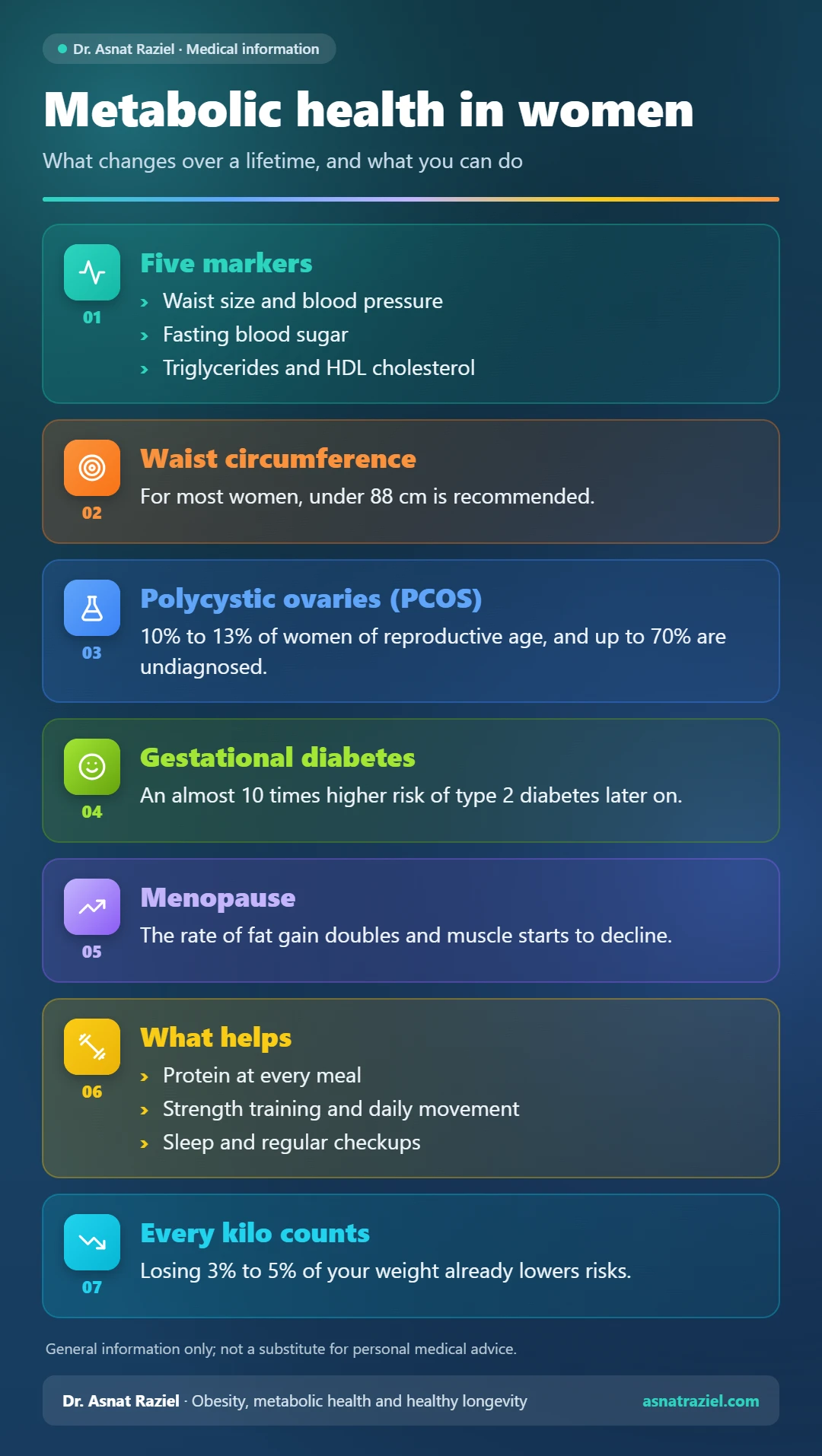
How metabolic health in women shifts through life
Over a lifetime, a woman’s body goes through several major hormonal milestones. At each of them, metabolism changes too, so it helps to know them in advance.
Polycystic ovary syndrome (PCOS)
According to the World Health Organization, 10% to 13% of women of reproductive age have polycystic ovary syndrome (PCOS). Moreover, up to 70% of them are undiagnosed. The syndrome increases insulin resistance, weight gain around the belly and the risk of type 2 diabetes. You can read more in my complete guide to PCOS.
Pregnancy and gestational diabetes
Gestational diabetes usually goes away after birth, but it leaves a mark. A meta-analysis published in the BMJ included more than a million women. The researchers found that women who had gestational diabetes had an almost 10 times higher risk of developing type 2 diabetes. In other words, gestational diabetes is a warning sign, and it is important to keep checking blood sugar for years after giving birth.
Menopause and metabolic health in women
The SWAN study followed women for years and measured their body composition. At the start of the menopause transition, the rate of fat gain doubled and muscle mass began to decline. This process continued until about two years after the last period. Interestingly, the rate of weight gain did not change, but body composition shifted for the worse. I wrote about this in detail in my article on obesity treatment during menopause.
What the numbers predict: risks to know
Heart disease is the leading cause of death for women in the United States, not only for men. In addition, obesity in women is linked to 13 types of cancer, including breast, uterine and ovarian cancer. Furthermore, obesity sharply raises women’s risk of high blood pressure. It is also important to know that heart attack symptoms in women are sometimes different from those in men, as I explained in my article on heart disease in women and obesity.
How to improve metabolic health in women
The good news is that even a small change makes a difference. Losing just 3% to 5% of your weight already lowers health risks. For example, for a woman who weighs 90 kg, that means about 3 to 4.5 kg.
- Nutrition with protein at every meal, vegetables, legumes and whole grains, and less processed food and sugar.
- Strength training two or three times a week to preserve muscle, especially around menopause.
- Walking and daily movement, even in short bouts throughout the day.
- Enough sleep and stress management, which directly affect appetite and blood sugar.
- Periodic blood tests: fasting blood sugar, blood lipids and liver function.
It also helps to pick one goal at a time. For example, start with a 20-minute daily walk, and only then change your dinner. Gradual change lasts much longer than a one-week makeover. Logistics matter too. Scheduling appointments and tests in advance helps you stick with it instead of putting it off again.
Medical treatment is not a sign of weakness
Obesity is a chronic disease, not a failure of willpower. When lifestyle changes are not enough, effective tools are available today. Drug treatment for obesity relies on drugs that regulate appetite and fullness. In suitable cases, bariatric surgery is also a proven option.
However, treatment for women needs to be tailored. For example, pregnancy should be planned in advance, and some medications must be stopped beforehand. In addition, weight loss sometimes changes the dynamics at home, as I described in my article on weight loss drugs and relationships.
At our clinic, we work as a multidisciplinary team that includes physicians, dietitians and other professionals. That way, we can build a plan that fits your stage of life, your medical background and your family plans. Ultimately, the goal is not just a number on the scale, but good health for years to come.
Bottom line
Metabolic health in women changes throughout life, from adolescence through pregnancy to menopause. Waist size, simple blood tests and moderate weight loss can change the picture. The real power is knowing your numbers and acting in time. If you have questions, you can read about me and the center and reach out for a consultation.
The information in this article is general and does not replace personal medical advice.
Frequently asked questions
What is a healthy waist size for a woman?
For most women, a waist circumference under 88 cm is recommended. Measure it at the level of the navel, at the end of a normal breath out.
Does metabolic health in women depend only on weight?
No. Even a woman of normal weight can have belly fat, high blood sugar or a fatty liver. That is why we check markers, not just weight.
I had gestational diabetes. What now?
Your risk of type 2 diabetes is almost 10 times higher. Periodic blood sugar tests and an active lifestyle are recommended.
When should I see a doctor?
When your waist size is going up, when blood tests are outside the normal range, or when you have irregular periods along with weight gain.
Sources
Weight and obesity – Office on Women’s Health
Changes in body composition and weight during the menopause transition