By Dr. Asnat Raziel, bariatric surgeon specializing in obesity treatment, metabolic health and healthy longevity; Director of the Multidisciplinary Center for Obesity Treatment, Assia Medical, Assuta Ramat HaChayal, Tel Aviv
VR for weight loss: from video game to treatment tool
Can VR for weight loss really work? Many people are surprised to see virtual reality and obesity in the same sentence. When we think of VR headsets, games and virtual trips usually come to mind. In recent years, however, the same technology has moved into hospitals, rehabilitation centers, pain clinics and research on obesity and healthy aging. In this article, I focus on one question: what the studies show about VR in obesity treatment, and what they have not shown yet.
One of the leading centers in the field is Cedars-Sinai in Los Angeles. There, Prof. Brennan Spiegel has studied the medical uses of VR for years. Mount Sinai’s Abilities Research Center in New York also builds advanced technologies into rehabilitation. Still, it is important to be precise: the headset is not the treatment. Rather, it is the platform that places the patient in a controlled therapeutic environment. For the wider picture, from pain to anxiety to rehab, see my overview of how VR is used across medicine.
What happens when you put on a VR headset?
The headset blocks out the outside world and displays a three-dimensional environment. That environment changes as you move your head and body. More advanced systems also track your hands and your gaze. The result is called presence: the feeling that “I am really there.”
This is exactly what makes VR so interesting for medicine. Instead of explaining to patients how to react, we can let them practice. For example, a person can stand in a virtual supermarket, restaurant or party, facing food that triggers cravings. In this way, they rehearse their response in a safe setting. In addition, VR allows embodiment, a state in which a person experiences a virtual body as if it were their own.
What VR has already taught us about pain
Pain is one of the areas with a substantial research base. In 2021, the US Food and Drug Administration (FDA) authorized a prescription VR system for chronic low back pain. The system, then called EaseVRx and now RelieVRx, combines principles of cognitive behavioral therapy, relaxation and breathing.
A large study included 1,093 patients. A home program of 56 sessions reduced pain intensity and its impact on daily function, compared with sham VR. Moreover, the benefit held up 12 months after treatment.
However, the science keeps evolving. In a 2026 randomized trial led by Spiegel, 385 people with chronic back pain took part. On most outcomes, the researchers found no significant advantage for skills-based VR or distraction VR over sham VR. This is an important lesson: VR is not magic. The content, the control group and the population matter just as much as the headset.
When virtual reality meets artificial intelligence
At Cedars-Sinai, researchers developed a system called XAIA, short for eXtended-reality Artificial Intelligence Assistant. The user enters a virtual environment and talks with an AI-based character. A feasibility study in npj Digital Medicine tested the approach in people with mild to moderate anxiety and depression. Participants found it acceptable and safe, although some preferred a human therapist. Therefore, it should not be seen as a replacement for a psychologist.
VR for weight loss: what does the research say?
Obesity is not just a matter of calories. It is shaped by hunger and satiety, the brain’s reward system, habits, stress, sleep and body image. VR headsets make it possible to bring part of that environment into treatment.
A 2026 systematic review included 23 studies, 11 of them in obesity. In obesity, VR combined with cognitive behavioral therapy was linked to better maintenance of weight loss. In addition, VR-based exercise training was associated with a short-term drop in BMI. That said, the studies were small and differed widely from one another.
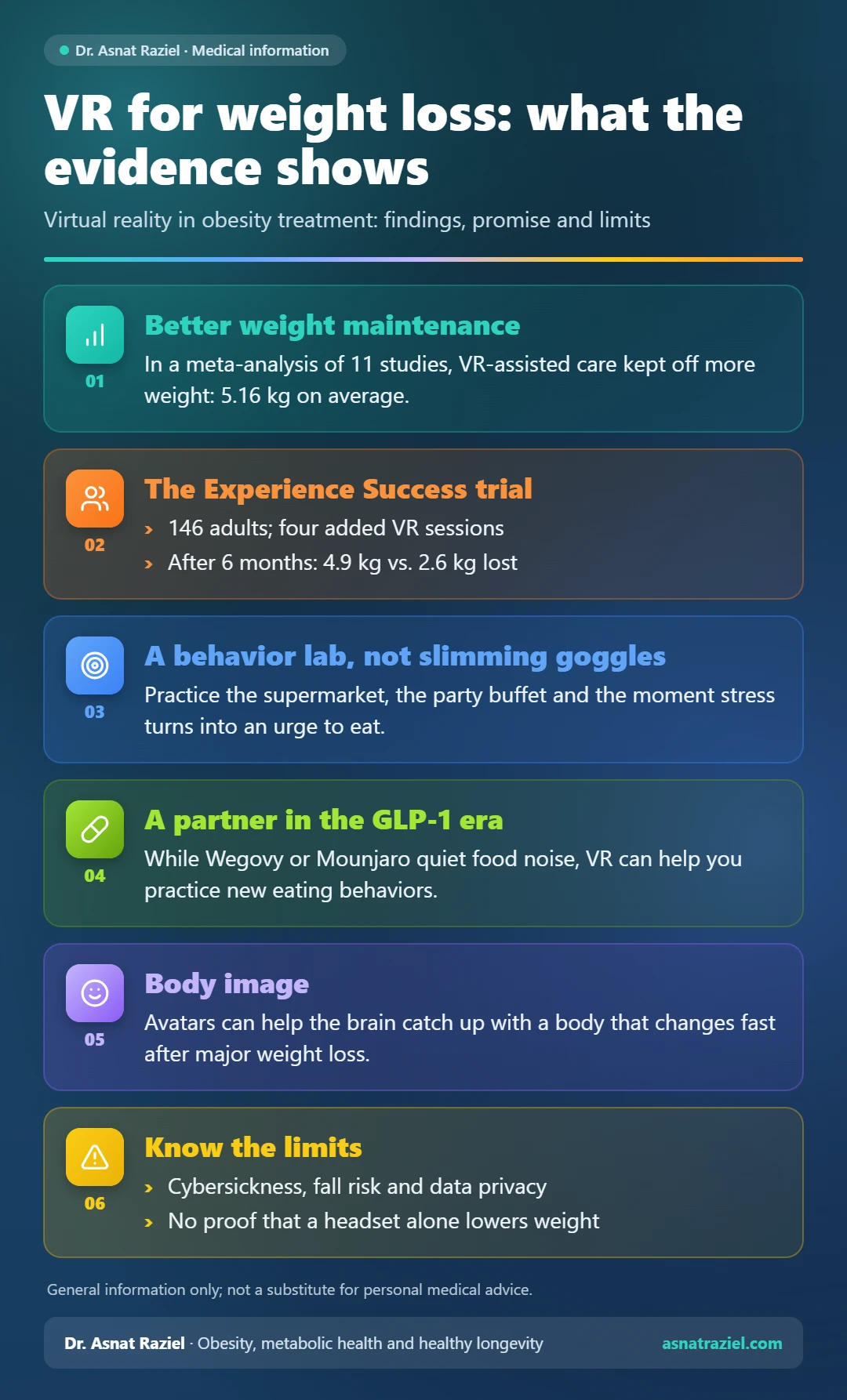
Meanwhile, a meta-analysis of 11 studies found that during the intervention, VR-assisted treatment was just as effective as standard treatment. Interestingly, in the maintenance phase, people who received VR-assisted treatment kept their weight off better, by an average of 5.16 kg. But the researchers urge caution: the number of studies is small, and some raised quality concerns. In other words, there is no basis yet to say that VR headsets on their own lead to weight loss.
Not “slimming goggles,” but a behavior lab
The real potential lies in VR as a simulator for real-world behavior. One patient practices grocery shopping in a virtual supermarket. Another stands in front of a buffet at a party. A person who struggles with emotional eating learns to spot the moment when stress or fatigue turns into an urge to eat. For more on stress and eating, read my article on meditation and weight.
The Experience Success trial enrolled 146 adults with overweight or obesity. The group that also received four VR sessions practiced skills at home, at work, during physical activity and at a party. After six months, this group had lost 4.9 kg, compared with 2.6 kg in the standard program.
VR for weight loss in the GLP-1 era
Medications such as Wegovy (semaglutide) and Mounjaro (tirzepatide) reduce hunger and food noise, the constant, intrusive thoughts about food. However, they do not teach you how to cope when the cravings come back. That is why the period when urges are weaker can be used to practice new behaviors. To understand the signals behind hunger, see my article on the hormones and brain circuits of satiety.
In theory, VR can gradually expose a person to trigger foods and situations, and let them practice pausing and choosing. In a small 2026 study of 30 people, VR exposure therapy improved food craving and body image. Still, this was a small, non-randomized study, and the evidence is preliminary.
Body image: the unique advantage of VR
Virtual reality allows something that is hard to do in standard therapy: changing, in a controlled way, the body a person sees as their own. It is possible to create an avatar of the person, adjust its proportions and explore how they perceive themselves. Such a tool can be especially valuable after major weight loss, when the body changes much faster than the brain’s image of it.
VR for weight loss: proven, promising or unproven?
Putting the findings side by side helps separate hope from evidence. Here is how I would sort them today:
- Supported by research: VR added to cognitive behavioral therapy was linked to better maintenance of weight loss.
- Promising but early: VR exposure for food craving and body image, and VR-based exercise, which was linked only to a short-term drop in BMI.
- Not proven: that a headset on its own lowers weight, or that VR extends life.
So if someone offers you “slimming goggles,” ask which treatment program the VR is part of. Keeping weight off is a stage of care in its own right, as I explain in my article on metabolic rehabilitation.
Beyond weight: VR and longevity
Longevity medicine focuses on healthspan, the years in which we stay active, independent and mentally sharp. Here, VR may help on several levels. First, balance: falls are a major threat to independence in older age, and researchers are testing VR training as a way to improve stability.
Second, cognitive training. A meta-analysis of 30 trials in people with mild cognitive impairment found improvements in global cognition and attention. However, the researchers saw no improvement in memory or executive function. Third, physical activity: VR can turn a workout into a dance, a boxing match or a journey. Even so, long-term studies on adherence are still missing.
Looking ahead, we can imagine a “longevity clinic inside a headset.” Such a system would combine strength and balance training, breathing, cognitive training and food simulations. It would connect to smartwatch data, such as heart rate, sleep and steps, and AI would adjust the level of difficulty. You might even meet an avatar of your “future self”: strong, active, playing with the grandchildren and getting up off the floor without help.
The downsides: cybersickness and privacy
VR has its limits. The most common one is cybersickness: nausea, dizziness, headache or unsteadiness. In older adults, we also need to consider the risk of falls, vision problems and neck limitations. Therefore, it is wise to start gradually, sometimes while seated, after a risk assessment.
In addition, new-generation headsets collect data on movement, gaze and voice. Once they are connected to AI and to medical information, that data becomes especially sensitive. For this reason, medical use requires data security, informed consent and full transparency.
The bottom line on VR for weight loss
As of today, there is no proof that VR headsets extend life. But if they help people exercise, keep their balance, cope with pain or change their eating habits, they will become one more tool in the toolbox. When it comes to VR for weight loss, the value comes from combining the technology with medicine, psychology, nutrition and measurement. Instead of only talking about food choices, we can practice them. And instead of talking about the person we want to be at 80, perhaps we can actually meet them.
The information in this article is general and does not replace personal medical advice.
References
Evaluating the use of virtual reality for weight management: A systematic review and meta-analysis




