By Dr. Asnat Raziel, bariatric surgeon specializing in obesity treatment, metabolic health and healthy longevity; Director of the Multidisciplinary Center for Obesity Treatment, Assia Medical, Assuta Ramat HaChayal, Tel Aviv
Mounjaro for sleep apnea: breathing at night is changing
Using Mounjaro for sleep apnea has become a real option in recent years. Obesity is one of the main causes of obstructive sleep apnea. In this condition, breathing stops or becomes shallow again and again during the night. So researchers set out to test whether tirzepatide, the active ingredient in Mounjaro, could improve the condition. The answer came from the SURMOUNT-OSA trial program, and it is impressive.
What is obstructive sleep apnea?
In obstructive sleep apnea, the upper airway narrows or collapses during sleep. As a result, breathing stops for tens of seconds, sometimes many times an hour. The condition is especially common in people with obesity. Fat around the neck and at the base of the tongue narrows the airway.
The main symptoms are loud snoring, daytime fatigue and trouble concentrating. In addition, bed partners sometimes notice pauses in breathing. Doctors diagnose it with a sleep study, called polysomnography, in a sleep lab or at home. For a broader explanation of the risks, see my article on obesity and sleep apnea.
What does the AHI measure?
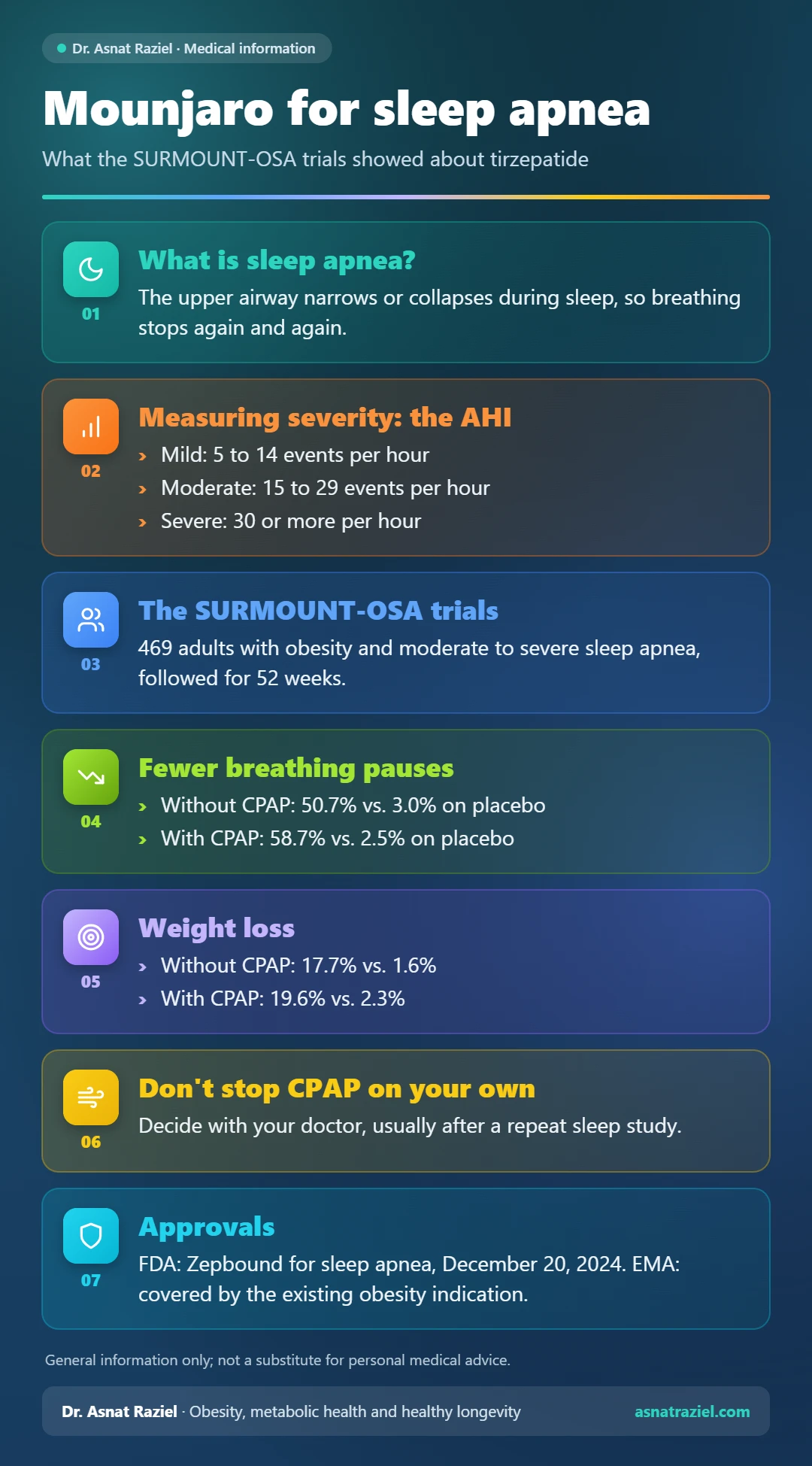
The AHI (Apnea-Hypopnea Index) counts how many breathing pauses and shallow breaths occur per hour of sleep. Severity is graded as follows:
- 5 to 14 events per hour: mild sleep apnea.
- 15 to 29 events per hour: moderate sleep apnea.
- 30 or more events per hour: severe sleep apnea.
CPAP remains a key treatment
A CPAP (continuous positive airway pressure) machine pushes air through a mask and keeps the airway open. It is the standard treatment, and it is very effective. However, it works only when you use it regularly. According to a review published in JAMA Otolaryngology, only 30% to 60% of patients stick with it. So the need for an additional treatment is clear.
Mounjaro for sleep apnea: what did SURMOUNT-OSA test?
The results were published in NEJM in June 2024. The program included 469 adults with obesity and moderate to severe sleep apnea. Follow-up lasted 52 weeks. The first trial enrolled people who were not using CPAP. The second enrolled patients who were already using the machine and continued to do so.
Participants received tirzepatide at the highest dose they could tolerate, 10 or 15 mg a week, or a placebo. At the start, the average AHI was 51.5 events per hour in the first trial and 49.5 in the second. In other words, most participants had severe sleep apnea.
A sharp drop in breathing pauses
In the first trial, the AHI fell by 25.3 events per hour with tirzepatide, compared with 5.3 on placebo. According to Lilly, in percentage terms that is a 50.7% reduction, compared with just 3.0%. In the second trial, the drop was even larger: 29.3 events per hour, compared with 5.5 on placebo. That is a 58.7% reduction versus 2.5%.
What’s more, a large share of patients reached remission. According to the JAMA review, 42% to 50% of patients on tirzepatide reached remission. This means fewer than five events per hour, or fewer than 15 without symptoms.
Weight loss plays a central role
In the first trial, participants on tirzepatide lost 17.7% of their body weight, compared with 1.6% on placebo. In the second trial, they lost 19.6%, compared with 2.3%. The FDA noted that the improvement in breathing is probably linked to the weight loss. When there is less fat around the airway, there is less pressure on it at night.
More than fewer breathing pauses
The trial also found improvements in other measures. The researchers saw a drop in “hypoxic burden,” meaning how long blood oxygen levels fall during sleep. In addition, hsCRP, a marker of inflammation in the blood, went down, and so did systolic blood pressure. Patients also felt better: they were less sleepy and slept better.
These findings matter, because sleep apnea and obesity together raise the risk of heart disease. However, the trial did not test whether treatment reduces heart attacks or strokes. You can read about the link between obesity and the heart in my article on heart risk in obesity, and about blood pressure in my article on weight loss and high blood pressure.
Can you stop CPAP after losing weight?
The short answer: not automatically. The trial was not designed to test stopping CPAP. So do not stop using the machine on your own. You make the decision together with your doctor, usually after a repeat sleep study. Later on, if your AHI has dropped a lot, your doctor can adjust your treatment.
Approvals in the United States and Europe
On December 20, 2024, the FDA approved Zepbound for moderate to severe obstructive sleep apnea in adults with obesity. It was the first drug approved for this condition. Zepbound and Mounjaro contain exactly the same active ingredient.
In Europe, the situation is different. In December 2024, the European Medicines Agency concluded that a separate indication was not needed. According to the agency, the existing indication for obesity treatment already covers these patients. Even so, the trial data were added to the drug’s prescribing information. For general information about the drug, see my complete guide to Mounjaro.
Mounjaro for sleep apnea: who is it right for?
In people with obesity and sleep apnea, it makes sense to treat both problems together. Medication for sleep apnea does not replace CPAP for everyone. But it can complement it, and sometimes reduce the severity of the disease significantly. By contrast, in people without obesity, or with a purely anatomical blockage, the benefit is likely to be small.
As with any treatment, there are side effects. The most common are nausea, diarrhea, vomiting and constipation, and most are mild to moderate. I explain how to manage them in my article on Mounjaro side effects. In addition, good sleep also affects appetite, as I described in my article on sleep deprivation and obesity.
The bottom line on Mounjaro for sleep apnea
The SURMOUNT-OSA trials showed that tirzepatide cuts breathing pauses by about half or more. At the same time, it lowers weight, blood pressure and markers of inflammation. Ultimately, Mounjaro for sleep apnea opens a new chapter for patients with obesity. The decision about treatment, and about continuing CPAP, should be made with a doctor and guided by sleep studies.
This article is general information and is not a substitute for personal medical advice.
References
Tirzepatide for the Treatment of Obstructive Sleep Apnea and Obesity
FDA Approves First Medication for Obstructive Sleep Apnea
Glucagon-Like Peptide-1 Receptor Agonists for Obstructive Sleep Apnea: A Review




