By Dr. Asnat Raziel, bariatric surgeon specializing in obesity treatment, metabolic health and healthy longevity; Director of the Multidisciplinary Center for Obesity Treatment, Assia Medical, Assuta Ramat HaChayal, Tel Aviv
Post-bariatric hypoglycemia: why this matters now
Post-bariatric hypoglycemia is a problem few people talk about. Yet it disrupts the lives of many patients. These are repeated, sometimes severe drops in blood sugar after gastric bypass or sleeve surgery. Now, at ObesityWeek, the American obesity congress in Washington, researchers will present phase 3 results for an investigational drug called avexitide. In the trial, it cut significant low blood sugar events by 55% compared with placebo.
One point up front: avexitide is an investigational drug. It is not approved for use in the US or in Israel.
What is a blood sugar crash after surgery?
After gastric bypass, food reaches the intestine very quickly. In response, the gut most likely releases a large amount of the hormone GLP-1. This hormone boosts insulin release from the pancreas. In some patients, the response goes too far. Insulin spikes, and then blood sugar plunges.
According to Amylyx, the company developing the drug, the condition affects about 8% of people in the US who have had a sleeve gastrectomy or gastric bypass. That is roughly 160,000 people in the US alone. In addition, there is currently no approved drug treatment for it.
Level 2 and Level 3 events can be emergencies. They can cause confusion, impaired functioning, loss of consciousness and seizures. Sometimes the patient needs another person’s help to recover.
Treating post-bariatric hypoglycemia: how avexitide works
Most well-known weight loss drugs, such as Wegovy and Mounjaro, activate the GLP-1 receptor. Avexitide does the opposite. It is a first-in-class GLP-1 receptor antagonist. The drug binds to GLP-1 receptors on beta cells in the pancreas. In this way, it curbs the exaggerated insulin response that causes the crash. If you want the background on the drugs that switch this receptor on, see how obesity medication works.
The US Food and Drug Administration (FDA) has granted it Breakthrough Therapy designation for post-bariatric hypoglycemia. It has also received Orphan Drug designation.
The LUCIDITY trial: what researchers tested
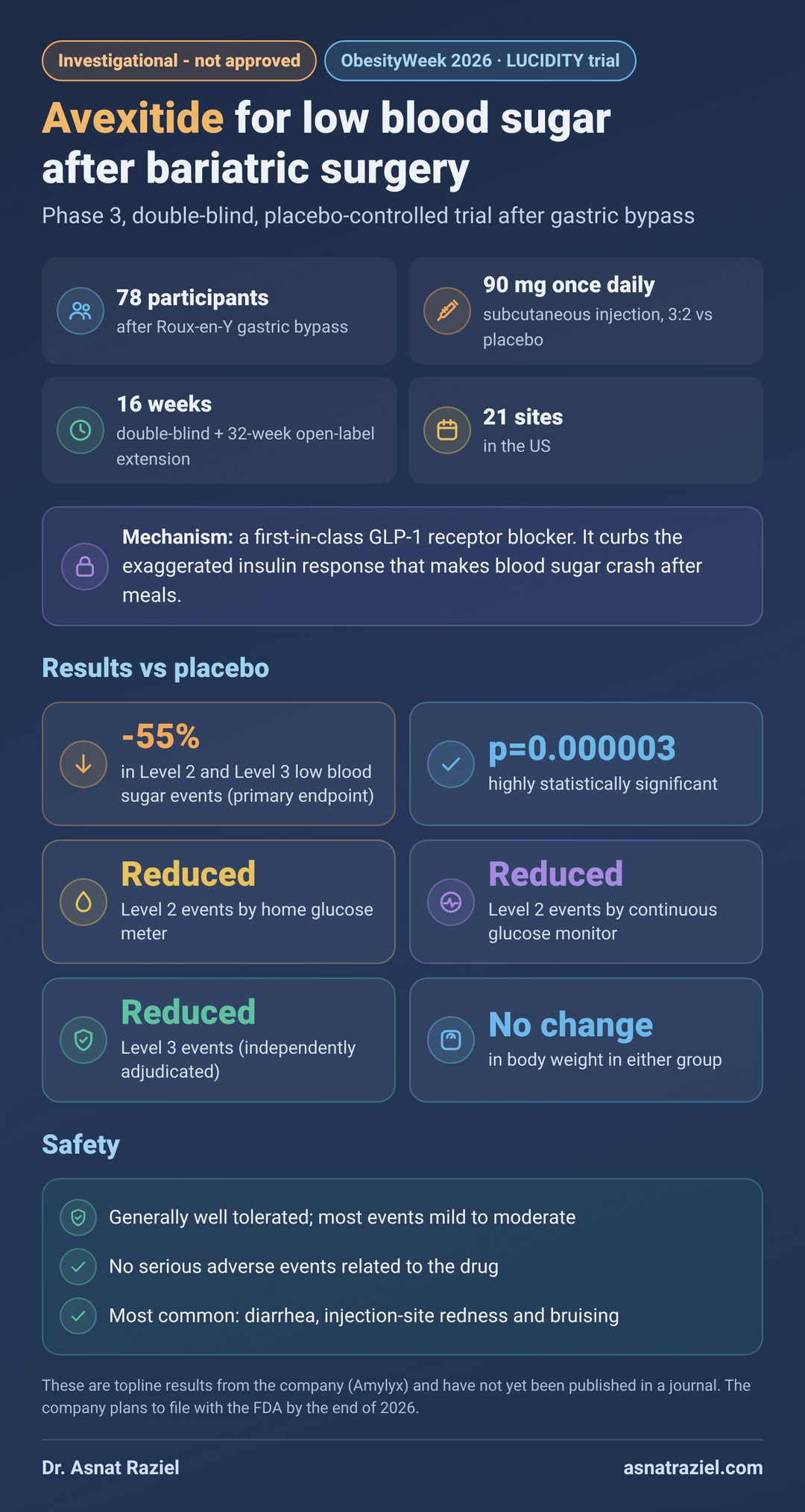
The LUCIDITY trial is a phase 3, double-blind, placebo-controlled study. It enrolled 78 adults who had Roux-en-Y gastric bypass and were experiencing blood sugar crashes. The trial ran at 21 sites in the US.
Researchers randomized participants 3:2. One group received a 90 mg subcutaneous injection of avexitide once daily. The other group received placebo. A three-week run-in period came first. Then came 16 weeks of double-blind treatment. A 32-week open-label extension is now ongoing.
The main goal was a reduction in the combined number of Level 2 and Level 3 low blood sugar events through week 16.
Post-bariatric hypoglycemia: what the trial found
According to the company’s topline announcement, avexitide reduced the rate of Level 2 and Level 3 low blood sugar events by 55% compared with placebo. The result is highly statistically significant (p=0.000003). Put simply, for every 100 events in the placebo group, there were about 45 in the drug group.
Moreover, the trial met all of its secondary endpoints. Researchers saw fewer Level 2 events measured with a home glucose meter. They also saw fewer events measured with a continuous glucose monitor (CGM), a device that tracks blood sugar around the clock. Finally, Level 3 events, reviewed by an independent committee, also dropped. The announcement does not give separate percentages for these endpoints.
Safety and side effects
According to the company, the drug was generally well tolerated. Most side effects were mild to moderate. In addition, there were no serious adverse events related to avexitide. The most common side effects were diarrhea, redness at the injection site and bruising at the injection site.
Another important finding: body weight did not change in either group. That is reassuring for anyone who has had surgery and worries that blocking GLP-1 might cause weight gain. However, follow-up lasted only 16 weeks. For more on side effects of the drugs that activate this receptor, see our guide to GLP-1 side effects.
What researchers will present at ObesityWeek
Dr. Marilyn Tan, the trial’s principal investigator, will present the data in a late-breaking oral session. The talk takes place on Sunday, November 15, 2026, in a session on findings from clinical trials. In addition, on November 16 the company will present a study that tries to identify patients with the condition in US insurance claims data.
Post-bariatric hypoglycemia: what it means for you
The results are encouraging, but the drug is not yet available. The company plans to submit an application to the FDA by the end of 2026. If approved, it could reach the US market in 2027. So for now, care relies on dietary changes and close follow-up.
First, if you have had bariatric surgery and you get sweating, shakiness, a racing heart, weakness or confusion about one to three hours after a meal, tell your care team. On the other hand, do not start any treatment on your own. A proper workup includes blood sugar measurements and sometimes a continuous glucose monitor. In addition, a bariatric dietitian can build a meal plan that reduces blood sugar swings. Follow-up after surgery also matters for your overall health, as we discuss in weight regain after bariatric surgery and alternatives to bariatric surgery.
The bottom line
Post-bariatric hypoglycemia is a real problem, and until now there has been no dedicated drug for it. In the LUCIDITY trial, avexitide cut significant low blood sugar events by 55%, with no change in weight. Ultimately, we will need to see the full data at the congress, the extension results and the FDA’s decision. Until then, anyone who has blood sugar crashes after surgery should contact their care team and not wait.
This article is general information and is not a substitute for personal medical advice.
References
Avexitide for Treatment of Post-Bariatric Hypoglycemia (LUCIDITY)
Amylyx Pharmaceuticals to Host Investor Event at ObesityWeek 2026 Featuring Leading PBH Experts
Amylyx, the drug’s maker, funds the trial. The results have not yet been published in a peer-reviewed journal.




