By Dr. Asnat Raziel, bariatric surgeon specializing in obesity treatment, metabolic health and healthy longevity; Director of the Multidisciplinary Center for Obesity Treatment, Assia Medical, Assuta Ramat HaChayal, Tel Aviv
EFT tapping: when the brain stops listening to logic
EFT tapping looks a little strange at first. You tap with your fingertips on points on your face and body while saying out loud what is bothering you. Even so, millions of people around the world use it to calm down in stressful moments. At the recent Nervous System Reboot summit, Nick Ortner explained how it works, and why he believes many of us are missing it.
Ortner discovered the method at a young age, at one of Tony Robbins’ events. At the time, he says, he had plenty of motivation, but also constant inner tension. He always felt he wasn’t doing enough, wasn’t fast enough and wasn’t good enough. Tapping, he said, gave him what was missing: the ability to settle into his body and return to clarity.
What is EFT tapping?
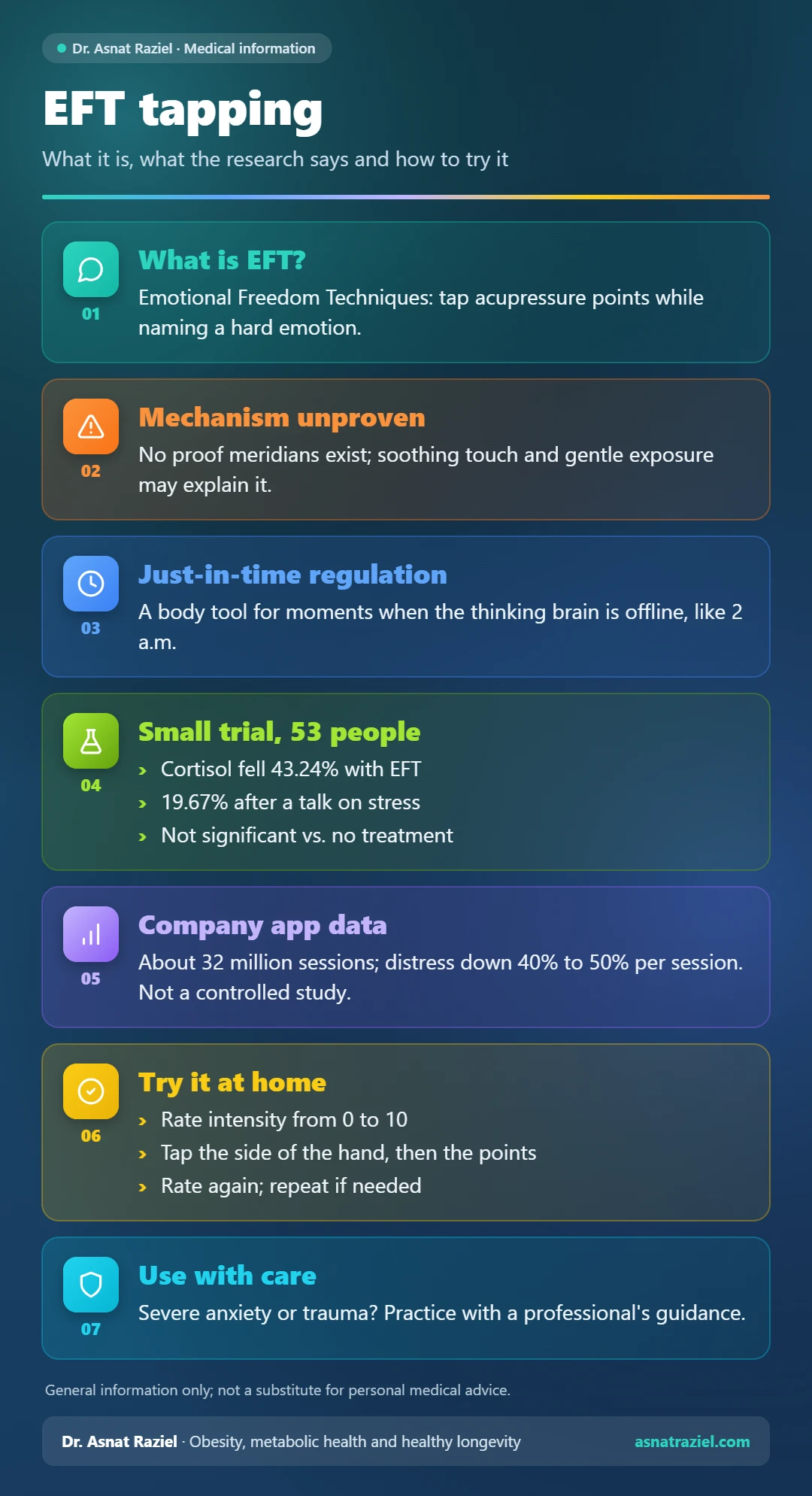
EFT stands for Emotional Freedom Techniques. The method combines modern psychology with acupressure points from Chinese medicine. The person gently taps on the endpoints of meridians (energy channels in Chinese medicine) while focusing on a difficult emotion.
It is important to know that the mechanism is still controversial. In Western science, there is no proof that meridians exist. So some researchers explain the effect through soothing touch, attention to the body and gentle exposure to the emotion. Ortner himself admits he doesn’t know exactly why tapping calms rather than startles. In his view, the likely explanation is that tapping sends a calming signal to the amygdala, the brain’s alarm center.
Start with the difficult emotion
Unlike positive thinking, tapping does not deny what we feel. Ortner cites Tony Robbins: you can’t look at a garden, declare that there are no weeds and expect them to disappear. You have to pull them out. That is why the practice opens with a statement such as Even though I’m stressed and overwhelmed, I choose to calm down. First we acknowledge the emotion, and only then do we release it.
Why EFT tapping works at 2 a.m.
Ortner talks about what he calls just-in-time regulation, meaning regulation at exactly the moment you need it. Imagine a panic attack at 2 a.m. At that point, cognitive behavioral therapy is excellent for building resilience, but the thinking brain is simply not available. A simple physical tool, by contrast, is available. You start tapping, breathe gently, and the body gradually calms down.
In addition, he says, most of our stress is not a roaring alarm. It is background hum, like the annoying noise of a refrigerator. It comes from social media, from work and from old patterns. This hum affects our sleep, our relationships and our work. For example, Ortner shared that a smart ring showed him early awakenings during a busy period. A few minutes of tapping before bed, he said, brought back quieter nights.
Watch the full talk: Nick Ortner on EFT tapping
The talk is in English, from the Nervous System Reboot 2026 summit of the Heart Mind Institute. At the end, Ortner demonstrates a full practice.
What does the research say?
There are already controlled studies of the method, although most are small. For example, a randomized controlled trial from Australia included 53 participants. They received a 60-minute group session of tapping, a talk about stress, or no treatment. In the tapping group, salivary cortisol fell by 43.24%, compared with 19.67% in the talk group. However, the difference compared with the no-treatment group did not reach statistical significance. Moreover, the distress participants reported did not change in the same way.
In addition, a broad systematic review gathered studies of the method across a range of mental and physical conditions. Overall, the picture is encouraging, but larger, high-quality studies are still needed.
Ortner also presented data from his company’s app. According to him, users have completed about 32 million sessions in it. Based on company data, self-rated distress drops by about 40% to 50% per session. He also said an eight-day challenge around the belief “I’m not enough” reduced it by 29%. These are data from a commercial company, not a controlled study. So they should be treated with caution.
From anger to sadness, and from sadness to understanding
One of the beautiful insights in the talk concerns emotions. According to Ortner, when you tap on anger, it often turns into sadness. Then the sadness softens into understanding, perspective and sometimes even forgiveness. The summit host, Fleet Maull, added that beneath anger there is usually a longing for connection.
What’s more, Ortner compares emotional work to physical training. Nobody runs a marathon on their first day. Likewise, nobody processes trauma in three days. In his view, tapping is like a daily walk: a little every day, gently and consistently.
A short exercise: EFT tapping for uncertainty
At the end of the talk, Ortner demonstrated a practice for the feeling of uncertainty in the world. Here is how to try it at home:
Step one: Close your eyes and ask yourself where in life you feel a lack of control. Rate the intensity from 0 to 10, and notice where it sits in your body.
Step two: Tap with two fingers on the side of your hand. Say a statement like this three times: Even though there is so much uncertainty, I choose to find calm inside.
Step three: Move through the points: the start of the eyebrow, the side of the eye, under the eye, under the nose, under the mouth, under the collarbone, under the arm and the top of the head. At each point, describe what you are feeling.
Step four: In the second round, switch to empowering statements: I focus on what is in my control; I have a choice about how I feel and how I show up in life.
Finally, take a deep breath and rate your intensity again. If the number hasn’t dropped, you can repeat the round.
Stress, sleep and weight: the bigger picture
In my clinic, I see every day how much chronic stress affects the body. It disrupts sleep, increases emotional eating and makes weight loss harder. That is why I recommend that every patient keep several ways to calm down in their toolbox. You can read more in my guide to practical stress relief techniques and in my article on the link between stress and weight. Also, if you struggle to fall asleep, you will find more tools in my guide to improving sleep naturally.
The bottom line
EFT tapping is a simple, cheap and accessible tool that is especially suited to moments when logical thinking doesn’t work. The research on it is still developing, and its mechanism is controversial. Still, it is a gentle practice that anyone can try. If you suffer from severe anxiety or trauma, you should do it with the guidance of a professional.
The information in this article is general only and does not replace personal medical or mental health advice.




