By Dr. Asnat Raziel, bariatric surgeon specializing in obesity treatment, metabolic health and healthy longevity; Director of the Multidisciplinary Center for Obesity Treatment, Assia Medical, Assuta Ramat HaChayal, Tel Aviv
Consequences of childhood obesity: why it is not a passing phase
The consequences of childhood obesity follow a child long after they grow up. Obesity at a young age is not a phase, and it is not a cosmetic issue. It is a chronic disease with metabolic, emotional and physical effects. That is why it matters to recognize it early and to treat it gently and professionally.
A worrying global trend
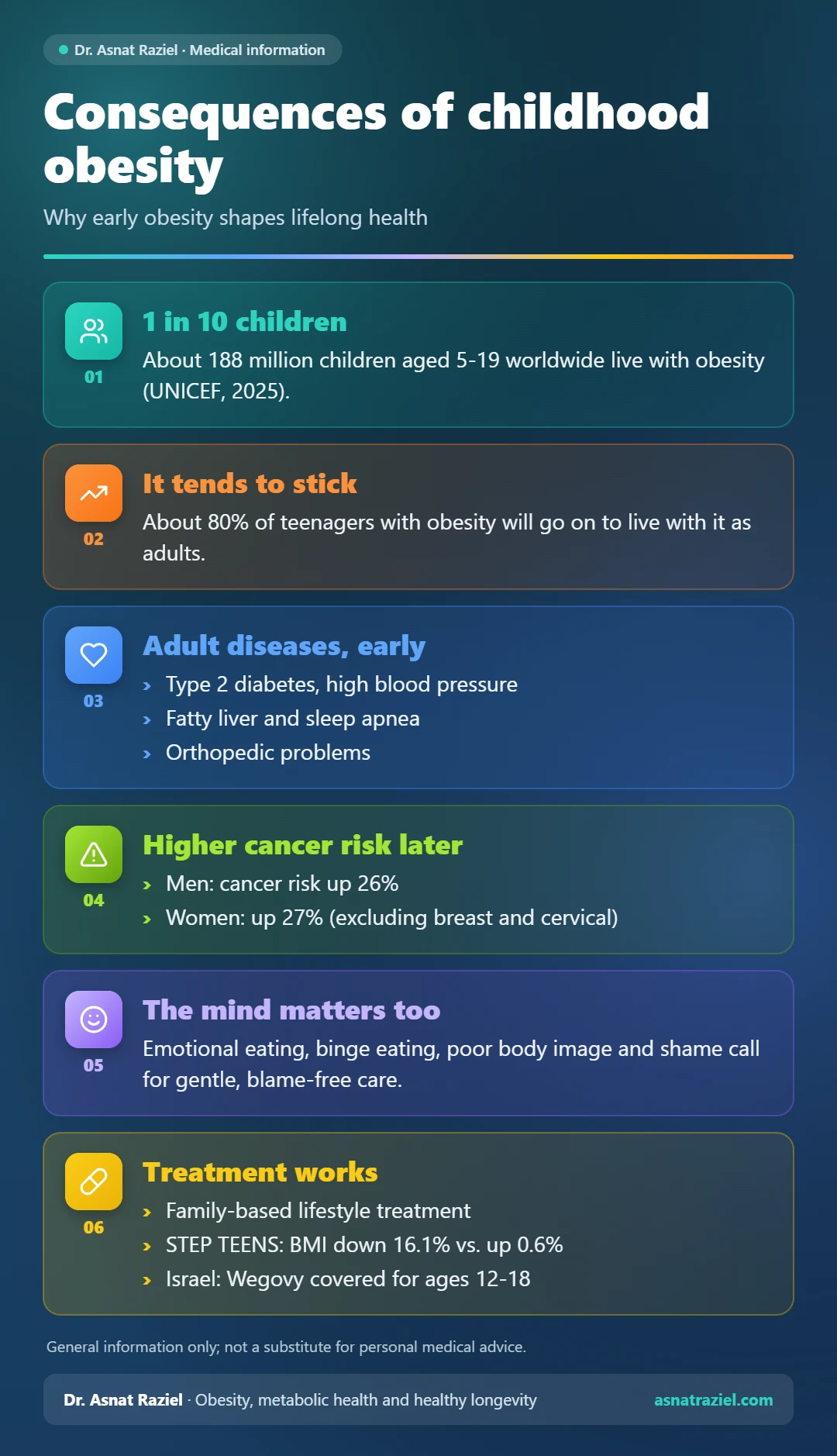
Over the past two decades, obesity rates among children and teenagers have risen sharply. According to a UNICEF report from September 2025, obesity has overtaken underweight among 5- to 19-year-olds for the first time. Today, one child in ten lives with obesity, about 188 million children worldwide. In addition, one in five has overweight or obesity. In 2000, the obesity rate in this age group stood at just 3%; today it is 9.4%.
The picture in Israel is worrying, too. According to Israeli Ministry of Health data, 17% of first graders have overweight or obesity. By seventh grade, the rate reaches 30%, and 7.8% of students have severe obesity. In other words, the problem gets worse as children get older.
Obesity at a young age tends to stick
One of the central problems is that obesity tends to persist. A review of 15 cohort studies with about 200,000 participants looked at the transition from childhood to adulthood. The researchers found that about 80% of teenagers with obesity will go on to live with it as adults. Moreover, children and teenagers with obesity were about five times more likely to have obesity in adulthood. I review newer data in my article on childhood obesity research.
In practice, this means a long exposure to metabolic, inflammatory and hormonal stress that begins early in life. What’s more, that burden starts even before the body has finished developing. So every year of timely intervention is worth a great deal. This burden may also reach the brain, as I explain in my article on obesity and brain health. I look at the youngest age group in my article on obesity in preschool children.
Consequences of childhood obesity for the body
However, complications do not wait for adulthood. Even at a young age, we now see diseases that once affected only adults. Type 2 diabetes now appears in teenagers as well. Alongside it come high blood pressure, abnormal blood lipids, fatty liver and sleep apnea. In addition, orthopedic problems limit movement, daily function and quality of life. I have also written about the link between weight, blood sugar and lifelong health in my article on treating childhood obesity in Israel.
The link to cancer later in life
The link between obesity at a young age and cancer is becoming clearer. A large Israeli study followed about 2.3 million teenagers who were examined at age 17 before military service. Among men who had obesity as teenagers, cancer risk rose by 26%. Among women, after excluding breast and cervical cancer, the risk rose by 27%. The explanation probably lies in a combination of chronic inflammation, hormonal changes and insulin resistance over many years.
Obesity and eating disorders: a link that calls for sensitivity
A common myth says that obesity and eating disorders are opposites. In reality, the link between them is complex and sometimes overlapping. Children and teenagers with obesity often struggle with emotional eating, binge eating, a damaged body image and shame. Moreover, social stigma intensifies all of these. Sometimes, unhelpful messages at home also make things worse.
Therefore, treatment must steer clear of judgmental or blaming language. It should give mental health the same weight as physical health. A team of doctors, a dietitian, a psychologist and, at times, family counseling is a condition for success.
The screen in their pocket: an environment that promotes obesity
Meanwhile, the digital world has created a new food environment. From an early age, children meet aggressive marketing of ultra-processed food on social media, in games and in apps. Food high in sugar, fat and salt appears there as part of fun, success and social life. By contrast, healthy food gets almost no comparable exposure.
UNICEF stresses that digital marketing gives the food industry direct access to a young audience. In other words, the problem is not just a personal choice by the child or the parents. As a result, tackling it requires nutrition education, regulation and system-wide thinking. I have written at length about the brain and policy side in my article on ultra-processed food.
How to reduce the consequences of childhood obesity
The good news is that timely treatment makes a big difference. Lifestyle change at a young age, in a supportive family setting, can change the course of the disease. The goal is not to “make the child lose weight.” Instead, the goal is to improve the child’s health, daily function and quality of life.
In 2023, the American Academy of Pediatrics published a comprehensive clinical practice guideline on treating obesity in children and teenagers. The guideline recommends intensive lifestyle and behavioral treatment that involves the family. In addition, it allows doctors to consider medication from age 12 in teenagers with obesity.
What parents can do starting today
Change starts at home, but without blame. First, eat regular family meals together. Second, cut back on sweetened drinks and keep only a few snacks in the house. In addition, enough sleep and shared physical activity help the whole family. Finally, do not talk about weight in front of your child; talk about strength, energy and health instead.
Medication for teenagers
In some cases, mainly in teenagers with severe obesity and complications, medication comes into the picture. In the STEP TEENS trial, teenagers received Wegovy (semaglutide) for 68 weeks. Their BMI, the ratio of weight to height, fell by 16.1% on average. By contrast, BMI rose by 0.6% in the placebo group. I discuss the trial in more detail in my article on treating obesity in teenagers.
Israel has seen an important change. The 2026 national health basket, the list of treatments Israel’s health funds (HMOs) must cover, includes the Wegovy injection for teenagers aged 12 to 18 only. Adults were not included in the decision. Either way, treatment must be multidisciplinary, gradual and tailored to each child, with close follow-up.
The bottom line on the consequences of childhood obesity
Obesity in childhood and adolescence is an early warning light for the health of all of us. It is a chronic disease that starts at a young age and deserves a serious, professional and sensitive response. The sooner we intervene, support the child and family well and act at the system level, the more we will limit the consequences of childhood obesity. Ultimately, we can change not only weight but the future health of the next generation.
The information in this article is general and does not replace personal medical advice.
References
Predicting adult obesity from childhood obesity: a systematic review and meta-analysis




