By Dr. Asnat Raziel, bariatric surgeon specializing in obesity treatment, metabolic health and healthy longevity; Director of the Multidisciplinary Center for Obesity Treatment, Assia Medical, Assuta Ramat HaChayal, Tel Aviv
Finding the right obesity treatment when there is no one-size-fits-all
How do you choose the right obesity treatment? The question “Which treatment is best?” comes up in almost every clinic visit. The accurate answer is that no single treatment is the best. There is a treatment that suits a particular person at a particular time. Modern obesity medicine is moving away from uniform solutions and toward personalized care. It relies on a deep understanding of biology and of the life of the person behind the weight.
Professional organizations think so too. In 2025, the European Association for the Study of Obesity (EASO) published a framework for the pharmacological treatment of obesity and its complications. The framework suggests matching the drug to each patient’s related conditions. For more on tailored care, see my article on the future of obesity medicine.
The first step toward the right obesity treatment: diagnosis
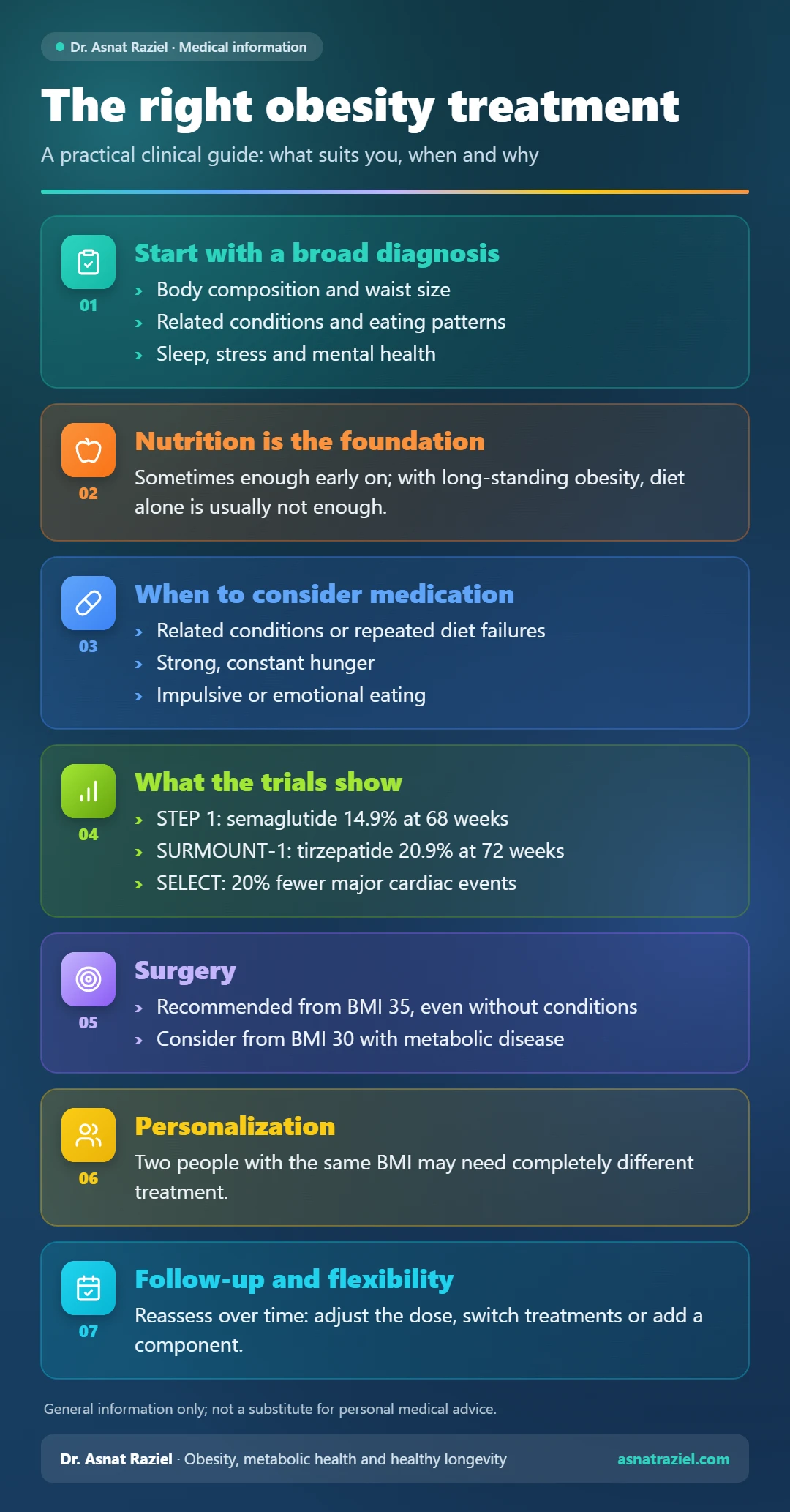
Choosing the right treatment starts with a broad assessment, not just a BMI measurement. In 2025, the Lancet Commission on clinical obesity stated that BMI alone is not enough for diagnosis. That is why it recommends also measuring waist circumference or body composition, and checking whether excess fat is already harming organ function. In a thorough assessment, I check:
- Body composition: fat versus muscle, and waist circumference.
- Related conditions: diabetes, high blood pressure, fatty liver disease, heart disease or sleep apnea.
- Eating patterns: physical hunger, emotional eating or impulsivity.
- Sleep, stress and mental health.
- Previous treatments, and how the patient responded to them.
Without this kind of assessment, therefore, any treatment may be random rather than precise.
Nutrition therapy: the foundation, but not always enough
Tailored nutrition is the cornerstone of every obesity treatment. However, there is no “one right meal plan.” Some people will succeed with dietary change alone, mainly in the early stages of the disease or without significant complications.
On the other hand, with long-standing obesity, insulin resistance or repeated failures, diet alone is usually not enough. The reason is not a lack of willpower, but biology. The body defends its higher weight through hunger and satiety hormones.
When should you consider medication?
Drug treatment for obesity is not a shortcut. It is a medical tool that rebalances the mechanisms of hunger, fullness and cravings. It is especially suitable when:
- Obesity comes with related conditions.
- Diets have failed again and again.
- Hunger is strong and constant.
- There is impulsive or emotional eating.
- A relatively fast metabolic improvement is needed.
The choice between drugs depends on the patient’s profile, possible side effects, other medications they take and their own preferences.
Choosing the right obesity treatment based on the data
The data help guide the decision. In the STEP 1 trial, semaglutide, the active ingredient in Wegovy, led to an average weight loss of 14.9% after 68 weeks. In the SURMOUNT-1 trial, tirzepatide, the active ingredient in Mounjaro, led to a 20.9% loss at the 15 mg dose after 72 weeks.
Moreover, the SURMOUNT-5 trial compared the two drugs head to head. After 72 weeks, Mounjaro led to a 20.2% loss, compared with 13.7% with Wegovy. Still, effectiveness is not the only consideration. The SELECT trial included 17,604 people with obesity and heart disease, without diabetes. In them, semaglutide reduced major cardiac events by 20%. So for a patient with heart disease, this evidence affects the choice.
What is available in Israel today
The toolbox has grown a great deal. In addition to injections, there are now pills as well. For example, Foundayo reached pharmacies in Israel in September 2026. The Wegovy pill was approved in the United States in December 2025 and since November 2026 it has been available in Israel through Form 29C, the Ministry of Health pathway for medications not yet registered in Israel. There are also older drugs such as Mysimba and Razin (phentermine). Israel’s Ministry of Health lifted the three-month limit on Razin, and today it can be prescribed long term under medical follow-up. I covered Foundayo in detail in my Foundayo treatment guide.
The right obesity treatment: what about surgery?
Bariatric surgery is an effective and safe tool for suitable patients, mainly in severe obesity or with significant complications. The updated indications from the bariatric surgery societies recommend surgery from a BMI of 35 and up, even without related conditions. They also recommend considering surgery from a BMI of 30 with metabolic disease.
That said, surgery is not a “magic solution” either. Its success depends on ongoing nutritional, behavioral and medical support. Sometimes a combination of surgery with drug or behavioral treatment is the best path. For a full comparison, see my article on bariatric surgery in the era of obesity drugs.
Personalization: the key to success
In fact, two patients with the same BMI may need completely different treatment. For example, one will need medication, another emotional support, and a third a combination of both. Age, sex, medical background, eating patterns and the ability to stick with treatment all affect the choice.
In other words, a treatment that is not personalized may fail, even when it is “right on paper.” When choosing the right obesity treatment, we first ask what bothers the patient and what puts them at risk. Only then do we choose a tool.
Follow-up and flexibility: part of the choice
Above all, choosing a treatment is not a one-time decision. It requires follow-up, reassessment and adjustments along the way. Sometimes we need to switch treatments, change the dose, add a component or take one away. This is a natural part of a sound process. Flexibility is not inconsistency; it is professionalism.
It is also important to keep the long term in mind. Obesity is a chronic disease, so its treatment is long term as well.
The patient as a partner, not someone who “has to comply”
Equally, the success of treatment depends on partnership. When patients understand the reasoning behind the choice, they become partners in the decisions. Moreover, when they feel that their pace and their lives are respected, the chances of persistence and real change rise sharply. That is why it is also important to choose a team that listens. You will find some tips in my article on how to choose an obesity doctor.
The practical bottom line: how to choose the right obesity treatment
The right treatment does not look for a quick fix, but for a sustainable process. It combines science, clinical care and humanity. When you choose the right obesity treatment with personalization, professional support and continuous follow-up, you can do more than lose weight. You can also improve your health, function and quality of life.
Ultimately, the “right” treatment is the one that fits you: your body, your brain and your life. Good medicine does not only ask what works, but for whom, when and how.
The information in this article is general and does not replace personal medical advice.
References
Definition and diagnostic criteria of clinical obesity
Once-Weekly Semaglutide in Adults with Overweight or Obesity
Tirzepatide Once Weekly for the Treatment of Obesity
Tirzepatide as Compared with Semaglutide for the Treatment of Obesity
Semaglutide and Cardiovascular Outcomes in Obesity without Diabetes
No more injections? New weight-loss pill to launch in Israel next week




