By Dr. Asnat Raziel, bariatric surgeon specializing in obesity treatment, metabolic health and healthy longevity; Director of the Multidisciplinary Center for Obesity Treatment, Assia Medical, Assuta Ramat HaChayal, Tel Aviv
GLP-1 drugs and the brain: what patients feel
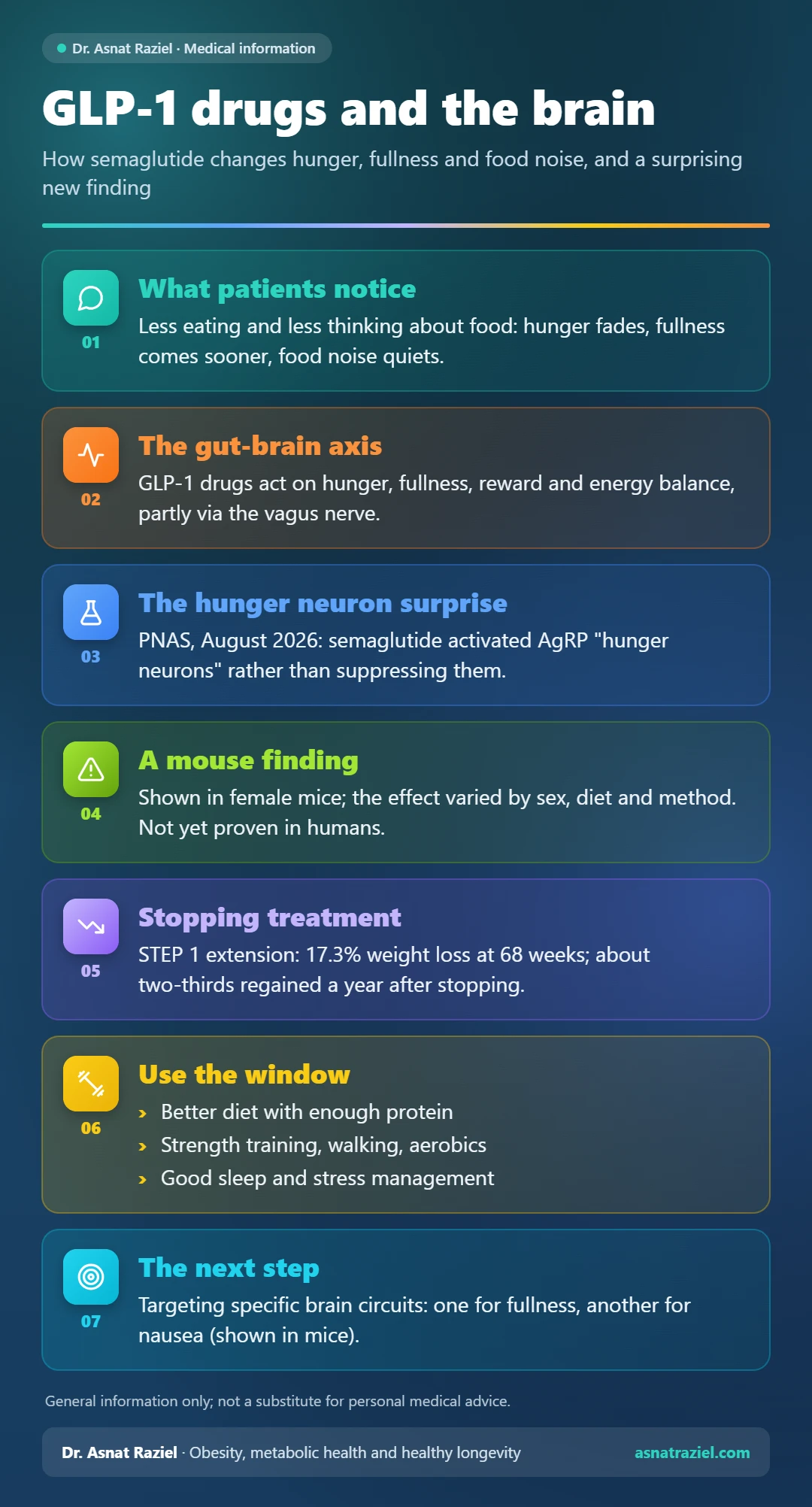
GLP-1 drugs and the brain are connected in ways that go far beyond the stomach. Patients on Ozempic, Wegovy or Mounjaro describe an interesting change: they not only eat less, they also think about food less. Hunger fades, fullness comes sooner and cravings ease. Sometimes food noise also quiets down a great deal. Food noise is a constant stream of thoughts about food.
A new study from Yale University adds a surprising twist to the story. During long-term treatment, semaglutide actually recruits nerve cells linked to hunger. According to the researchers, this recruitment helps the body adapt to weight loss and maintain it.
Why obesity drugs also work in the brain
GLP-1 drugs do not act only on the stomach and pancreas. They also affect the systems that manage hunger, fullness, reward, motivation and energy balance. A review in Nature Reviews Gastroenterology & Hepatology describes the gut-brain axis and the vagus nerve as a main channel through which the gut “talks” to the brain. It is also worth reading about how obesity medication works.
This understanding changes the way we look at obesity. It is not just a question of how much we eat. Rather, it is a disease in which the body’s biological control system plays a central role.
The hypothalamus: the control room for hunger
The hypothalamus is a key region for weight regulation. Inside it, groups of nerve cells pick up information about the body’s energy status. A review in Endocrinology describes how GLP-1 drugs activate different circuits in the hypothalamus.
One of the important groups is AgRP neurons, nerve cells that switch on mainly during fasting and energy shortage. For years, researchers called them “hunger neurons.” So it seemed logical that an effective obesity drug would simply silence them. However, the new study paints a different picture.
GLP-1 drugs and the brain: the hunger neuron surprise
The study appeared in PNAS in August 2026 and was covered in an article by Forbes Health. Researchers from Yale University and the University of Manchester examined what happens to AgRP neurons during long-term semaglutide treatment. They found signs that the treatment activated these cells rather than suppressing them.
What’s more, when the researchers disrupted the cells, the drug’s full effect on weight weakened. It is important to be precise here: the researchers did the experiments in female mice. In addition, the strength of the effect varied by sex, type of diet and the method used to disrupt the cells. In other words, this is a fascinating lab finding, but not yet proof in humans.
How hunger cells help with weight loss
The answer is that AgRP is not just an “I’m hungry” switch. An earlier study from the same Yale group showed that these cells direct how the body uses carbohydrates and fat. Put simply, they manage the entire energy balance.
In the new study, treatment raised markers of nerve activity and mitochondrial activity in the cells. In addition, the researchers identified a signaling pathway that starts with stress hormones (glucocorticoids) and reaches the AgRP cells. So we can describe semaglutide as working in two directions. On the one hand, it reduces eating through fullness and reward pathways. On the other hand, it recruits adaptive mechanisms that help the body live with its new metabolic state.
Food noise: not just how much we ate, but how much we wanted
Physical hunger is only part of why we eat. The smell of pastries, a favorite dessert, emotional stress or knowing there is something tasty in the fridge all trigger a desire to eat. All of these work even when the body has no real need for energy. I have written more about this in my article on food noise.
The GLP-1 system communicates with brain regions involved in motivation and reward. As a result, it also affects how drawn we are to food and how much value the brain assigns to it. Perhaps that is why patients tell me they still love food, but it no longer runs their lives. From a treatment standpoint, this is a very significant change.
Why hunger comes back when you stop
These drugs do not erase the biology that contributed to obesity. As long as they are working, they change some of the signals in the brain and in metabolism. After treatment stops, hunger, cravings and food noise return for many people.
For example, in the STEP 1 trial extension, participants on semaglutide lost an average of 17.3% of their body weight after 68 weeks. A year after stopping, they had regained about two-thirds of the weight they had lost. This is not evidence of a lack of willpower. Instead, it shows how strongly biology controls body weight. If this is happening to you, read my article on appetite after stopping GLP-1. That is why, for some patients, it makes sense to see obesity as a chronic disease and its treatment as long-term and personalized.
GLP-1 drugs and the brain: a window of opportunity
The period when hunger and food noise quiet down is an opportunity. During this time, it is worth building a foundation that will protect your health for years. First, improve the quality of your diet and make sure you get enough protein. Second, add strength training, walking and aerobic activity. In addition, it is important to sleep well and manage stress.
The goal is not just a lower number on the scale. We want good body composition, less visceral fat (deep abdominal fat) and strong muscles. That is why it is worth learning how to prevent muscle loss while losing weight. These are also core principles of longevity medicine.
The next generation: not just which drug, but which brain circuit
Today we have semaglutide, which acts on the GLP-1 receptor. Alongside it is tirzepatide, which acts on both GLP-1 and GIP. Since December 2025 there has also been the Wegovy pill, and in April 2026 the FDA approved Foundayo, a non-peptide GLP-1 pill. Other drugs, such as retatrutide, act on several receptors at once and are still in development.
But the next stage may be even smarter. Instead of asking which hormone a drug mimics, we will ask which brain circuit it activates. A study in Nature showed in mice that the brainstem has one circuit for fullness and a separate one for nausea. A precise understanding of these circuits could lead to drugs that reduce hunger and food noise, but with fewer side effects.
Bottom line on GLP-1 drugs and the brain
Obesity is not simply the result of overeating and a lack of willpower. Behind our behavior around food is a nervous system whose job is to protect the body’s energy reserves. GLP-1 drugs do more than suppress appetite. They enter this control system and change the way the brain interprets hunger, fullness and reward. Ultimately, the new study teaches us that sometimes it is not enough to silence hunger. We also need to recruit, in the right way, the mechanisms the brain switches on when it senses an energy shortage. If you want to dig deeper, you can also read about the physiology of satiety hormones.
The information in this article is general and does not replace personal medical advice.
References
AgRP neurons are required for the weight-lowering effects of GLP-1 receptor agonists in female mice
How Do GLP-1s Work For Weight Loss? New Study Explores The Brain’s Role
The critical role of gut-brain signalling in eating behaviour and obesity
Glucagon-Like Peptide 1 (GLP-1) Action on Hypothalamic Feeding Circuits
Regulation of substrate utilization and adiposity by Agrp neurons
Dissociable hindbrain GLP1R circuits for satiety and aversion




