By Dr. Asnat Raziel, bariatric surgeon specializing in obesity treatment, metabolic health and healthy longevity; Director of the Multidisciplinary Center for Obesity Treatment, Assia Medical, Assuta Ramat HaChayal, Tel Aviv
The aleniglipron pill at ObesityWeek in Washington
The aleniglipron pill is an experimental once-daily drug from the GLP-1 family of appetite hormones. It’s worth saying up front: aleniglipron is not approved anywhere in the world. Meanwhile, its developer, Structure Therapeutics, announced that it will present two posters at ObesityWeek, the American obesity meeting in Washington. In a study published this year, the pill led to up to 11.3% weight loss beyond placebo over 36 weeks. In the study’s extension, average weight loss reached up to 16.2% after 72 weeks.
What is the aleniglipron pill?
Most of the well-known drugs in this class, such as Wegovy and Mounjaro, are small proteins (peptides) given by injection. Aleniglipron, by contrast, is a small molecule – a small chemical compound rather than a protein. As a result, it can be swallowed as a pill once a day. Other experimental pills use different pathways, such as the CRB-913 pill, which targets the endocannabinoid system. Foundayo (orforglipron), which is already approved, belongs to the same family. I explain the differences between the two types of pills in my guide Weight-loss pills: the Wegovy pill and Foundayo.
The company also describes the drug as a “biased agonist.” Put simply, it switches on only the receptor’s main signaling pathway. According to the company, a small molecule is also easier to manufacture at large scale than a protein drug.
What will be presented at ObesityWeek
The annual meeting of The Obesity Society runs from November 14 to 17, 2026. The company will present two posters on November 15:
- Results from the open-label extension of the ACCESS trial.
- The effects of the drug’s different doses across the ACCESS trials.
However, the press release itself contains no new numbers. So I have gathered here the results that the company and the researchers have already published.
The ACCESS trial: what the researchers found
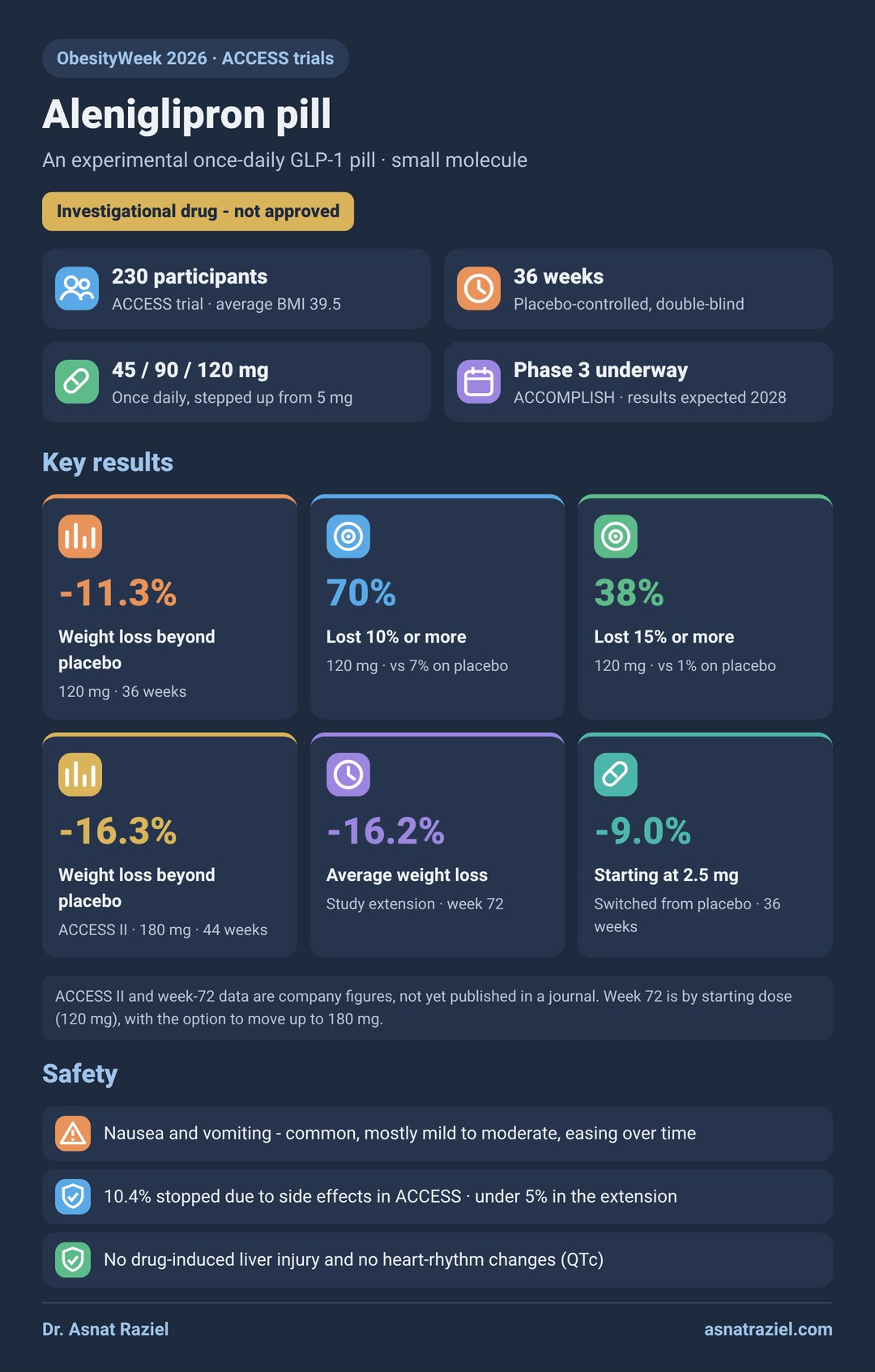
The ACCESS trial enrolled 230 adults with obesity or overweight. Their average BMI was 39.5, and 54% were women. Participants took a daily pill or placebo for 36 weeks. After that, the dose started at 5 mg and rose every four weeks to 45, 90 or 120 mg. Finally, the researchers published the results in Nature Medicine.
At the end of the study, weight loss was 9.0%, 10.7% and 12.1% on the three doses. In the placebo group, weight fell by just 0.8%. In other words, weight loss beyond placebo reached 8.2%, 9.8% and 11.3%.
On the 120 mg dose, 70 out of 100 participants lost at least 10% of their weight. In the placebo group, only 7 out of 100 got there. What’s more, 38% lost at least 15%, compared with 1% on placebo. In addition, according to the company, systolic blood pressure dropped by 6.4 to 7.5 mmHg.
The aleniglipron pill at higher doses
A second trial, ACCESS II, tested much higher doses: 120, 180 and 240 mg. In addition, it included 85 adults over 44 weeks. According to the company’s announcement, weight loss beyond placebo reached 14.7%, 16.3% and 16.0%. On the other hand, these are preliminary company figures and have not yet appeared in a scientific journal.
A year and a half of treatment: the study extension
After the first 36 weeks, participants could keep taking the drug openly. From week 60 they could move up to 180 mg. At week 72, average weight loss was 11.6%, 14.4% and 16.2%, depending on the dose they started on. More than a third of participants in the two highest-dose groups lost over 20% of their weight.
In addition, participants who switched from placebo to the drug started on a low 2.5 mg dose. After 36 weeks they had lost 9.0% of their weight, and according to the company they had fewer digestive side effects.
Side effects and safety of the aleniglipron pill
As with every drug in this class, the most common side effects were digestive. Nausea affected up to 71.1% of participants, and vomiting up to 44.6%. Most of these effects were mild to moderate, and they eased over time. In the ACCESS trial, 10.4% of participants stopped treatment because of side effects. By contrast, in the study extension, the dropout rate fell below 5%.
Importantly, the researchers reported no drug-induced liver injury. Similarly, they found no dangerous changes in heart rhythm.
What comes next: phase 3 trials
As a next step, the company has launched the ACCOMPLISH trials. The first will include up to 3,600 adults with obesity or overweight. Meanwhile, the second will include up to 1,100 adults who also have type 2 diabetes. Participants will start at 2.5 mg and move up to 45, 90 or 180 mg. The company expects first results in the second half of 2028.
The aleniglipron pill: what it means for you
First, this pill won’t reach pharmacies in the next few years. So if you’re looking for a pill treatment today, you can turn to options that already exist, such as the Wegovy pill and Foundayo. Still, the aleniglipron data show that competition among weight-loss pills is heating up. In the end, more options mean a better fit for each patient.
Alongside the aleniglipron pill, Novo Nordisk will also present new data at the meeting, as I describe in what Novo will present at ObesityWeek.
The bottom line
The aleniglipron pill is an experimental once-daily GLP-1 drug that has not yet been approved. In a controlled trial it led to up to 11.3% weight loss beyond placebo over 36 weeks. With longer treatment, weight loss reached up to 16.2%. The drug is now being tested in large phase 3 trials, and the full answers will only come in a few years.
This article is general information only and is not personal medical advice. Talk to your doctor before making any change to your treatment.
References
Structure Therapeutics Announces Multiple Upcoming Presentations at ObesityWeek® 2026
The studies were funded by Structure Therapeutics, and some of the researchers are company employees.




