By Dr. Asnat Raziel, bariatric surgeon specializing in obesity treatment, metabolic health and healthy longevity; Director of the Multidisciplinary Center for Obesity Treatment, Assia Medical, Assuta Ramat HaChayal, Tel Aviv
Multidisciplinary obesity care: why one treatment is not enough
Multidisciplinary obesity care is one of the most important changes in obesity treatment over the past decade. Today it is clear that successful treatment cannot rely on a single factor. Not one diet, not one drug and not one doctor. Obesity is a chronic disease that affects many systems in the body. It has metabolic, hormonal, behavioral and psychological dimensions. That is why its treatment must also be multidisciplinary.
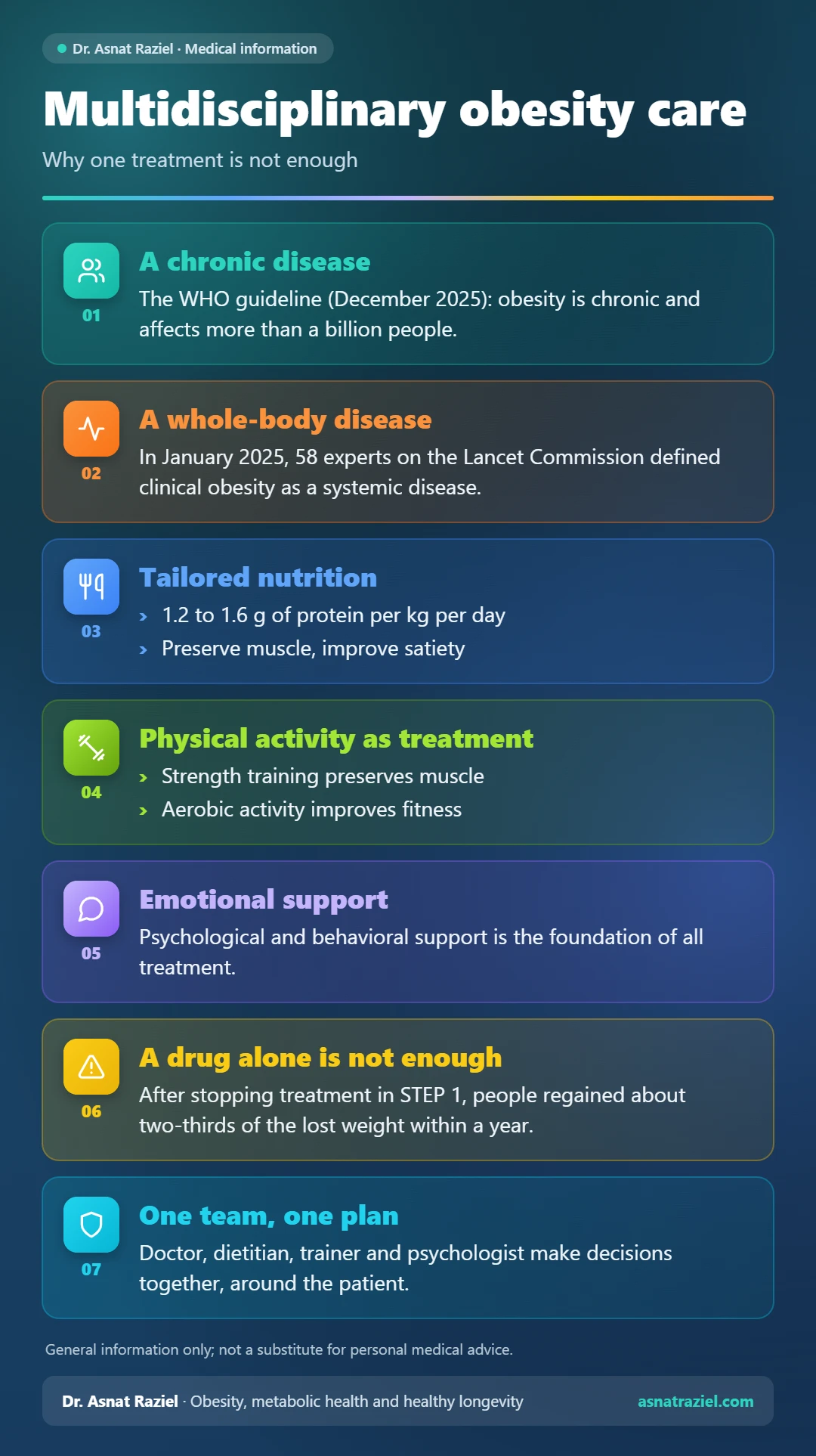
International bodies say so explicitly, too. In December 2025, the World Health Organization published its first global guideline on the use of GLP-1 medicines in obesity. The WHO defines obesity as a chronic, relapsing disease that affects more than a billion people. In addition, it recommends combining the drugs with a comprehensive approach: healthy eating, regular physical activity and support from health professionals.
Obesity: a disease of whole body systems
Obesity affects metabolism, the heart and blood vessels and the respiratory system all at once. It also harms the muscles, the skeleton, the hormonal system and the brain. Moreover, it often comes with emotional eating, stress, sleep disorders and social stigma. All of these deepen the complexity of treatment.
The Lancet Commission on clinical obesity reinforced this view in January 2025. Fifty-eight experts from different fields, together with people living with obesity, defined “clinical obesity” as a systemic disease. The definition is based on impaired organ function and impaired daily functioning, not only on weight. In other words, every patient needs a broad assessment of the whole body.
Treatment aimed at only one aspect, such as diet alone or a drug alone, may bring temporary improvement. However, it usually fails to create stable, lasting change. I have also written about this in my article on obesity as a chronic disease and its modern treatment.
The doctor’s role: a coordinator, not just a prescriber
In modern obesity medicine, the doctor does more than write a prescription or give general advice. Instead, the doctor acts as a coordinator. They identify the main drivers of the disease in each patient, choose the right tools and make sure treatment progresses safely.
Medical assessment, detection of related diseases, tailoring of drug or surgical treatment and monitoring of side effects all require a broad view and clinical experience. That is why it is important to know how to choose the right doctor for obesity treatment.
Nutrition: far more than “what to eat”
In obesity medicine, the dietitian does much more than build a meal plan. She tailors nutrition to the patient’s metabolic state, drug treatment, body composition and ability to stick with the plan. Nutrition is not meant only to cut calories. It is also meant to preserve muscle mass, support the microbiome, reduce inflammation and improve satiety.
For example, the joint advisory of four American organizations on nutrition during GLP-1 treatment sets a target of 1.2 to 1.6 grams of protein per kilogram of body weight per day during weight loss. Personal tailoring is critical. A meal plan that works for one patient may fail completely for another. I discuss this in more detail in my article on nutritional support during drug treatment.
Physical activity: a treatment tool, not general advice
In obesity medicine, physical activity is not a “nice extra.” It is a central part of treatment. Strength training preserves muscle, tailored aerobic activity improves fitness, and better physical function is an integral part of care.
Professional guidance makes it possible to build a realistic and safe plan. This is especially important for patients with pain, physical limitations or related diseases. I have written about this side of treatment in my guide on how to preserve muscle while losing weight.
The mind within the body
Obesity often comes with complex emotional aspects. Emotional eating, poor body image, anxiety, depression and repeated experiences of failure are all part of the picture. Ignoring the psychological component can undermine even successful physiological treatment.
Psychological or behavioral support is not a sign of weakness. Rather, it is a treatment tool that makes deep and lasting change possible. It helps patients understand their eating patterns, cope with stress and build a new, healthy relationship with their body and with food. The Canadian clinical practice guideline for obesity in adults also sees psychological and behavioral intervention as the foundation of all treatment. You can read more in my article on emotional eating and how to cope with it.
Drugs and surgery within multidisciplinary obesity care
Obesity drugs and bariatric surgery are important tools, but they do not stand alone. Their success depends on nutritional guidance, physical activity, emotional support and medical follow-up. When they are combined within a multidisciplinary framework, they make deep, safe and lasting change possible.
The data illustrate this well. In the STEP 1 trial extension, both the drug and the lifestyle support were stopped. One year later, participants had regained about two-thirds of the weight they had lost. That is why the WHO recommends offering intensive behavioral intervention alongside the drugs. You can read more in my article on stopping obesity drugs and weight regain.
What a multidisciplinary obesity care team looks like
In practice, multidisciplinary obesity care relies on a team that works together around the patient. Each professional brings a different tool, and they all share one plan:
- An obesity medicine specialist, who manages medical treatment and coordinates everyone involved.
- A clinical dietitian, who tailors nutrition to the treatment and to body composition.
- An exercise physiologist or fitness trainer, who builds a safe activity plan.
- A psychologist or behavioral therapist, who supports the emotional side.
- When needed, also a bariatric surgeon, a cardiologist, an endocrinologist or a sleep specialist.
The advantage is clear: information flows between team members, and decisions are made together. As a result, the patient does not have to piece together conflicting recommendations alone.
The patient at the center
At the heart of the multidisciplinary approach is the patient. Not as someone who needs to “be disciplined,” but as an active partner in the process. Listening and tailoring treatment to the patient’s values, lifestyle and ability to persevere are the keys to long-term success.
The bottom line: multidisciplinary obesity care is a necessity
Multidisciplinary obesity care is not a luxury but a necessity. It reflects a deep understanding of the complexity of the disease and of the person behind it. When obesity is treated as a systemic problem rather than a personal failure, the results are much better. Health becomes more stable, and quality of life improves.
The information in this article is general and does not replace personal medical advice.
References
WHO issues global guideline on the use of GLP-1 medicines in treating obesity
Definition and diagnostic criteria of clinical obesity




