By Dr. Asnat Raziel, bariatric surgeon specializing in obesity treatment, metabolic health and healthy longevity; Director of the Multidisciplinary Center for Obesity Treatment, Assia Medical, Assuta Ramat HaChayal, Tel Aviv
Semaglutide production cost: a medical revolution with a high price tag
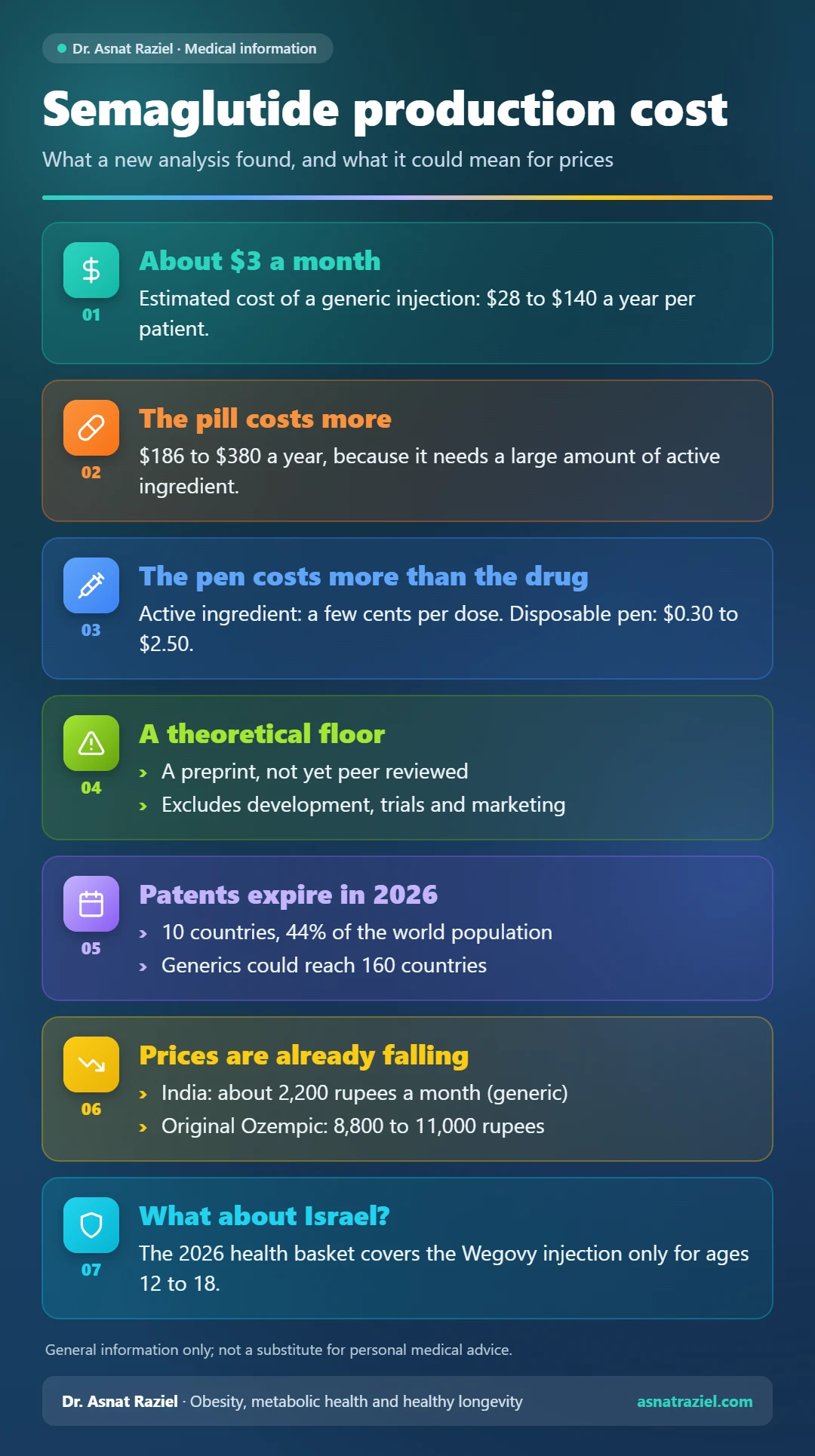
The semaglutide production cost may be far lower than what most of us pay. That is the conclusion of a new analysis published in March 2026. The researchers estimate that a generic injectable version could cost only about $3 a month. Not surprisingly, this figure made waves around the world.
Obesity treatment has changed enormously over the past decade. Today, many patients lose 10%, 15% and sometimes even 20% of their weight. In doing so, they lower their risk of diabetes, heart disease and other complications. However, the drugs are still expensive. In the United States they cost hundreds of dollars a month, and in Israel many patients pay hundreds of shekels every month.
The study that challenges drug prices
Researchers from the UK, South Africa and New Zealand wrote the analysis; its first author is Jacob Levi and its senior author is Andrew Hill. They posted it as a preprint on the medRxiv server. In other words, the paper has not yet gone through peer review. The researchers examined 33 shipments of the active ingredient from India. In addition, they calculated the cost of formulation, packaging, labor and shipping. Finally, they added tax and a 30% profit for the manufacturer.
The result is surprising. A generic semaglutide injection could cost $28 to $140 a year per patient. At the low end, that is indeed about $3 a month. The pill, by contrast, is much more expensive, at $186 to $380 a year, because it needs a large amount of active ingredient. Another interesting finding concerns the injection pen. The active ingredient itself costs just a few cents per dose, whereas a disposable pen costs $0.30 to $2.50. In other words, the device costs more than the drug.
It is important to be precise. The calculation does not include the costs of development, clinical trials, regulation and marketing. So it is not an expected shelf price, but rather a theoretical floor for efficient, large-scale production.
Semaglutide production cost compared with earlier studies
The new finding builds on work from 2024. That year, researchers from Harvard and Doctors Without Borders published an estimate of cost-based prices for diabetes drugs in the journal JAMA Network Open. According to that estimate, GLP-1 drugs could sell for $0.75 to $72.49 a month, including a reasonable profit. There too, market prices were far higher than the cost. Thus, both studies point to the same gap.
How obesity drugs work
These drugs build on natural gut hormones called incretins. They work through several mechanisms at once. First, they increase the feeling of fullness in the brain and reduce hunger. In addition, they slow stomach emptying and improve insulin release. As a result, appetite regulation changes and weight goes down. In the large trials, semaglutide led to an average weight loss of about 15%. Newer drugs such as tirzepatide reach about 20%. I review the available drugs in my article on obesity medications.
Beyond weight loss: other medical effects
Research in this field is moving quickly. Today it is clear that these drugs affect many systems in the body, not just appetite.
Protecting the heart
The SELECT trial enrolled 17,604 people with heart disease and excess weight, without diabetes. A major cardiac event occurred in 6.5% of patients on semaglutide, compared with 8.0% on placebo. That is a 20% reduction in relative risk. You can read more in my article on how Wegovy protects the heart.
Kidneys, sleep and liver
Studies show that these drugs slow the progression of kidney disease, especially in people with diabetes. Beyond that, the FDA has approved tirzepatide in the United States to treat obstructive sleep apnea. I discuss this in my article on obesity and sleep apnea. In addition, in August 2025 the FDA approved Wegovy to treat metabolic fatty liver inflammation (MASH). You can read more in my article on Wegovy for fatty liver.
Other areas of research
Researchers are also studying effects on heart failure, neurological diseases, chronic inflammation and addictions. In other words, the impact of these drugs is broad and system-wide.
Semaglutide production cost vs the consumer price
The gap between production cost and consumer price is no accident. Developing a new drug costs billions of dollars. Clinical trials last for years, and regulators demand extensive safety testing. To recover that investment, the company receives a patent. The patent grants market exclusivity for many years. During that period there are no generic competitors, so the price stays high.
Semaglutide production cost as patents expire
Patents do not last forever. According to the analysis, in 2026 the semaglutide patent expires in ten countries, including India, China, Canada, Brazil and Turkey. These countries account for 44% of the world’s population. Furthermore, in 150 other countries the company never registered a patent at all. As a result, by the end of 2026 a generic drug could reach 160 countries. These countries are home to 69% of people with type 2 diabetes and 84% of people with clinical obesity.
The change has already begun. After the patent expired in India on March 21, 2026, several companies launched generic versions there. For example, the average monthly cost of one of them is about 2,200 rupees. By comparison, the original Ozempic cost 8,800 to 11,000 rupees a month there. Then, in April 2026, Health Canada approved the first generic semaglutide, for type 2 diabetes. The same thing happened in the past with HIV drugs, cholesterol-lowering statins and many antibiotics.
What it means for global public health
Obesity is one of the most common diseases in the world. It goes hand in hand with type 2 diabetes, heart disease, high blood pressure, fatty liver and some types of cancer. According to the analysis, about 3.7 million deaths from noncommunicable diseases in 2022 were linked to a higher-than-optimal BMI. Therefore, a cheap, accessible drug could allow earlier treatment, prevent complications and ease the burden on health systems. What is more, generic manufacturers in India are already looking for new markets.
And what does it mean for Israel?
These drugs are available in Israel, but price is still a barrier. Some of Israel’s health funds (HMOs) offer discounts through their supplementary insurance. However, the 2026 national health basket covers the Wegovy injection only for ages 12 to 18. Adults with obesity alone usually pay hundreds of shekels a month. If global prices fall thanks to generics or price agreements, access in Israel may improve as well.
The bottom line on semaglutide production cost
The study does not promise that the price will drop to $3. What it shows is that the semaglutide production cost is far lower than the price people pay today. In addition, a new generation of drugs is already on the way. Over the next decade, we can expect highly effective drugs, strong competition, lower prices and broader access. If that happens, the world will treat obesity completely differently. Either way, you choose treatment together with your doctor, based on each person’s needs and health.
This article provides general information and is not a substitute for personal medical advice.
References
Estimated Sustainable Cost-Based Prices for Diabetes Medicines
Semaglutide and Cardiovascular Outcomes in Obesity without Diabetes
Weight-Loss Drugs Could Cost Just $3 a Month to Make as Patents End
Generic semaglutide launches in India after patent expiry, prices drop sharply
The SELECT trial was funded by Novo Nordisk, the manufacturer of the drug.




