By Dr. Asnat Raziel, bariatric surgeon specializing in obesity treatment, metabolic health and healthy longevity; Director of the Multidisciplinary Center for Obesity Treatment, Assia Medical, Assuta Ramat HaChayal, Tel Aviv
AI in obesity treatment: the second revolution
AI in obesity treatment is no longer a distant vision. Obesity medicine is going through a double revolution today. On the one hand, powerful new drugs are changing our ability to lose weight. On the other hand, a technological revolution is under way: smart apps, digital monitoring and the analysis of huge amounts of medical data.
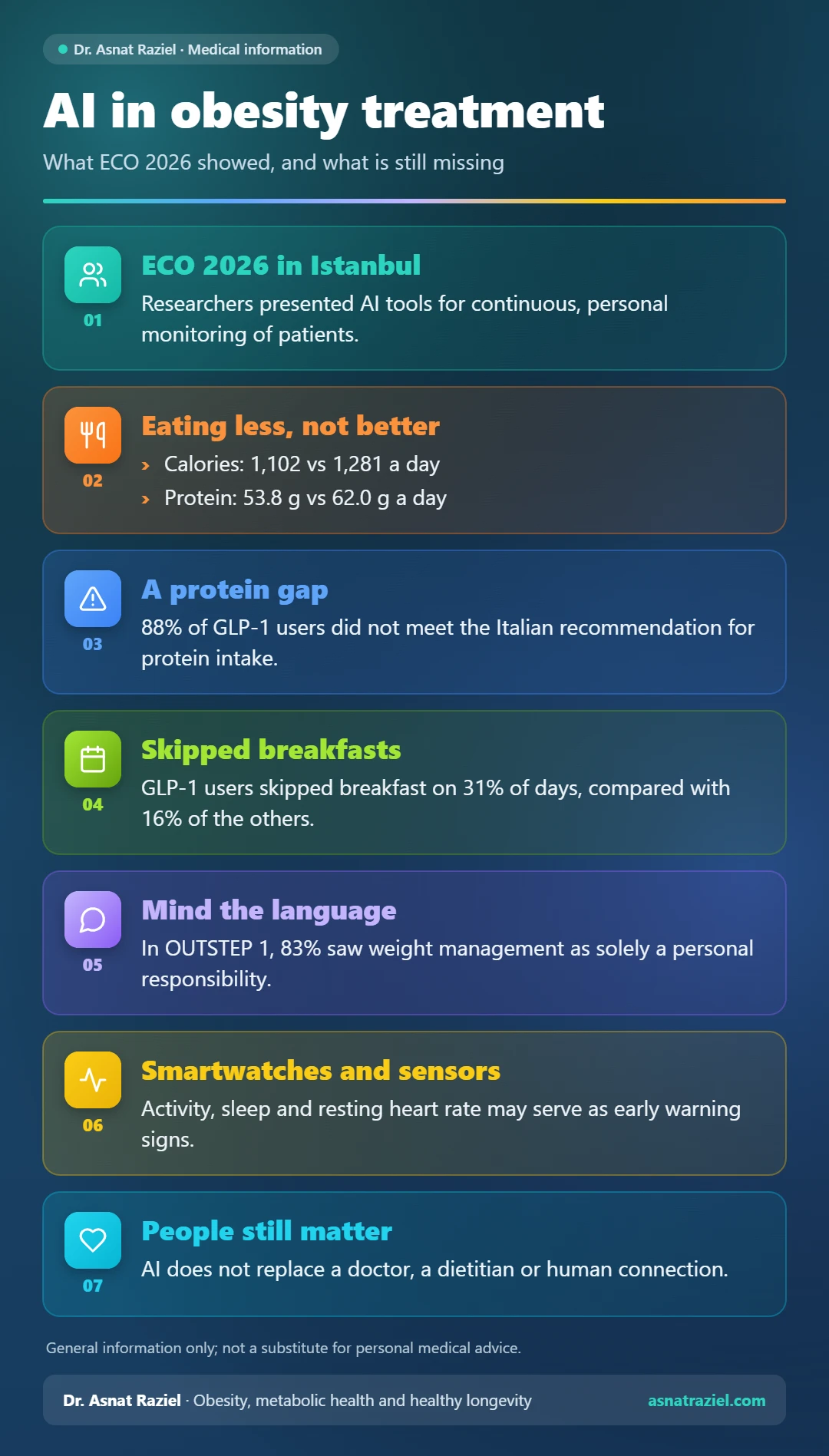
At the European Congress on Obesity, ECO 2026, held in Istanbul in May 2026, researchers presented tools that illustrate this change. The central message is clear. In the near future, treatment will not rely only on a short clinic visit. Instead, it will draw on continuous data, personal monitoring and tools based on artificial intelligence (AI) that accompany the patient in daily life.
What do people on GLP-1 drugs actually eat?
One of the most intriguing studies at the congress came from Italy. A team from San Raffaele Hospital in Milan examined the eating habits of patients on GLP-1 drugs using the Robin Health app. Patients log their meals with a photo, free speech, a barcode scan or text. Instead of relying on memory or a questionnaire, the system collects far more accurate data.
According to the report on the study, it included 332 adults with overweight or obesity. Of these, 116 were taking semaglutide or tirzepatide. The drug users ate an average of 1,102 calories a day, compared with 1,281 among the other participants. However, they also ate less protein: 53.8 grams a day versus 62.0 grams.
Moreover, 88% of the drug users did not reach the Italian recommendation for protein intake. They also skipped meals much more often. For example, they skipped breakfast on 31% of days, compared with 16% in the other group. As the lead researcher summed up, eating less does not mean eating well. That is why it is important to include close nutritional support throughout drug treatment.
AI no longer just keeps track
In the past, nutrition apps worked mainly as a digital food diary. Today, AI systems are starting to detect much deeper patterns. In the near future, they may warn of a sharp drop in protein intake. They may also detect regular meal skipping or the first signs of weight regain.
In this way, these systems will turn from passive tracking into an active clinical tool. They will help doctors and patients make decisions in real time. For example, an alert about low protein would allow a timely response that protects muscle. In this context, it is also worth reading about getting the right amount of protein while losing weight.
Not every app really helps
Alongside the excitement, important warnings were also raised at the congress. The OUTSTEP 1 study examined patient experiences with semaglutide injections in Germany and Australia. The interim analysis included 389 patients, and 78% of them reported being satisfied with treatment. However, 83% saw weight management as solely a personal responsibility. According to the presenter, this kind of thinking feeds weight stigma.
This message is highly relevant to the world of apps. Some of them use judgmental language or encourage extreme calorie counting, guilt and rigid control over eating. That is why it is important to choose science-based tools that speak to patients in respectful, non-blaming language.
AI in obesity treatment and personalized medicine
One of the most exciting areas today is the ability to tailor treatment to each person. Instead of a uniform approach, obesity medicine is moving toward decisions based on biological, behavioral and digital data. This is exactly the approach described in the European framework for personalized obesity treatment.
In the future, AI systems will be able to combine data from many sources: sleep, physical activity, heart rate, blood sugar, eating patterns, genetics, blood tests and body composition. This would make it possible to identify in advance who is at risk of weight regain and who needs more protein. However, a scientific review from September 2026 notes that the evidence in obesity is still preliminary. In other words, the direction is promising, but the research is only just beginning.
From reactive medicine to predictive medicine
One message came up again and again at the congress. Modern medicine is moving away from treating disease after it develops and toward predicting risk and intervening in time. Instead of waiting for weight gain, diabetes or heart disease, AI systems may detect risk at an early stage. As a result, it will be possible to intervene in time and in a personalized way.
Smartwatches: AI in obesity treatment outside the clinic
The future of obesity medicine is also unfolding outside the clinic. Smartwatches, activity sensors, sleep tracking and stress measures are becoming part of medical follow-up. A drop in activity, too little sleep or a rise in resting heart rate may serve as warning signs in the future. AI systems will analyze them continuously, and so we may be able to prevent weight gain before it even starts.
On the other hand, a review of digital therapeutics for obesity paints a balanced picture. Such tools improve engagement and behavior change in the short term. However, long-term adherence and significant weight loss remain a challenge. In addition, the researchers warn of algorithmic bias, digital divides and privacy concerns.
AI in obesity treatment does not replace human connection
Despite the excitement, experts at the congress stressed that AI does not replace a doctor, a dietitian or human connection. Obesity is a chronic disease that involves the body, the mind, emotions, environment and habits. An algorithm can detect patterns, but it cannot replace empathy, support and personal guidance.
Likewise, the World Health Organization guideline from December 2025 emphasizes long-term, person-centered care. Alongside the drugs, it recommends offering a behavioral program of nutrition and physical activity. So the future will most likely combine the two: human medicine alongside smart technology.
The bottom line
A decade ago, tracking nutrition by photographing meals belonged to science fiction. Today it is already happening. AI in obesity treatment is making the field more precise and data-driven. The combination of advanced drugs, digital monitoring and AI may change the way we treat obesity. Ultimately, it may also change the way we understand the human body. To see how AI is also changing the operating room, you can read about smart technology in bariatric surgery.
The information in this article is general and does not replace personal medical advice.
References
AI-based monitoring reveals protein deficiencies in people taking GLP-1s
GLP-1 users eat less, but do not change macronutrient composition of diet
OUTSTEP 1 interim analysis: Patient experiences with injectable semaglutide for obesity management
Applications of artificial intelligence in personalized nutrition interventions
WHO issues global guideline on the use of GLP-1 medicines in treating obesity




