By Dr. Asnat Raziel, bariatric surgeon specializing in obesity treatment, metabolic health and healthy longevity; Director of the Multidisciplinary Center for Obesity Treatment, Assia Medical, Assuta Ramat HaChayal, Tel Aviv
Obesity around the world: there is no single kind of obesity
Obesity around the world is one of the biggest health problems of our time. However, as research advances, it is becoming clear that there is no single kind of obesity. People from different countries, cultures and health systems develop obesity in different ways. Risk patterns, complications and response to treatment also vary between them.
At the European Congress on Obesity, ECO 2026, held in Istanbul in May 2026, large international studies were presented. They showed how strongly genetics, culture, environment, society and the economy shape obesity. The central message is clear. To understand the epidemic, we need to look beyond weight and understand the differences between populations.
The numbers behind obesity around the world
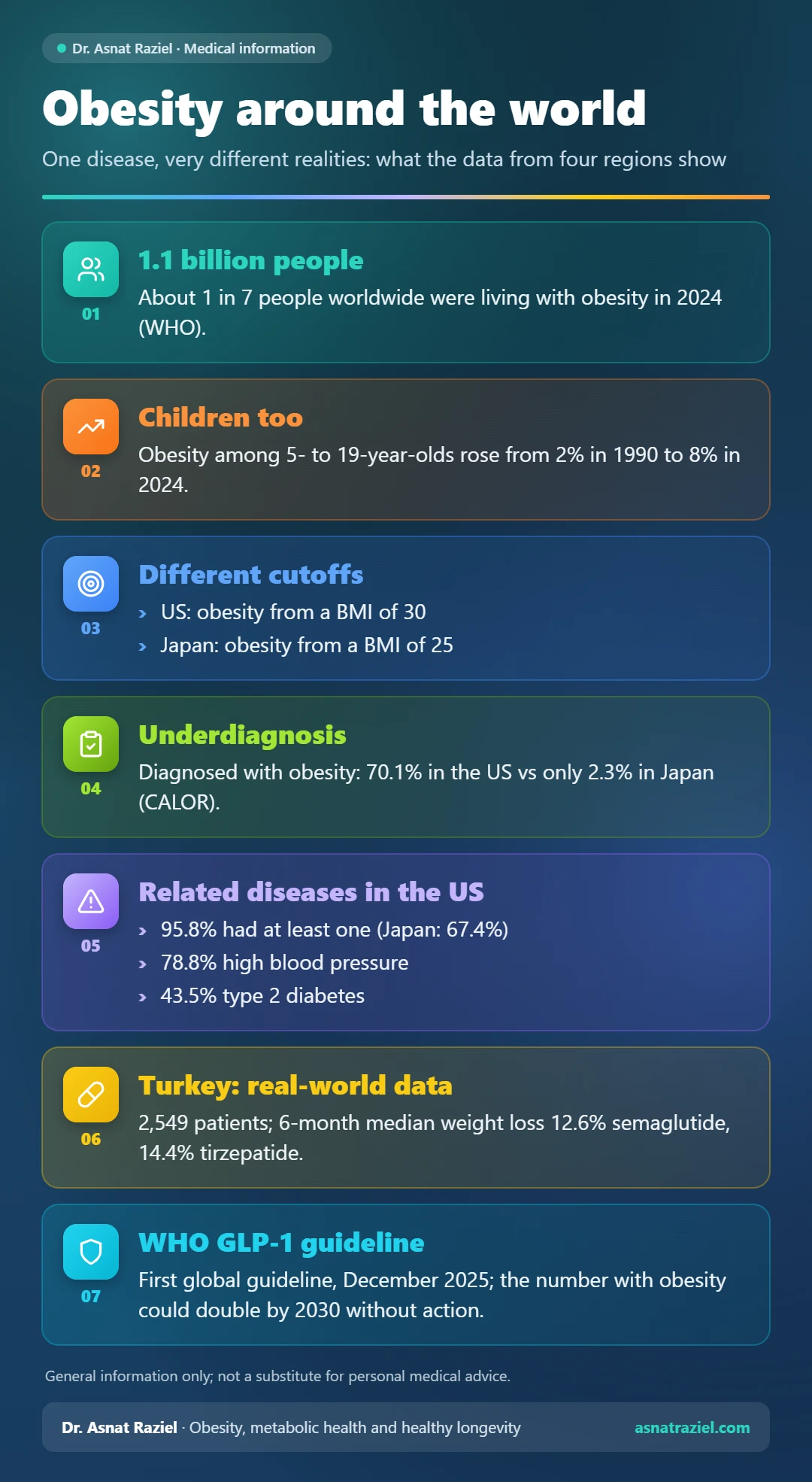
According to the World Health Organization fact sheet, about 1.1 billion people worldwide were living with obesity in 2024. In other words, roughly one in seven. Among adults, 2.6 billion were overweight, and 940 million of them were living with obesity. In addition, the rate of obesity among adults has more than doubled since 1990.
Children are part of the picture, too. Obesity among 5- to 19-year-olds rose from 2% in 1990 to 8% in 2024. A large global analysis published in The Lancet found that in most countries, the rise in the combined burden was driven by rising obesity.
The same disease, a completely different reality
The CALOR study looked at millions of patients in the United States and Japan. The analysis published in the journal Obesity included 3,584,120 adults in the United States and 3,140,900 in Japan. Even the definition differs. In the United States, obesity starts at a BMI of 30, while in Japan it starts at a BMI of 25. BMI, or body mass index, is the ratio of weight to height.
This gap is no accident. Asian populations tend to develop metabolic complications at a relatively low weight. Another surprising finding concerned diagnosis. In the United States, 70.1% of people with a high BMI had an official diagnosis of obesity. In Japan, by contrast, only 2.3% did.
Why do Asian people develop diabetes at a lower weight?
One important insight is that it is not only the amount of fat that matters, but also where it is stored. Asian populations tend to accumulate fat in the abdomen and around the internal organs, even when BMI is not especially high. This is linked to a higher risk of diabetes, fatty liver and heart disease. I expanded on this in my article on visceral fat and its harms.
For this reason, a World Health Organization expert consultation concluded back in 2004 that in Asian people, risk rises at a lower BMI than usual. As a result, many East Asian countries use different diagnostic cutoffs from those in Europe and the United States.
Obesity around the world: the US and the burden of related diseases
The data from the United States are especially worrying. According to a summary of the CALOR study, 95.8% of US adults with a high BMI had at least one related disease, compared with 67.4% in Japan. For example, 78.8% had high blood pressure, 43.5% had type 2 diabetes and 32% had sleep apnea. In addition, 28.7% had chronic kidney disease and 19.2% had heart failure.
These data show that obesity is a multisystem disease, not just excess weight. It is worth getting to know the diseases related to obesity and the ways to prevent them.
Turkey: what does real-world data teach us?
The congress took place in Turkey, and local data drew a lot of interest. A nationwide multicenter study compared 2,549 patients treated with semaglutide (Ozempic/Wegovy) or tirzepatide (Mounjaro/Zepbound). After six months, median weight loss was 12.6% with semaglutide and 14.4% with tirzepatide.
One open question is whether certain populations respond well even to low doses, for example because of a smaller body frame. The study has not yet answered this. Still, the question fits the personalized approach to adjusting medication doses.
Europe: a shift from obesity to metabolic health
Europe is now leading a change in thinking in this field. The focus is no longer only on the number on the scale, but on the health of the heart, kidneys and metabolism. The European Association for the Study of Obesity framework defines obesity also by fat distribution and its impact on health. Likewise, new European models for predicting heart failure already include BMI. This approach sees obesity as a chronic disease that requires multidisciplinary care, not just advice to eat less.
Obesity around the world is shaped by culture
You cannot understand obesity without understanding the environment. Eating habits, the availability of ultra-processed food, working hours, sleep and stress all affect risk. Transportation, family culture and even urban planning play a role as well. In some countries, regular family meals are the norm. In others, consumption of fast food and sugary drinks is especially high.
Moreover, the stigma around obesity varies between cultures. It affects people’s willingness to seek treatment as well as their mental health.
The future: treatment tailored to the population
One of the main themes at the congress was developing treatment approaches for specific populations. In the future, different populations may receive different BMI cutoffs, different doses and different dietary recommendations. In addition, different risk prediction models may also be developed. Obesity medicine is moving away from a one-size-fits-all approach.
At the same time, the World Health Organization issued its first global guideline in December 2025 on the use of GLP-1 medicines for obesity. According to the WHO, without decisive action, the number of people with obesity is projected to double by 2030.
The bottom line: obesity around the world is also a personal story
The main message from the congress was that obesity around the world is a global disease, but also a deeply personal one. Genetics, culture, environment, economics and technology all shape it. Therefore, the solutions will also be multidimensional and precise. Ultimately, the question is not just how much a person weighs. It is also who they are, where they live, how their body works and what environment shapes their life.
The information in this article is general and does not replace personal medical advice.
References
Trends in Diagnosing Obesity: The CALOR Study
Lack of obesity diagnosis common among adults with elevated BMI in US, Japan
A new framework for the diagnosis, staging and management of obesity in adults
WHO issues global guideline on the use of GLP-1 medicines in treating obesity




