By Dr. Asnat Raziel, bariatric surgeon specializing in obesity treatment, metabolic health and healthy longevity; Director of the Multidisciplinary Center for Obesity Treatment, Assia Medical, Assuta Ramat HaChayal, Tel Aviv
Mood and lifestyle: which comes first?
Mood and lifestyle are linked in ways that are more complex than we thought. We all know that exercise is good for our health. Quality sleep, a healthy diet and time in nature are also cornerstones of a healthy life. But is there a right order? Does activity improve our mood, or does a good mood get us out the door for a walk?
A new study published in July 2026 tries to answer exactly this question. The results show that there is no single formula that suits everyone. In fact, each person responds differently. The links between daily habits and emotional well-being are personal and dynamic.
Seventy days of real life
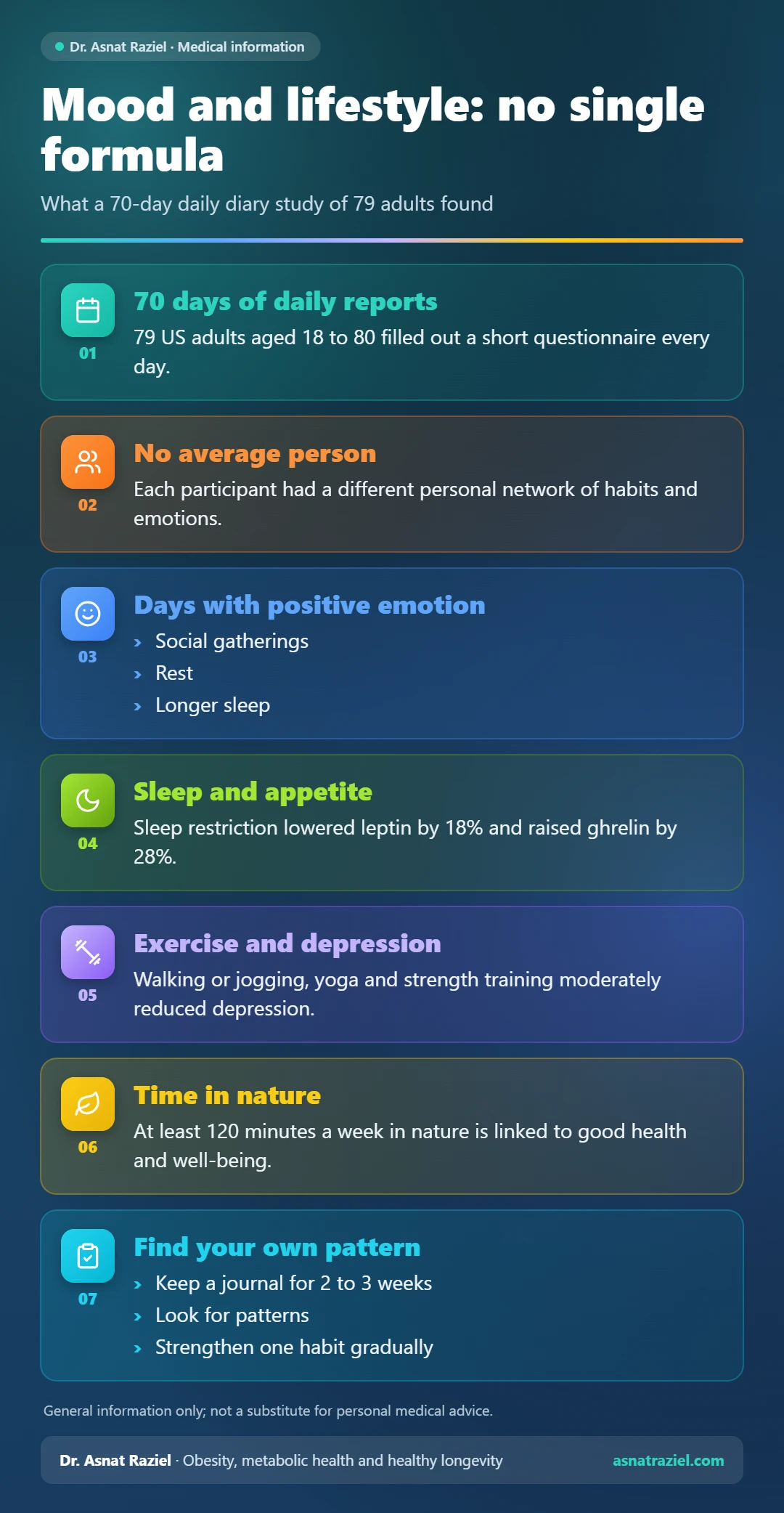
In a study published in the journal Applied Psychology: Health and Well-Being, researchers followed 79 adults in the United States. The participants were aged 18 to 80, and they filled out a short questionnaire every day for 70 consecutive days.
Each day, they reported on their sleep quality and naps. In addition, they recorded physical activity, servings of fruit and vegetables, alcohol and caffeine. They also reported time in nature, social gatherings, hobbies, rest and TV watching. Finally, they rated their positive and negative emotions. This allowed the researchers to examine how each day affects the next, and not only what happens on average.
There is no “average person”
One of the key conclusions is that the average is misleading. The researchers built a personal “network” of links between habits and emotions for each participant. These networks differed greatly from one another. For example, in only one participant was physical activity linked to time in nature. In another participant, by contrast, activity sat at the center of the entire network.
In other words, there is no uniform path. Each person’s body and mind work as a network of mutual influences. What drives one person does not necessarily drive another.
Mood and lifestyle: everything is connected
At the group level, habits tended to appear together. Active people tended to spend a lot of time in nature and to eat plenty of fruit and vegetables. In addition, on days with high positive emotion, participants reported social gatherings, rest and longer sleep. On days with negative emotion, on the other hand, they reported disturbed sleep and less time for hobbies.
The study shows how hard it is to separate the components of lifestyle. Earlier studies explain some of these links. For example, a small trial in healthy young men showed that sleep restriction lowered the satiety hormone leptin by 18%. At the same time, it raised the hunger hormone ghrelin by 28%. You can read more about this link in my article on obesity, sleep and appetite.
Movement itself also affects the mind. A large review in The BMJ included 218 studies and 14,170 participants with depression. Walking or jogging, yoga and strength training reduced depression to a moderate degree. Moreover, a study of almost 20,000 people in England found that at least 120 minutes a week in nature is associated with good health and well-being. This is not a simple chain of cause and effect, but a whole system in which a small change affects everything else.
Mood and lifestyle in personalized medicine
One implication of the study is that general recommendations are not enough. “Exercise” or “sleep eight hours” is sound advice, but it is not always precise for a particular person. That is why the goal is to build a personal picture of mood and lifestyle.
In the future, apps, smartwatches and artificial intelligence may be able to build a “health map” for each person. The map will identify which changes affect that person most. For one person, the key will be a daily walk. For another, better sleep. And for a third, it may be time in nature or stronger social ties. This is another step toward personalized lifestyle medicine.
What about obesity treatment?
These findings fit well with what we see in the clinic. Innovative medications such as Mounjaro (tirzepatide) or Wegovy (semaglutide) reduce hunger and help with weight loss. However, long-term treatment success does not depend on the medication alone.
Good sleep, enough protein and physical activity remain an integral part of treatment. In addition, stress management, daylight and social connections all contribute to success. So it is worth reading about nutritional support during medication treatment and about stress reduction as a weight-loss tool. The study reminds us that there is no “magic pill.” Even in the age of medications, mood and lifestyle remain the foundation of metabolic health and healthy aging.
Important to know: what the study did not prove
The researchers themselves point out several limitations. The participants were not a representative sample, and the measures were brief self-reports. In addition, the findings show associations, not proof of cause and effect. This is therefore a preliminary study, not a clinical guideline.
How do you start identifying your personal pattern?
You don’t need a lab to get started. You can keep a simple journal for two or three weeks. Each evening, write down how long you slept, how much you moved, what you ate and how you felt. Also note whether you went outside and whether you met people.
After a few weeks, look for patterns. For example, is it easier to go for a walk after a good night’s sleep? Does meeting friends improve your evening? This way, you will discover what motivates you most. Then choose one habit and strengthen it gradually. A regular daily walk can also be a good starting point.
The bottom line
For years, scientists have tried to understand what matters most: exercise, sleep, diet or mood. The new study offers a different answer. No single factor leads all the others. It is a living system in which every part affects the others, and each person has a pattern of their own.
Perhaps this is the promise of future medicine. Instead of identical recommendations for everyone, we will deeply understand the link between mood and lifestyle in each person. From there, we can build a personal plan that helps people not only live for many years, but live those years well.
The information in this article is general and does not replace personal medical advice.
References
Examining the clustering of lifestyle factors and affect in daily life: An idiographic approach
Study maps how exercise, sleep, diet, and mood connect in daily life
Spending at least 120 minutes a week in nature is associated with good health and wellbeing




