By Dr. Asnat Raziel, bariatric surgeon specializing in obesity treatment, metabolic health and healthy longevity; Director of the Multidisciplinary Center for Obesity Treatment, Assia Medical, Assuta Ramat HaChayal, Tel Aviv
The limit of human lifespan: a silent mechanism that keeps adding damage
The limit of human lifespan is a question that has occupied scientists for decades. Imagine a world where we have beaten heart disease, diabetes, cancer and dementia. Would we then live for hundreds of years? A new study offers a surprising answer. Even if we neutralize almost all aging processes, tiny changes in DNA will keep building up. According to the model, they set another biological limit, at around 146 to 194 years.
The study appeared in June 2026 in npj Aging, a Nature Portfolio journal. It is important to understand what it is not. It is not an experiment in humans, and it does not promise that any of us will reach 194. Instead, the researchers built a mathematical model that explores a theoretical question: how long would the body survive if only the mutations in our cells kept working against us?
The changes written into our DNA over a lifetime
Most of us know about inherited mutations, which pass from parents to children. However, this study deals with a different kind: somatic mutations. These are random changes in the DNA of the body’s cells. They develop during life, and parents do not pass them on to their children.
These mutations start to accumulate from the very beginning of life. They appear when cells copy their DNA, as a result of normal metabolic processes or because of exposures. Examples include ultraviolet radiation, tobacco smoke and harmful substances in the environment. A broad study in 16 mammal species showed that the rate at which mutations build up is linked to each species’ lifespan. In other words, long-lived species gather mutations more slowly.
Most mutations cause no noticeable harm. Others, however, impair the cell’s ability to make proteins, repair damage or produce energy. Sometimes they contribute to tumor growth. In other cases, the cell gradually loses its function or dies.
The experiment no lab can perform
Researchers from the Skolkovo Institute of Science and Technology and the AIRI institute in Russia built a multi-step model. With it, they computationally “switched on” and “switched off” different mechanisms of aging. These included damage to mitochondria, epigenetic changes, shortening telomeres and loss of control over protein structure. These are part of the hallmarks of aging that science recognizes today.
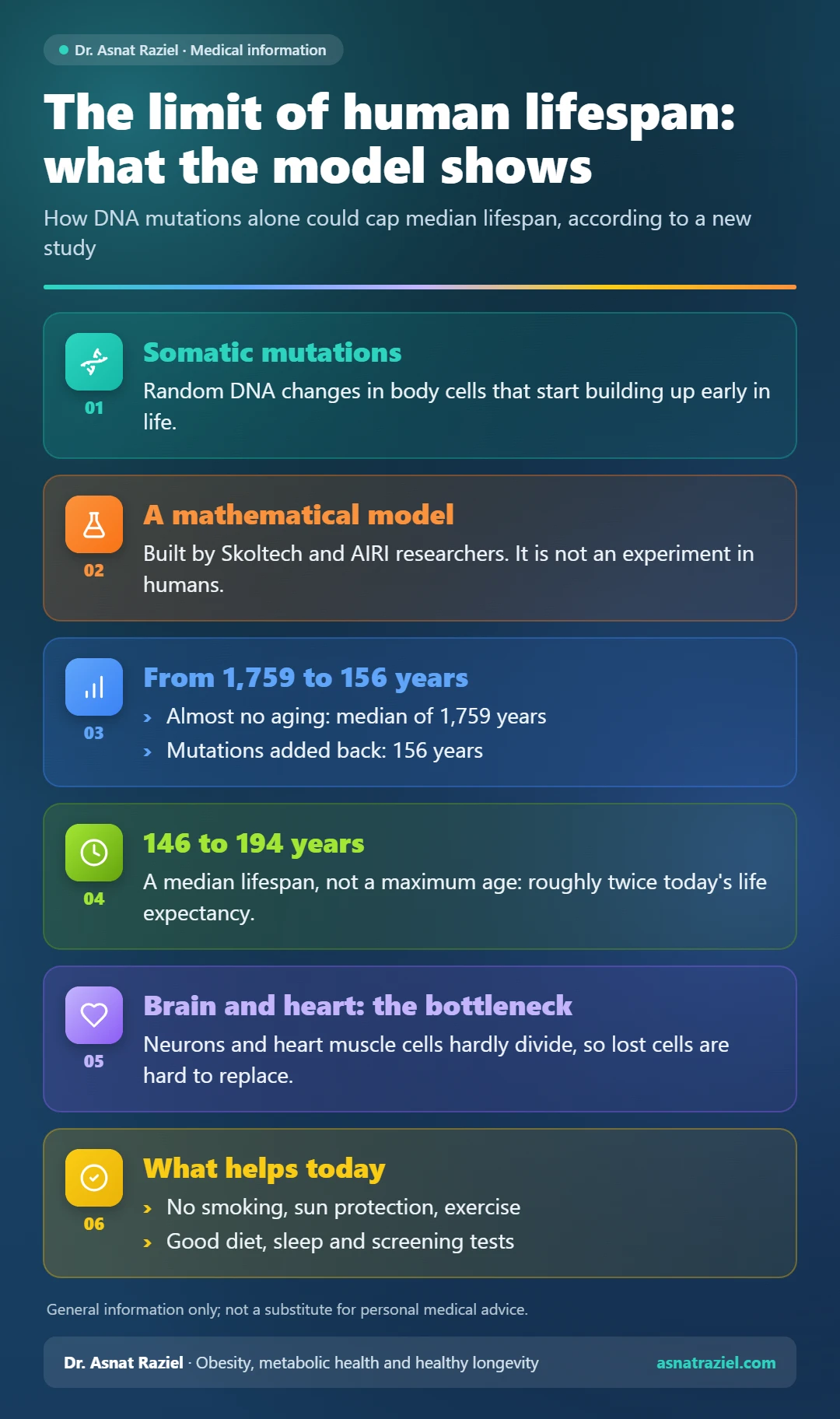
In a first imaginary scenario, the researchers removed almost all aging mechanisms from the equation, including mutations. In this situation, the model produced a theoretical median lifespan of 1,759 years. This extreme number is not a forecast. Rather, it is a mathematical reference point that shows how much the result depends on the assumptions.
Next, the researchers put somatic mutations back into the model. The median lifespan dropped to 156 years, mainly because of brain and heart cells. In the final step, the researchers combined several vital organs. That gave the range of 146 to 194 years, roughly twice today’s life expectancy.
The limit of human lifespan is a median, not a maximum age
The number 194 quickly made headlines as the “new limit of human life.” But it is important to be precise. The study did not determine that any particular person will live to that age. In addition, it did not calculate an absolute maximum age.
The range of 146 to 194 describes the median lifespan in different versions of the model. That is, in an imaginary world where only mutations remain, half of the simulated population would die before that age and half after it. In reality, by contrast, we face diseases, infections, accidents and many aging processes that act together. So we should not see the study as a promise of a life of nearly 200 years.
The liver can renew itself, but the brain and heart are vulnerable
One of the most interesting findings is the gap between different body tissues. Liver cells divide and replace damaged cells with new ones. Therefore, according to the model, tissues like these keep working for thousands of years under theoretical conditions.
On the other hand, nerve cells in the brain and heart muscle cells (cardiomyocytes) hardly divide at all once they mature. When such a cell builds up genetic damage and dies, the body has great difficulty replacing it. For this reason, the researchers called the brain and heart the “bottlenecks” of longevity. Even if we learn to renew the liver, skin and blood in the future, the gradual loss of brain and heart cells will continue to limit us.
Aging is not a single fault we can fix
There is another important conclusion. Somatic mutations contribute to aging, but they cannot explain on their own when people die. If they were the only cause, the median lifespan would reach 146 to 194 years according to the model. In practice, life expectancy is much lower. Hence other mechanisms also make a significant contribution. Examples include mitochondrial dysfunction, epigenetic disruption, chronic inflammation, aging of the immune system and the buildup of senescent cells.
The researchers hope to use this approach to quantify the share of each mechanism. That way, it will be possible to decide which targets deserve research investment. You can read about the drug approaches under study today in my article on what slows aging.
Will we be able to fix the mutations?
In principle, the study points to a future target for longevity medicine. This means protecting DNA, improving its repair mechanisms and preventing the loss of cells that do not renew.
But this is a huge challenge. The mutations differ from one another and spread across billions of cells. Each cell builds up a different combination of changes. Such a treatment would need to reach an enormous number of cells, identify the dangerous changes and fix them without causing new damage. In the future, we may see better DNA repair, replacement of damaged cells, gene therapies or stem cells. For now, though, no treatment has proven able to stop the buildup of mutations or to extend life to these ranges.
The main limitation: a mathematical person, not a real one
The model relies on estimates: the rate at which mutations build up, the number of cells in each tissue and the amount of damage a cell can withstand. Some of the data exist for only a small number of tissues. Therefore, the researchers relied on assumptions and generalizations.
Moreover, in real life the mechanisms of aging act together. DNA damage triggers inflammation. Poor mitochondrial function increases genetic damage. In addition, an aging immune system struggles to clear damaged cells. The model simplifies these connections, so it does not precisely predict future life expectancy. In the past, too, researchers have argued that there is a natural limit to human lifespan, at around age 115, and the scientific debate is still open.
The limit of human lifespan and the real goal: healthy years
The headline about age 194 captures the imagination. Even so, the practical message is far more modest and far more important. Science is moving from a general description of aging to an attempt to measure the damage each mechanism causes.
The near-term goal of longevity medicine is not to get us to 194. Instead, it is to delay heart disease, diabetes, cancer, cognitive decline and loss of independence. The better we protect the brain and heart, and the more we preserve metabolic, muscle and immune function, the more good years we gain. I wrote about the difference between years of life and years of health in my article on healthspan and longevity.
What we can do today
Until researchers develop treatments that act directly on mutations, the most effective tools are already well known to us:
- Not smoking and protecting yourself from the sun, which reduce exposure to factors that damage DNA.
- Regular physical activity and maintaining muscle mass.
- A high-quality diet and maintaining a healthy weight and metabolic health, as I describe in my guide to the longevity diet.
- Enough sleep, less stress and strong social connections.
- Screening tests and early treatment of risk factors.
If you want to understand how to measure your personal pace of aging, you can read about aging clocks and biological age.
The bottom line on the limit of human lifespan
The study does not prove that 200-year lives are just around the corner. But it offers a new way to think about the limit of human lifespan. Not as a fixed number set in advance, but as the result of several layers of biological damage. In the future, we may be able to prevent, repair or delay some of these layers.
The information in this article is general and is not a substitute for personal medical advice.
References
Somatic mutations impose an entropic upper bound on human lifespan
Researchers estimate the upper limit of human lifespan determined by somatic mutations
Somatic mutation rates scale with lifespan across mammals
Hallmarks of aging: An expanding universe
Evidence for a limit to human lifespan
The Russian Science Foundation funded the study.




