By Dr. Asnat Raziel, bariatric surgeon specializing in obesity treatment, metabolic health and healthy longevity; Director of the Multidisciplinary Center for Obesity Treatment, Assia Medical, Assuta Ramat HaChayal, Tel Aviv
Red light therapy and the mitochondria: the light that switches on the cell’s power plants
Red light therapy is built on a simple idea: red and near-infrared light may act directly on the mitochondria, the power plants of our cells. We have known for years that sunlight sets the biological clock, affects sleep and allows the skin to make vitamin D. Now it turns out that certain parts of the spectrum have a far more direct effect. They change how the cell produces energy.
A new study even found that light at certain wavelengths passes through the human body. What’s more, it affects tissues that were not directly exposed to it. Could light be another piece of the puzzle of healthy aging?
Mitochondria: the power plant that ages with us
Almost every cell in the body needs energy to function. Much of that energy is made in the mitochondria in the form of ATP (adenosine triphosphate), the cell’s “energy currency.”
Inside the mitochondria, an electron transport chain is at work. Electrons that come from food pass through a series of proteins, and at the end of the process ATP is formed. With age, and in various diseases and metabolic conditions, mitochondrial function may weaken. Lower energy production, excess free radicals, inflammation and disrupted communication between cells are all part of the link between mitochondria and aging. You can read more about this in my article on mitochondria and aging. And this is where light comes into the picture.
Do human cells “harvest” energy from light?
Of course, we are not plants, and we do not carry out photosynthesis. Food remains our main source of energy. Even so, studies show that photons at certain wavelengths affect molecules inside the cell and the activity of the mitochondria.
This process is called photobiomodulation (PBM), which means regulating biology with light. Researchers usually use red and near-infrared light. In other words, the effect is not limited to light the eye can see.
How red light therapy works inside the cell
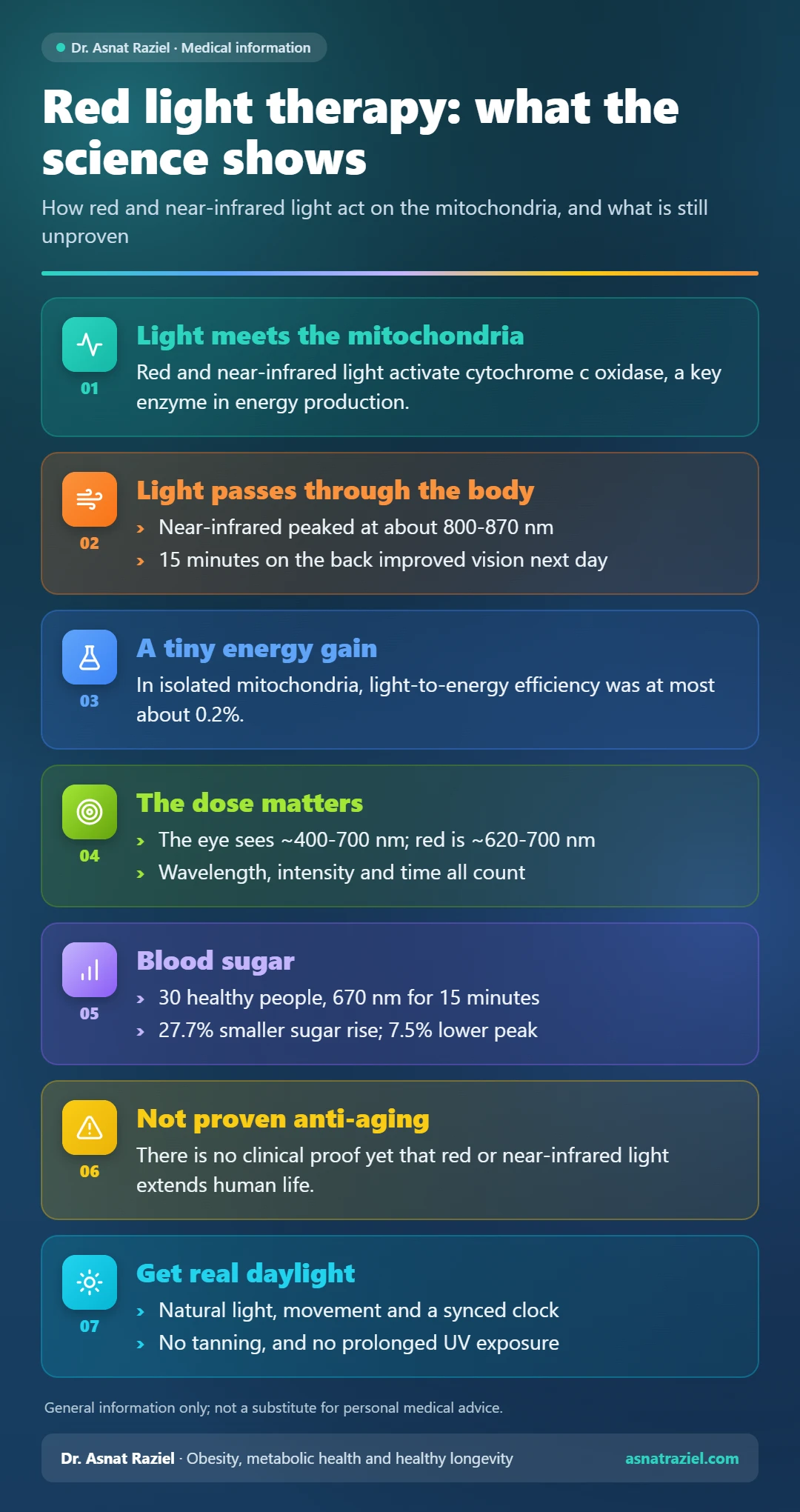
One of the most studied targets is cytochrome c oxidase, a key enzyme in the electron transport chain. According to a review from the American Academy of Dermatology, red and near-infrared light are absorbed by this enzyme and activate it. As a result, ATP production, free radical levels and calcium inside the cell all change. These changes then switch on additional signaling pathways.
To be precise, this is not a simple case of “charging a battery.” It is a complex biological effect. It depends on the wavelength, the light intensity, the length of exposure, the state of the tissue and the total dose.
A surprising study: light passes through the human body
A study published in July 2025 in Scientific Reports tested 40 women and men aged 25 to 63. The researchers found that long wavelengths of sunlight, in the near-infrared range, penetrate deep into the body. Transmission peaked at roughly 800 to 870 nanometers, and it could be measured after the light had passed through the chest. Clothing reduced the intensity of the light, but did not block it.
Then came the intriguing part. The researchers shone light at 830 to 860 nanometers on the participants’ backs for 15 minutes. The next day, they tested visual function, since the retina is especially rich in mitochondria. Sensitivity to color contrast improved. The improvement appeared even when the researchers covered the head and eyes. In other words, lighting one area may also affect distant tissues. However, the researchers themselves stress that the mechanism behind this whole-body effect is still unclear.
Does light increase ATP production?
In a 2024 lab experiment, researchers shone 810-nanometer light on mitochondria isolated from beef liver. They measured extra biochemical energy produced after the light exposure. For the first time, they also estimated how efficiently light energy was converted into biochemical energy.
The efficiency was very low, at most about 0.2% under the conditions tested. So clearly, this is nowhere near an energy source comparable to food. Still, the very ability to measure such a change is biologically interesting. Keep in mind that this was an experiment on isolated mitochondria, not a clinical trial in humans.
Not all light is the same
The human eye sees roughly the range between 400 and 700 nanometers. Red light sits at the upper end of this range, at around 620 to 700 nanometers. Near-infrared light, by contrast, lies beyond what we can see.
That is why “light therapy” means nothing without knowing the wavelength, intensity, dose and length of exposure. In the mitochondria study, for example, all the groups received the same amount of energy. Yet only some combinations of intensity and time triggered a response. In other words, the effect was not determined by total energy alone. This is also why we cannot assume that any red LED lamp bought online will reproduce the results of the studies.
Red light therapy and blood sugar
Another intriguing area is sugar metabolism. A small study in humans included 30 healthy people. Half of them received 15 minutes of red light at 670 nanometers on the back before a glucose tolerance test. The exposure reduced the total rise in blood sugar over the two hours after the drink by 27.7%. In addition, peak blood sugar fell by 7.5%, according to the university’s announcement.
This is a fascinating finding, but it is far too early to conclude that red light therapy treats diabetes or insulin resistance. We need larger, longer studies in diverse populations. Even so, the idea that an effect on the mitochondria could show up as a metabolic change in the whole body opens up a new field of research.
What does red light therapy have to do with aging and longevity?
Here it is important to separate healthspan, the years we live in good health, from extending life itself. There are good biological reasons to study photobiomodulation. Healthy mitochondria are vital for the muscles, brain, heart and immune system. Their function declines with age, so an intervention that improves it is an interesting candidate.
However, as of November 2026, there is no clinical proof that red or near-infrared light therapy extends human life. Moreover, studies linking time outdoors to better health suffer from confounding factors. People who spend time outside also walk, move and meet other people. So photobiomodulation is a promising field, but it is not yet a “proven anti-aging treatment.”
Maybe we simply spend too much time indoors
For most of our history, humans were exposed every day to a broad spectrum of natural light. Today, many of us spend almost the entire day in offices, homes and cars, under LED lighting. Daylight is not only far brighter. It also contains a very broad spectrum, including red and infrared light that we cannot see.
Perhaps good health depends not only on avoiding too much UV radiation, but also on getting enough daylight? This is still a hypothesis. Still, it fits with the well-known importance of daylight for the biological clock. You can read about this clock in my article on intermittent fasting and the biological clock.
So should you go outside?
Yes, but for reasons much broader than “charging your mitochondria.” Going out into daylight combines natural light, movement and syncing your biological clock. It also cuts down on sitting time. You do not need to get a tan to enjoy the benefits. And there is certainly no justification for prolonged UV exposure, which raises the risk of skin damage. The message is simple: the body may need not only darkness at night, but also real light during the day. Sleep itself depends on this, as I explain in my article on the effects of sleep deprivation.
Red light therapy panels at home: what you need to know
Home red light therapy devices are a different story. They deliver precise wavelengths at much higher intensities than those that reach our tissues in everyday life. In some areas there are promising clinical studies, but the results depend heavily on the protocol. According to the dermatology review, the treatment is generally safe, and the most common side effect is temporary redness of the skin.
If you buy a device, you should know at least four things: the wavelength, the irradiance (light intensity), the distance from the device and the dose that reaches the tissue. More is not necessarily better. Using infrared during exercise is a separate topic, which I cover in my article on infrared training.
The bottom line on red light therapy
One of the most beautiful insights in longevity medicine is that the body is not cut off from its environment. Food, movement, sleep, temperature, light and darkness are all biological signals. Now there is also the possibility that red and near-infrared light communicate directly with the mitochondria.
However, the research is still young. There is no light protocol that extends life, and there is no justification for presenting a red panel as a substitute for exercise, nutrition, sleep or medical care. Ultimately, the light around us may be one of the signals the body uses to regulate its energy. And perhaps in the future, a “light prescription” will also become part of the picture.
The information in this article is general and does not replace personal medical advice.
References
Light stimulation of mitochondria reduces blood glucose levels
Red light can reduce blood glucose levels, says study
Photobiomodulation CME part I: Overview and mechanism of action




