By Dr. Asnat Raziel, bariatric surgeon specializing in obesity treatment, metabolic health and healthy longevity; Director of the Multidisciplinary Center for Obesity Treatment, Assia Medical, Assuta Ramat HaChayal, Tel Aviv
Evening exercise and sleep: what does the science really say?
Evening exercise and sleep can live together, but not under every condition. For most people, light to moderate activity in the evening does not harm sleep. On the other hand, a hard workout that ends close to bedtime may delay falling asleep. So the key is timing, intensity and a personal fit.
This topic matters especially to busy people. For many, the evening is the only window for a workout. So should you give it up? The short answer is no. You will find the full answer below.
Why both exercise and sleep matter
Physical activity is one of the most powerful tools for the health of body and mind. It improves metabolic balance, helps with weight loss, reduces stress and lifts your mood. To enjoy all of these benefits, it is worth choosing the right mix of aerobic and strength training.
At the same time, good-quality sleep is a basic condition for health. Good sleep helps balance hormones and appetite, and it also supports muscle mass. Beyond that, lack of sleep increases hunger and makes weight loss harder, as I explain in my article on the link between obesity, sleep and appetite. In other words, neither habit has to come at the expense of the other.
What studies show about evening exercise and sleep
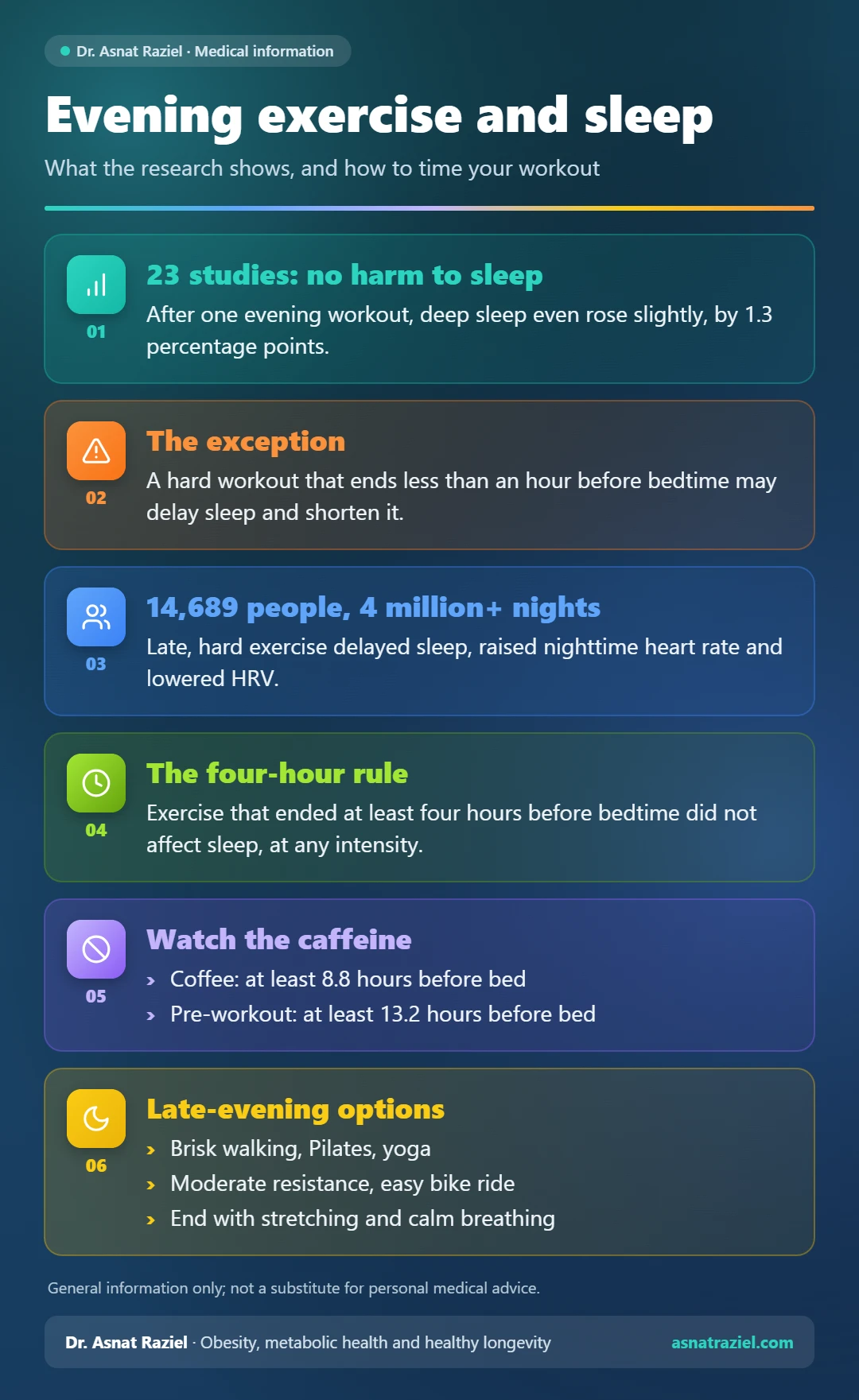
For years, the prevailing assumption was that an evening workout “wakes up the body.” However, research tells a different story. A systematic review and meta-analysis of 23 studies looked at healthy people after a single evening workout. The researchers found no harm to sleep. On the contrary, the share of deep sleep rose slightly, by 1.3 percentage points.
The only exception in this review was a hard workout that ended less than an hour before bedtime. In that case, exercise may hurt the time it takes to fall asleep, sleep duration and sleep efficiency. In addition, a large meta-analysis of 66 studies showed that regular physical activity improves sleep quality and shortens the time it takes to fall asleep.
The largest study to date
In 2025, the journal Nature Communications published a study of 14,689 active people. The participants wore a fitness band for a year, and the researchers analyzed more than four million nights. Late, hard exercise delayed falling asleep and shortened sleep. Moreover, nighttime heart rate went up, and heart rate variability went down.
Heart rate variability (HRV) is a measure of how well the nervous system recovers. A low value suggests that the body is still on alert. Still, the main finding is encouraging: exercise that ended at least four hours before bedtime did not affect sleep, at any intensity.
Why a late, intense workout makes it hard to fall asleep
Interval training, hard running or heavy strength training activate the sympathetic nervous system. This is the body’s “fight or flight” system. Heart rate goes up, body temperature rises, and the body stays on alert. When the workout ends shortly before bedtime, the body does not have enough time to calm down.
As a result, you may fall asleep later and sleep less soundly. As researchers at Monash University explained, it was specifically the combination of high intensity and a late hour that caused the biggest disruption.
The gap between your workout and bedtime
One especially practical finding concerns the time gap. When three to four hours pass between an intense workout and sleep, most of the negative effects disappear. Your heart rate returns to normal. Then your body temperature drops, and your nervous system gradually calms down.
In contrast, light exercise needs a much shorter gap. Brisk walking, Pilates, yoga, moderate resistance training or an easy bike ride also suit later hours. For many people, they even reduce tension and shorten the time it takes to fall asleep.
Evening exercise and sleep: there is no single rule for everyone
Some people have exercised in the evening for years, even at high intensity, and sleep beautifully. Others feel that any late activity disturbs them. These differences stem from several factors. For example, your personal biological clock, fitness level, emotional state and eating habits all play a part. Caffeine intake and your evening routine matter as well.
Caffeine, for instance, affects sleep for many hours. A meta-analysis of 24 studies found that caffeine cut sleep by 45 minutes. The researchers recommended drinking coffee at least 8.8 hours before bedtime. For a standard serving of a pre-workout supplement, the recommendation is at least 13.2 hours. So if you work out in the evening with such a supplement, you may be hurting your sleep without knowing it.
How to combine evening exercise and good sleep
My recommendation is personal, not one-size-fits-all. If you exercise in the evening and sleep well, there is no reason to change. However, if you have trouble falling asleep or your sleep is broken, it is worth trying a few adjustments:
- Move your intense workout a little earlier, so it ends about four hours before bedtime.
- Lower the intensity of late workouts, and favor moderate activity.
- End every workout with stretching and calm breathing exercises.
- Skip caffeine and pre-workout supplements in the afternoon and evening.
- Put screens away in the hour before bed.
Food after your workout also has an effect. A very heavy meal late at night may disturb your sleep. You can read more about this in my article on sleep and nighttime eating.
What this means if you are losing weight
In my clinic, I meet many patients who can only exercise in the evening. For them, giving up the workout is not the answer. Physical activity preserves muscle mass during weight loss, and sleep helps control hunger. That is why I suggest they build a routine that respects both. For example, a strength workout early in the evening, followed by a light dinner. That way, the body calms down in time, and sleep stays deep.
The bottom line on evening exercise and sleep
Evening exercise is not the enemy of sleep. When it is set up well, it is part of a healthy lifestyle that supports both fitness and rest. Ultimately, listening to your body and tailoring your routine are the key. People who combine evening exercise and good-quality sleep get the best of both worlds. And if your sleep is still not good, it is worth checking other factors too, such as stress, and learning how to improve sleep for better metabolic health.
The information in this article is general and does not replace personal medical advice.
References
Effects of Evening Exercise on Sleep in Healthy Participants: A Systematic Review and Meta-Analysis
Dose-response relationship between evening exercise and sleep
Exercise before bed is linked with disrupted sleep: study
The effects of physical activity on sleep: a meta-analytic review
The effect of caffeine on subsequent sleep: A systematic review and meta-analysis
Whoop, the maker of the fitness band, collaborated on the large tracking study.




