By Dr. Asnat Raziel, bariatric surgeon specializing in obesity treatment, metabolic health and healthy longevity; Director of the Multidisciplinary Center for Obesity Treatment, Assia Medical, Assuta Ramat HaChayal, Tel Aviv
Sleep deprivation and obesity: a self-reinforcing triangle
Sleep deprivation and obesity go hand in hand, and the brain sits right in the middle. Obesity harms sleep quality. Poor sleep, in turn, impairs brain function and appetite control. The damage to the brain then makes obesity worse. The result is a biological triangle that feeds itself, sometimes for years, without anyone noticing.
The good news is that you can break the cycle. Recent studies show that getting more sleep reduces eating, and that treating obesity improves sleep itself. So the right approach to obesity also starts at night.
When sleep suffers, the brain pays the price
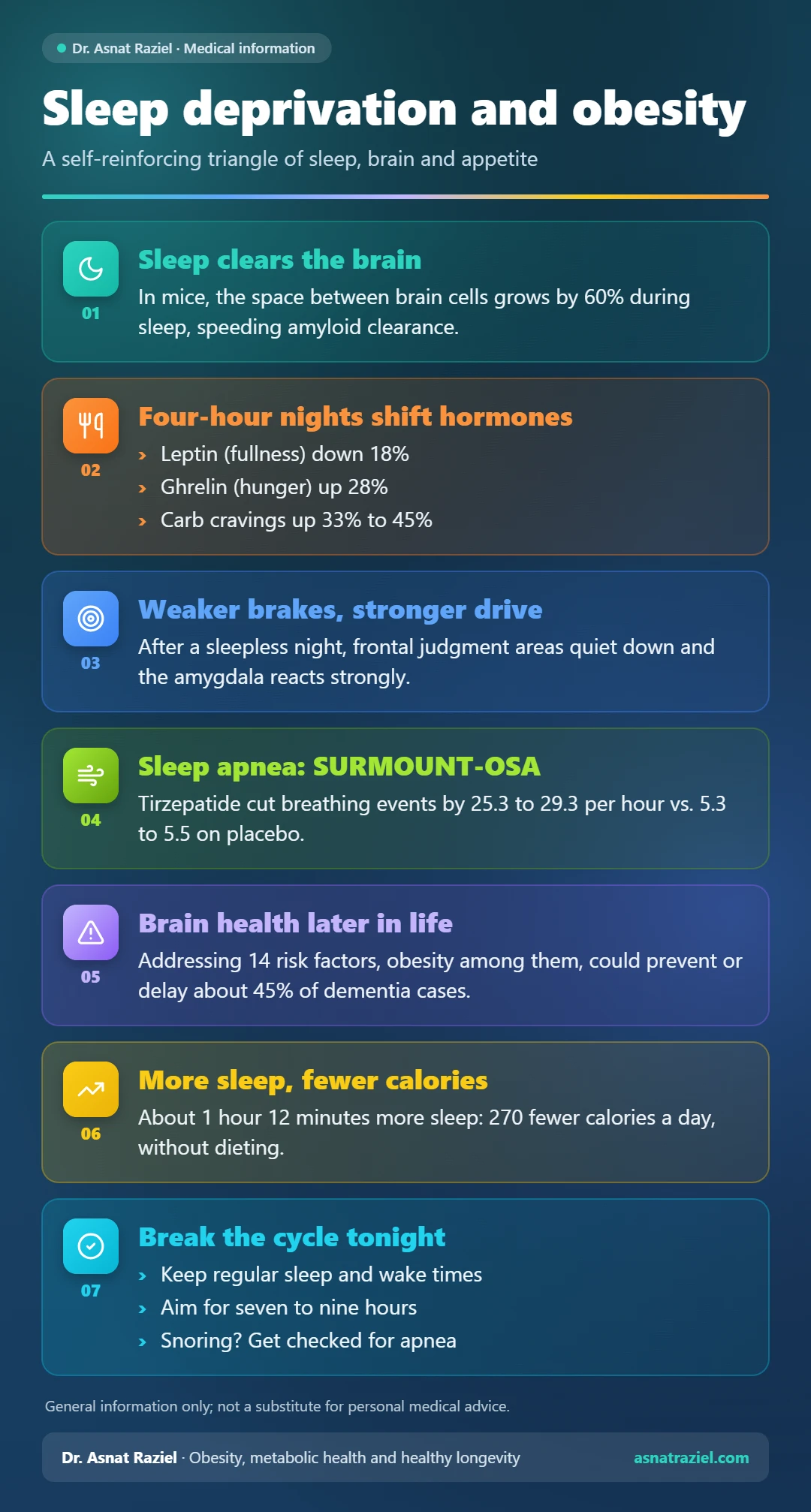
Good sleep is essential for brain function. During sleep, the brain consolidates memories, regulates emotions and balances nerve systems. It also clears out waste products. A study published in Science showed in mice that during sleep, the space between brain cells grows by 60%. As a result, the clearance of amyloid, a protein linked to Alzheimer’s disease, speeds up.
Chronic sleep loss or broken sleep disrupts these processes. The result is poorer concentration, memory and decision-making. In obesity, sleep quality often suffers. Sleep apnea, snoring, repeated awakenings and fragmented sleep are especially common, even in people who are not aware of them at all.
How sleep deprivation and obesity change appetite
Lack of sleep shifts the hormonal balance that regulates hunger and fullness. In a controlled trial at the University of Chicago, healthy young men slept four hours a night for two days. Levels of leptin, the fullness hormone, fell by 18%. In contrast, levels of ghrelin, the hunger hormone, rose by 28%. Hunger rose by 24%, and cravings for carbohydrate-rich foods rose by 33% to 45%.
The brain itself also responds differently. A brain imaging study found that after a night without sleep, the judgment areas of the frontal cortex are less active. At the same time, the amygdala, an emotional center deep in the brain, reacts strongly. In other words, the brakes weaken and the drive grows stronger. Participants chose high-calorie foods, and this choice grew stronger as their sleep loss became more severe.
The result is a tendency toward impulsive eating and difficulty sticking to an eating plan, even when motivation is there. In this situation, obesity is not the result of “bad choices.” Rather, it is a brain working under less-than-ideal biological conditions. You can read more about this mechanism in my article on hunger, the brain and food cravings.
Sleep apnea: a key link
Obstructive sleep apnea is a central link in this triangle. The pauses in breathing cause drops in oxygen and a nervous stress response, dozens or even hundreds of times a night. In this way, they impair brain function, increase inflammation and disrupt blood sugar and blood pressure control. Sleep apnea also raises the risk of stroke and early cognitive decline.
Here, there has been a real change. In the SURMOUNT-OSA trials, adults with obesity and moderate to severe sleep apnea received tirzepatide, the active ingredient in Mounjaro, or placebo for 52 weeks. The number of breathing events per hour fell by 25.3 to 29.3 events with the drug, compared with 5.3 to 5.5 with placebo. Following these results, the US Food and Drug Administration (FDA) approved tirzepatide in December 2024, under the brand name Zepbound, to treat moderate to severe sleep apnea in adults with obesity.
Obesity, sleep and cumulative brain damage
Obesity comes with chronic low-grade inflammation, insulin resistance and damage to small blood vessels, including in the brain. When this combines with poor sleep, the effects add up. Blood flow to the brain drops, neural flexibility suffers, and degenerative processes may speed up.
In 2024, the Lancet Commission on dementia listed obesity among 14 modifiable risk factors. According to the commission, addressing all 14 factors together could prevent or delay about 45% of dementia cases. Therefore, obesity in midlife is not just about weight. It is also about the future health of your brain.
Can treatment break the cycle of sleep deprivation and obesity?
The encouraging answer is yes, in both directions. First, sleep affects eating. In a randomized trial published in JAMA Internal Medicine, 80 adults with overweight who slept less than six and a half hours received brief counseling to extend their sleep. They slept about an hour and 12 minutes longer each night. As a result, they ate 270 fewer calories a day, without dieting, and lost weight.
Second, weight loss improves sleep. It reduces sleep apnea and improves alertness, concentration and memory. Obesity medications also contribute by reducing sleep apnea, improving blood sugar control and lowering inflammation. Their effect on the satiety centers in the brain also helps quiet the urge to eat.
Sleep as part of the treatment plan
Obesity treatment that ignores sleep is incomplete. That is why I recommend that every plan include a sleep quality assessment, screening for sleep apnea, better sleep habits and, in some cases, dedicated treatment. When sleep improves, the brain cooperates much better. It becomes easier to control appetite, stick to a healthy diet, exercise and make healthy decisions.
Practical steps to break the cycle of sleep deprivation and obesity
- Keep a regular bedtime and wake-up time, even on weekends.
- Aim for seven to nine hours of sleep a night.
- Avoid a heavy meal in the two hours before bed. I wrote separately about the link between sleep and late-night eating.
- Keep screens away from the bed, and make the bedroom dark.
- Snoring, morning fatigue or pauses in breathing? Get checked for sleep apnea.
- Include physical activity, ideally not too close to bedtime.
The bottom line
Obesity, sleep and brain health are three corners of the same triangle. Effective treatment must address all of them together. Ultimately, sleep is not a luxury, and the brain is not separate from the body. When we treat sleep deprivation and obesity at the same time, it is not only the weight that changes. Clarity, daily function and quality of life improve as well.
The information in this article is general and does not replace personal medical advice.
References
Sleep drives metabolite clearance from the adult brain
The impact of sleep deprivation on food desire in the human brain
Tirzepatide for the Treatment of Obstructive Sleep Apnea and Obesity
FDA Approves First Medication for Obstructive Sleep Apnea
Dementia prevention, intervention, and care: 2024 report of the Lancet standing Commission
The SURMOUNT-OSA trials were funded by Eli Lilly, the maker of tirzepatide.




