By Dr. Asnat Raziel, bariatric surgeon specializing in obesity treatment, metabolic health and healthy longevity; Director of the Multidisciplinary Center for Obesity Treatment, Assia Medical, Assuta Ramat HaChayal, Tel Aviv
Tiredness and appetite at night: weakness or biology?
Nighttime appetite is often seen as a weakness or a lapse in discipline. Many patients tell me, “During the day I’m in control, and at night I lose it.” However, research from recent years tells a different story: the link between tiredness and appetite is largely biological. Overeating when tired is mainly a physical response. It involves hormones, the brain and an internal clock, all working together.
Sleep is not a passive state of rest. Rather, it is an active process that regulates appetite, blood sugar balance and how energy is divided between muscle and fat. When sleep is short or poor, the body responds with a strong urge to eat. At the same time, it tends to store energy. I wrote about the broad effects of sleep deprivation in another article. Here, we will focus on late-night hunger.
Hunger and fullness hormones when you are short on sleep
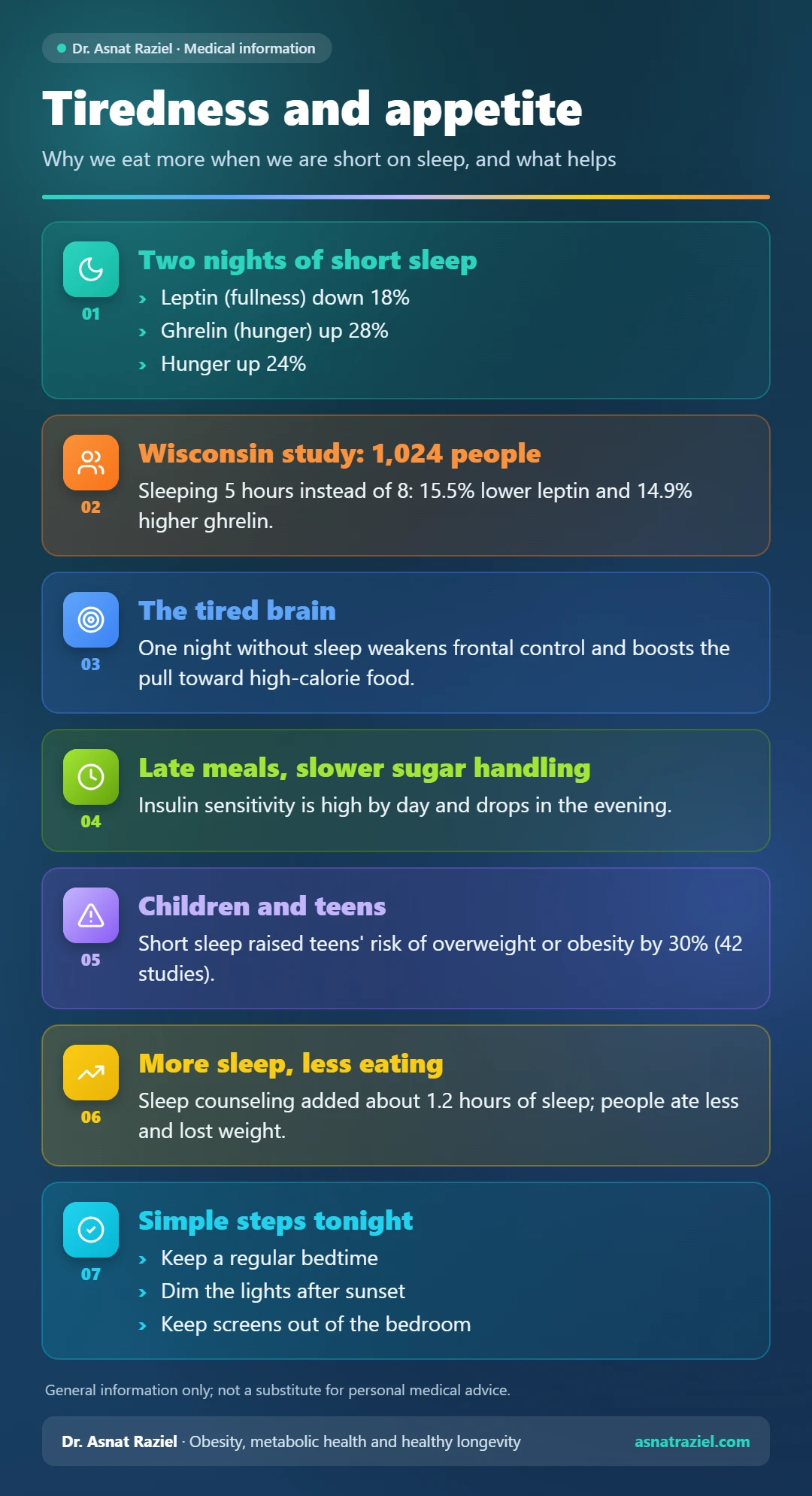
The key finding in this field involves two hormones. Ghrelin, which comes from the stomach, increases hunger. Leptin, which comes from fat tissue, signals fullness to the brain. In a controlled study from the University of Chicago, two days of short sleep lowered leptin by 18% and raised ghrelin by 28%. Hunger rose by 24%. In addition, appetite for carbohydrate-rich foods rose by 33%-45%. Admittedly, only 12 young men took part, but the findings were repeated in larger studies.
For example, a population study in Wisconsin included 1,024 participants. According to the researchers’ estimate, people who sleep 5 hours instead of 8 end up with 15.5% lower leptin and 14.9% higher ghrelin. In other words, strong hunger and weak fullness.
Sleep deprivation also impairs insulin sensitivity. As a result, blood sugar rises more after meals, and the body tends to store energy in fat tissue. Put simply, the body doesn’t just “want” to eat. It also gets ready to store.
The tired brain and the reward system
Sleep loss also changes how the brain itself works. In a brain imaging study in Nature Communications, one night without sleep weakened activity in the evaluation areas of the frontal cortex. Meanwhile, activity in the amygdala, an emotional center of the brain, increased. As a result, participants especially wanted high-calorie foods.
This combination of strong temptation and weak control sets the stage for impulsive eating. It is not a character flaw. Instead, it is a brain that works differently when tired. Tiredness and appetite are wired together, as I explain in my article on sleep deprivation, the brain and appetite.
Tiredness and appetite: a self-feeding cycle
The link between sleep and eating goes both ways. Sleep deprivation increases hunger and cravings for energy-dense food. On the other hand, heavy eating at night disrupts the next night’s sleep through discomfort, reflux and blood sugar swings. This creates a cycle: short sleep, hunger, late-night eating, poor sleep, and hunger again the next day.
Many patients try to break the cycle with a strict diet. However, when sleep itself is not addressed, the effort becomes an ongoing fight against physiology.
The biological clock and meal timing
Beyond how long we sleep, timing matters too. The body runs on a circadian rhythm, an internal 24-hour clock that guides metabolism. Insulin sensitivity is high during the day and drops in the evening. Therefore, late eating comes at a time when the body handles sugar slowly. I discuss this in detail in my article on meal timing and health.
In addition, bright light in the evening, especially from screens, suppresses melatonin, the sleep hormone, and delays bedtime. Every extra waking hour widens the “window of opportunity” for eating. The result is a double disruption: late sleep and plenty of temptation.
Children and teens: especially sensitive
In adolescence, the biological clock tends to shift later. Combined with screens and light at night, this leads to chronic sleep deprivation. A meta-analysis of 42 studies examined this link over time. In teens, short sleep raised the risk of overweight or obesity by 30%. In middle childhood, the risk was 2.23 times higher.
At a young age, the reward system is especially sensitive to stimuli. When sleep deprivation meets readily available ultra-processed food, a lasting preference for energy-dense food develops. Children don’t only inherit nutrition guidelines. They also inherit sleep patterns, lighting and habits. That is why parents should also pay attention to their teens’ screen time.
Sleep as part of obesity treatment
In metabolic medicine, sleep is not a side issue. It is part of the treatment plan for obesity, diabetes and metabolic syndrome. For this reason, I ask every patient in my clinic how long they sleep, how well they sleep and when they fall asleep. According to the consensus statement of the American Academy of Sleep Medicine, adults should regularly sleep at least 7 hours a night. The statement also links shorter sleep to weight gain and metabolic problems.
Tiredness and appetite: what you can do
The good news is that sleep can be changed, and that change affects eating. A controlled trial in JAMA Internal Medicine included 80 adults with overweight who slept less than 6.5 hours a night. A personal counseling session on sleep habits lengthened their sleep by about 1.2 hours. As a result, participants ate significantly less and lost weight, without dieting.
A few simple steps can help:
- Keep a regular bedtime, even on weekends.
- Dim the lights after sunset.
- Keep screens out of the bedroom.
- Keep the bedroom dark, quiet and cool.
Once sleep settles, hunger calms down too. It is not always dramatic or immediate, but it is cumulative and meaningful. And if the hunger continues during the day as well, it is worth reading about “food noise,” the constant thoughts about food.
The bottom line on tiredness and appetite
Nighttime appetite is not a moral failure. Instead, it results from hormonal, neural and circadian changes, so tiredness and appetite rise together. Willpower matters, but on its own it cannot beat a biological system pushing in the other direction. So before adding more restrictions or workouts, it is worth asking a basic question: how much, and how well, do you sleep? Sleep is not a luxury. It is one of the cornerstones of metabolic health.
The information in this article is general and does not replace personal medical advice.
References
The impact of sleep deprivation on food desire in the human brain




