By Dr. Asnat Raziel, bariatric surgeon specializing in obesity treatment, metabolic health and healthy longevity; Director of the Multidisciplinary Center for Obesity Treatment, Assia Medical, Assuta Ramat HaChayal, Tel Aviv
Obesity diagnosis: why weight alone is no longer enough
For years, obesity diagnosis relied almost entirely on weight. BMI became the main tool, and the conversation centered on the number on the scale. However, at the European Congress on Obesity, ECO 2026, a far broader and more accurate picture emerged. Obesity is a chronic, multisystem disease. It affects physical, mental and functional health, well beyond the kilograms.
The central message of the congress was clear. To improve our patients’ health, we need to diagnose on time, measure correctly and treat before complications become irreversible.
The two pillars of obesity diagnosis
In 2024, the European Association for the Study of Obesity (EASO) introduced a new diagnostic framework. The framework rests on two components.
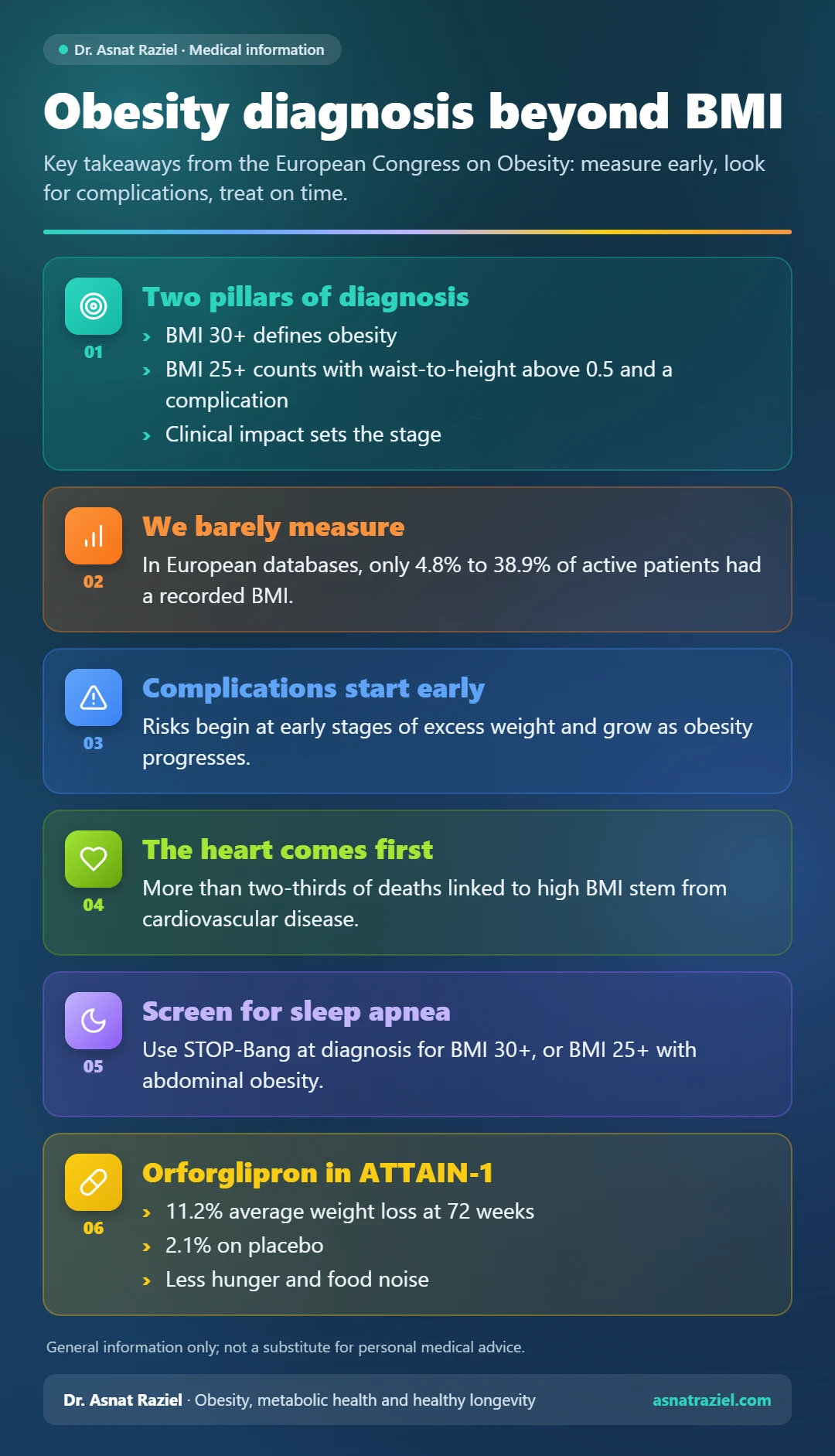
The first is the anthropometric component, meaning body measurements. A BMI of 30 or higher defines obesity. In addition, the framework gives special weight to abdominal obesity. So even a BMI of 25 or higher can meet the definition of obesity. This applies when the waist-to-height ratio is above 0.5 and there is a medical, functional or psychological complication.
The second is the clinical component. Here we look at the actual impact of the disease: medical complications, impaired daily functioning and psychological effects. Together, the two components determine the stage of the disease and allow personalized treatment. That is how we see that two people with the same BMI can be in completely different states of health. I expanded on this in an article on the EASO framework and personalized treatment.
Europe discovers that we barely measure
One of the most surprising findings concerned the most basic documentation. The IMPACT-O study examined medical databases covering millions of adults in the UK, Germany, France, Italy, Spain and other countries. In each database, only 4.8% to 38.9% of active patients had at least one recorded BMI measurement.
The implications are dramatic. If we don’t routinely measure weight, height and waist circumference, timely obesity diagnosis becomes very difficult. It is also hard to track the disease and offer suitable treatment. That is why the experts called for “naming the elephant in the room.” In other words, every medical file should record weight and BMI, just like blood pressure or blood sugar. If you want to check for yourself, a guide to calculating BMI can help.
Timely obesity diagnosis: complications start earlier than you think
Data presented at the congress showed that obesity complications begin as early as the first stages of excess weight. As the degree of obesity rises, the number and severity of complications rise too. The list is long: heart disease, type 2 diabetes, high blood pressure, fatty liver, sleep-disordered breathing, joint problems, several types of cancer and mental health disorders.
This leads to an important message. There is no point in waiting until a patient develops related diseases. On the contrary, intervention should start as early as possible.
The three Ms: a way to understand obesity
One approach at the congress divided complications into three groups:
- Mechanical: strain on the joints, obstructive sleep apnea, limited mobility and pain.
- Metabolic: diabetes, high blood pressure, blood lipid disorders and fatty liver.
- Mental: reduced quality of life, depression, anxiety, stigma and a damaged self-image.
This division is a reminder that obesity is not a disease of fat tissue alone. Instead, it affects the whole person.
The heart at the center: two-thirds of deaths
According to a large global analysis in NEJM, more than two-thirds of deaths linked to high BMI stem from cardiovascular disease. Therefore, preventing heart disease is central to modern treatment.
The congress also featured a new analysis of the ATTAIN-1 trial, which tested the pill orforglipron. Over the course of the trial, the high dose led to an average weight loss of 11.2% after 72 weeks, compared with 2.1% on placebo. In April 2026, the FDA approved the drug under the name Foundayo.
In the new analysis, the researchers calculated 10-year cardiovascular risk using the Framingham model. The model draws on age, BMI, blood pressure, smoking and diabetes. In the placebo group, risk rose slightly, while it fell in every treatment group. Projecting these results onto whole populations, the researchers estimated that long-term treatment could prevent hundreds of thousands of cardiac events over the next decade. Keep in mind, though, that this is a model estimate, not the result of an outcomes trial.
Sleep apnea: the complication we must not miss
A prominent topic at the congress was obstructive sleep apnea (OSA). It is one of the most common and dangerous mechanical complications of obesity. The syndrome is linked to mortality, high blood pressure, road accidents and poorer quality of life. Even so, many people with OSA remain undiagnosed.
That is why a new European consensus recommends screening for sleep apnea at the time of obesity diagnosis. The recommendation applies to anyone with a BMI of 30 or higher, or a BMI of 25 or higher with abdominal obesity. For screening, experts recommend the STOP-Bang questionnaire, a simple, quick tool that identifies patients at risk. I also wrote about this link in my article on obesity and sleep apnea.
Not just weight loss: a quieter mind
One of the hot topics in the GLP-1 era is food noise, meaning constant thoughts about food. Many patients describe persistent hunger and a daily preoccupation with eating. Yet only in recent years have researchers begun to measure the phenomenon systematically.
In the ATTAIN-1 analysis presented at the congress, patients on orforglipron reported less hunger and fewer thoughts about food. In addition, they reported greater satiety and fullness, along with a weaker emotional response to food cues. Many said it “freed up space in their head” for family, work and physical activity. You can read more in my article on food noise and how to treat it.
Quality of life as a key treatment measure
Beyond weight, the researchers also assessed quality of life with the SF-36 and IWQOL-Lite questionnaires. Improvement appeared in almost every domain: general health, physical function, energy, mental well-being and social functioning. Moreover, the improvement was far greater than in the placebo group. In other words, we also measure treatment success by the ability to live a full, active life.
The bottom line on obesity diagnosis
The message that summed up ECO 2026 was sharp: we diagnose obesity too late. Good obesity diagnosis starts with routine measurement and recording of weight, BMI and waist circumference. Next, we need to identify complications early and start the treatment conversation on time, including about medication.
Obesity is a lifelong chronic disease. The sooner we identify it and act, the more we can prevent diabetes, heart disease, sleep apnea and many other complications. Ultimately, the new obesity medicine is about extending life, improving its quality and restoring metabolic health to the whole person.
The information in this article is general and does not replace personal medical advice.
References
A new framework for the diagnosis, staging and management of obesity in adults
Health Effects of Overweight and Obesity in 195 Countries over 25 Years
Orforglipron, an Oral Small-Molecule GLP-1 Receptor Agonist for Obesity Treatment
FDA approves orforglipron, an oral GLP-1, for adults with obesity
STOP-Bang Questionnaire: A Practical Approach to Screen for Obstructive Sleep Apnea




