By Dr. Asnat Raziel, bariatric surgeon specializing in obesity treatment, metabolic health and healthy longevity; Director of the Multidisciplinary Center for Obesity Treatment, Assia Medical, Assuta Ramat HaChayal, Tel Aviv
Obesity drug guidelines: a new US document
In March 2026, three leading US organizations released new obesity drug guidelines. The document states that obesity medications are a central part of treatment, not a minor add-on. Obesity is no longer seen as a matter of willpower. Instead, it is a chronic, biological and progressive disease, and it should be treated as one.
Representatives of three organizations wrote the document:
- The Obesity Society (TOS).
- The Obesity Medicine Association (OMA).
- The Obesity Action Coalition (OAC).
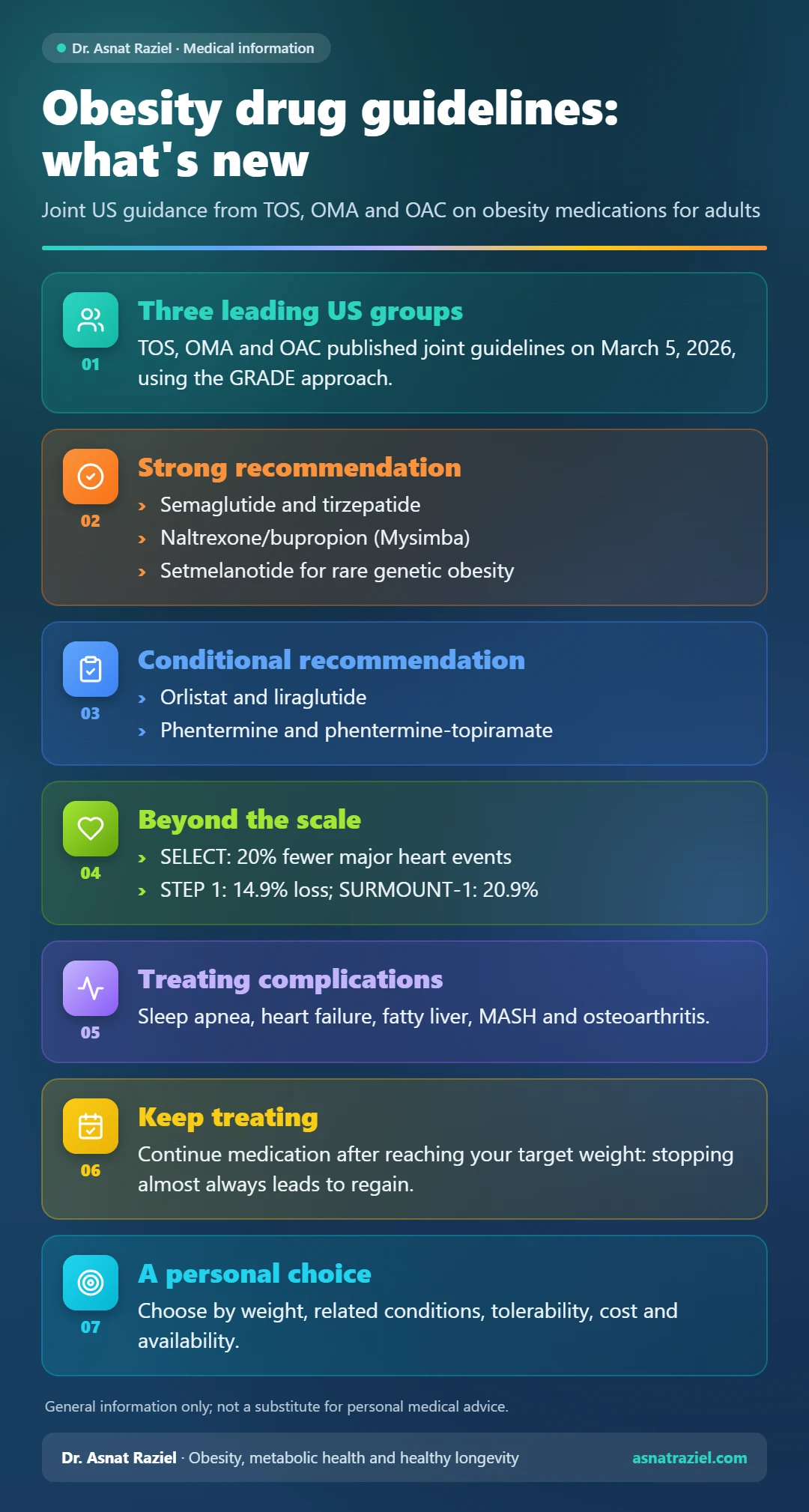
The guidelines appeared on March 5, 2026, in two journals: Obesity Pillars and Obesity. They rely on the GRADE approach, one of the most rigorous methods in the world for developing clinical recommendations. People living with obesity also had representatives on the panel.
No longer an add-on to lifestyle, but full medical treatment
One of the document’s most striking messages is the new status of medications. The authors stress that we should treat them like therapy for high blood pressure or diabetes. In other words, they are a long-term, chronic treatment that prevents the disease and its complications from progressing. In fact, as Dr. Jonathan Purnell, one of the panel’s co-chairs, put it, “medications are no longer optional add-ons to lifestyle recommendations.”
That said, all the recommendations are meant to work together with nutrition, physical activity and behavioral support. The medication is part of the story, not the whole story.
Four in ten Americans live with obesity
According to the document, 40.3% of US adults live with obesity. Over the past decade, the rate of severe obesity rose from 7.7% to 9.7%. Despite this, fewer than one-third of people with obesity receive a medical diagnosis. Moreover, in the past only about 1.6% of eligible people received any treatment.
The authors list the barriers: economic gaps, stigma, a lack of physician training and no insurance coverage. You can read about the cost of stigma in my article on weight stigma and respectful language.
Which medications the obesity drug guidelines cover
The document reviewed every medication that the FDA, the US Food and Drug Administration, has approved for obesity. The panel divided its recommendations into two levels: “we recommend” (a strong recommendation) and “we suggest” (a conditional recommendation).
- Strong recommendation: semaglutide, tirzepatide, naltrexone/bupropion and setmelanotide for rare genetic obesity.
- Conditional recommendation: orlistat, phentermine, phentermine-topiramate and liraglutide.
In Israel, naltrexone/bupropion is sold as Mysimba, and phentermine is sold as Razin. The US guidelines note that phentermine was originally approved for short-term use, but today doctors also use it long term. In Israel, the Ministry of Health has lifted the three-month limit, so doctors can now prescribe it long term with medical follow-up.
Semaglutide: weight loss and heart protection
Semaglutide is a GLP-1 drug given as a once-weekly injection. In the STEP 1 trial, weight fell by 14.9% over 68 weeks, compared with 2.4% on placebo. In addition, 50.5% of patients lost 15% or more of their body weight.
Beyond weight, the drug reduced the risk of a major cardiovascular event by 20% in the SELECT trial. The trial included people with heart disease and obesity, without diabetes. That’s why, within the obesity drug guidelines, the panel also suggests semaglutide for people who have had a heart attack, a stroke or peripheral artery disease. Furthermore, the document stresses that quality of life, not just kilograms, is a key goal of treatment.
Tirzepatide: unprecedented weight loss
Tirzepatide acts on two hormones, GIP and GLP-1. In the SURMOUNT-1 trial, weight fell by 20.9% at the 15 mg dose, compared with 3.1% on placebo. About half of patients on the higher doses lost 20% or more of their body weight. In other words, this treatment comes close to some of the results of bariatric surgery, especially when combined with multidisciplinary care.
The drugs affect every system in the body
One of the document’s innovations is its view of obesity as a multisystem disease. The guidelines also suggest GLP-1 drugs and tirzepatide for treating complications. Examples include sleep apnea, heart failure with preserved ejection fraction, fatty liver, metabolic liver inflammation (MASH) and osteoarthritis.
For example, in the SURMOUNT-OSA trial, breathing interruptions fell by about 20 events per hour more than with placebo. You can read more in my article on obesity and sleep apnea. In heart failure, studies showed better symptoms and function. In fatty liver, both fat and inflammation decreased.
Obesity drug guidelines: ongoing chronic treatment
One of the strongest recommendations in the document concerns the weight maintenance phase. The panel recommends continuing drug treatment even after reaching the target weight. The reason is simple: stopping treatment almost always leads to weight regain.
In the studies the panel reviewed, patients who stayed on treatment maintained their weight loss. In contrast, those who switched to placebo regained weight. Just as you don’t stop blood pressure treatment when your numbers improve, the same applies to obesity.
Obesity drug guidelines: quality of life and food noise
The document gives quality of life equal weight to mortality and heart events. The authors also explicitly mention what many patients call “food noise.” This refers to relentless thoughts about food, hunger and urges to eat. You can read more about this phenomenon in my article on food noise and the chemistry of hunger.
In addition, the document raises social and economic issues. In the United States, most insurance companies limit coverage of obesity medications. The authors warn that without broad coverage, the new medications will deepen health inequalities.
What’s new since the guidelines came out?
The guidelines drew on the literature up to May 2025, so they don’t include the newest medications. Since then, the FDA approved the Wegovy pill in December 2025. In April 2026, the FDA also approved the Foundayo pill, which has been available in Israel since September 2026. The guidelines themselves state that they will be updated as new data accumulate.
What do the obesity drug guidelines mean for patients in Israel?
The document was written for the US healthcare system, but its messages are relevant to us too. First, the guidelines reinforce the understanding that long-term treatment is the norm. Second, they remind us that choosing a medication should be personal. The choice depends on weight, related conditions, tolerability, cost and availability. In addition, most of the new medications are not included in Israel’s national health basket for adults, either. Therefore, an open conversation with your doctor about costs and goals is part of treatment. You’ll find a practical guide in my obesity medication guide.
The future: personalized obesity medicine
Instead of the simplistic “eat less and move more” approach, personalized medicine is emerging. It draws on biology, genetics, psychology, quality of life and multidisciplinary care. Ultimately, the new guidelines send a clear message. Treatment is not a luxury, and it is not about appearance. It is essential medical care that improves lives and saves lives.
This article provides general information and does not replace personal medical advice.
References
Leading medical groups affirm obesity medications are safe and effective for long-term use
Once-Weekly Semaglutide in Adults with Overweight or Obesity
Semaglutide and Cardiovascular Outcomes in Obesity without Diabetes
Tirzepatide Once Weekly for the Treatment of Obesity
Tirzepatide for the Treatment of Obstructive Sleep Apnea and Obesity
The three organizations funded the guidelines. Some panel members have ties to pharmaceutical companies, as detailed in the document.




