By Dr. Asnat Raziel, bariatric surgeon specializing in obesity treatment, metabolic health and healthy longevity; Director of the Multidisciplinary Center for Obesity Treatment, Assia Medical, Assuta Ramat HaChayal, Tel Aviv
Stopping GLP-1 drugs: obesity is a chronic disease
What happens after stopping GLP-1 treatment that works, not because it failed, but because the rules say you must stop? A Japanese study published in August 2026 looks at exactly this question, which concerns many patients and doctors. The answer is fairly clear. The drugs led to significant weight loss. However, after the stop, almost all patients started to regain weight.
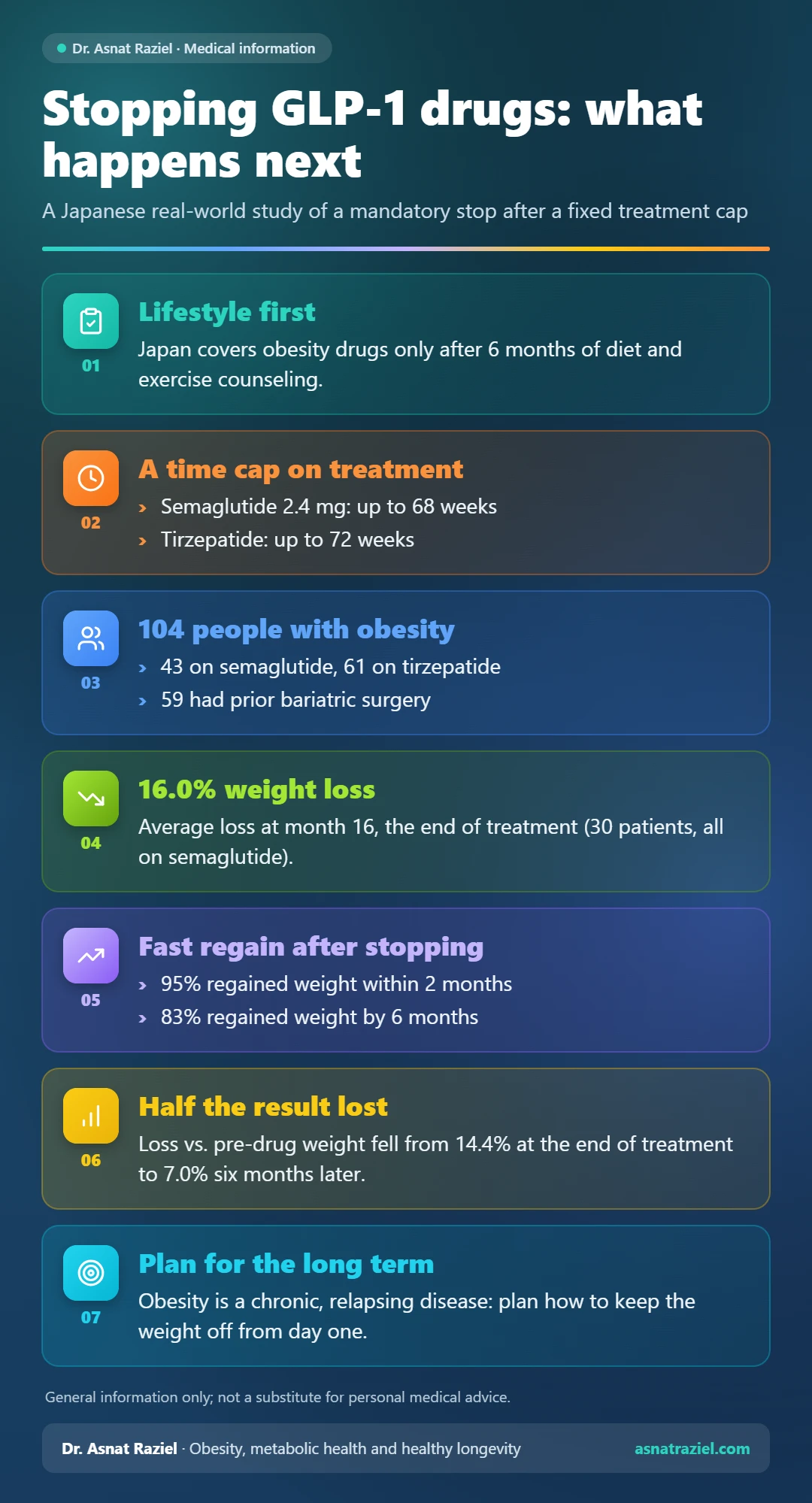
The study appeared in the journal Diabetes, Obesity and Metabolism. The researchers followed 104 people with obesity and without type 2 diabetes. Of these, 43 received semaglutide and 61 received tirzepatide. What makes the study unique is Japan’s national policy, which dictates when treatment starts and when it ends.
Lifestyle first, medication later
In Japan, public insurance covers obesity drugs only under strict conditions. First, patients must complete six months of nutritional counseling and exercise guidance. Only then can they start a medication. In addition, there is a time cap: insurance covers semaglutide 2.4 mg for up to 68 weeks, and tirzepatide for up to 72 weeks. After that, patients have to stop.
Thanks to this design, the researchers could examine three distinct periods. First came half a year of lifestyle changes alone. Next was the drug treatment period. Finally, they tracked the months after the medication ended.
Were six months of lifestyle changes enough?
The study included two groups. In the first group, 45 patients were starting obesity medication for the first time. By contrast, 59 patients had undergone bariatric surgery in the past and needed medication because of weight regain or a partial response to surgery.
During the six months of lifestyle changes alone, the first group kept an almost stable weight, with an average loss of 0.65 kg. In contrast, the post-surgery group gained an average of 2.28 kg, and 69% of them put on weight. The researchers note that for many of these patients, the gain had begun even before the study. Therefore, we can’t say the lifestyle program caused it. Still, the intervention alone did not stop it.
This is an important distinction. Good nutrition, physical activity, quality sleep and muscle preservation are the foundations of treatment. But in a person with active disease, they don’t always replace medication. People dealing with weight regain after bariatric surgery know this situation well.
Then the medications began
Once treatment started, significant weight loss followed. This is the expected finding, but the details are interesting. After six months, the first group lost 11.8% of their body weight, and the post-surgery group lost 10.8%. The difference between them was not statistically significant. In other words, previous surgery did not blunt the response to the drug. From month 4 onward, the weight-loss curves of the two groups were very similar.
Between months 10 and 14, weight loss slowed, although it continued to some extent. At the end of treatment, at month 16, the average loss reached 16.0% of body weight. This figure comes from 30 patients, all of whom took semaglutide.
What happened after stopping GLP-1 drugs
This is the dramatic part of the study. Just two months after stopping GLP-1 treatment, 21 of 22 patients, or 95%, had already regained weight. After six months, 10 of the 12 patients still in follow-up, or 83%, had regained weight.
The researchers also calculated the change relative to the weight measured six months before the drug. At the end of treatment, the loss stood at 14.4%. However, after half a year without the drug, only a 7.0% loss remained. In other words, patients lost a large part of what they had achieved within just a few months.
The findings fit earlier research
The results of this Japanese study are not surprising. Earlier controlled trials showed a similar picture. One year after stopping semaglutide, participants in the extension of the STEP 1 trial had regained two-thirds of the weight they had lost. Similarly, researchers saw a comparable pattern in the SURMOUNT-4 trial. People who switched to placebo after 36 weeks of tirzepatide gained 14.0% in body weight. By contrast, those who continued treatment lost another 5.5%.
In addition, a meta-analysis in the BMJ from January 2026 included 37 studies. The researchers found an average gain of 0.4 kg per month after people stopped weight-loss medications. According to their projection, metabolic markers return to baseline within about 1.4 years. You can read more in my article on the REST trial of tapering semaglutide.
Stopping GLP-1 drugs: do you need medication for life?
The study does not show that everyone needs GLP-1 drugs for life. Moreover, it is an observational, single-center study, not a randomized controlled trial. Even so, it reinforces an important concept: obesity is a chronic, relapsing disease. When a drug controls the mechanisms of hunger, stopping it is not necessarily a “successful finish.” For many people, it actually means taking treatment away from a disease that is still active.
In December 2025, the World Health Organization also defined obesity as a chronic, relapsing disease. Its guideline allows long-term use of GLP-1 drugs as a conditional recommendation. That’s why the Japanese researchers ask whether a mandatory stop after a fixed period fits the nature of the disease. For more on this topic, see my article on obesity as a chronic disease.
And what about lifestyle?
It’s important not to draw the opposite conclusion. The drugs don’t eliminate the need to change habits. In fact, the researchers emphasize the importance of nutrition education and physical activity. These affect behavior, body composition, safety and the maintenance of results.
So the goal is to combine, not to choose. Even in the age of medications, habits are the foundation that treatment rests on. The medication helps control the biology of the disease. At the same time, it’s worth using the period when hunger is quiet to build lasting habits: good nutrition, aerobic activity, strength training to preserve muscle and regular sleep. For a broader, cultural view of lasting habits, see my article on Japanese wisdom for a long life.
Limitations of the study on stopping GLP-1 drugs
First, we can’t apply all of the data to tirzepatide. The drug reached Japan later, so no tirzepatide patient has finished treatment yet. As a result, all the data on stopping GLP-1 treatment come from semaglutide patients. Second, the number of patients followed after the stop is small: 22 after two months and only 12 after six months. Therefore, these are important real-world data, but not the final word.
The bottom line
The message of this Japanese study is not “never stop.” Rather, the message is that an arbitrary end date makes no medical sense. Treatment of a chronic disease should not end after a fixed number of months. In the study, lifestyle changes alone barely produced any weight loss. The medication led to a 16.0% loss. After the forced stop, however, almost everyone began to regain weight.
In my view, this highlights why it’s worth asking two questions at the very start of treatment. The first is “How much will I lose?” The second, just as important, is “How will I keep the weight off for years?” If you’re thinking about stopping, read about what happens when you stop weight-loss medication and plan the process with your doctor.
This article provides general information and does not replace personal medical advice.
References
WHO issues global guideline on the use of GLP-1 medicines in treating obesity




