By Dr. Asnat Raziel, bariatric surgeon specializing in obesity treatment, metabolic health and healthy longevity; Director of the Multidisciplinary Center for Obesity Treatment, Assia Medical, Assuta Ramat HaChayal, Tel Aviv
Protein restriction: the review that challenges the nutrition world
Protein restriction is probably the last message you expected to hear this year. Lately, it seems that every product has become “protein-enriched”: yogurts, breakfast cereals, drinks, snack bars and even water. The marketing message is clear: more protein means more health, more muscle and more years.
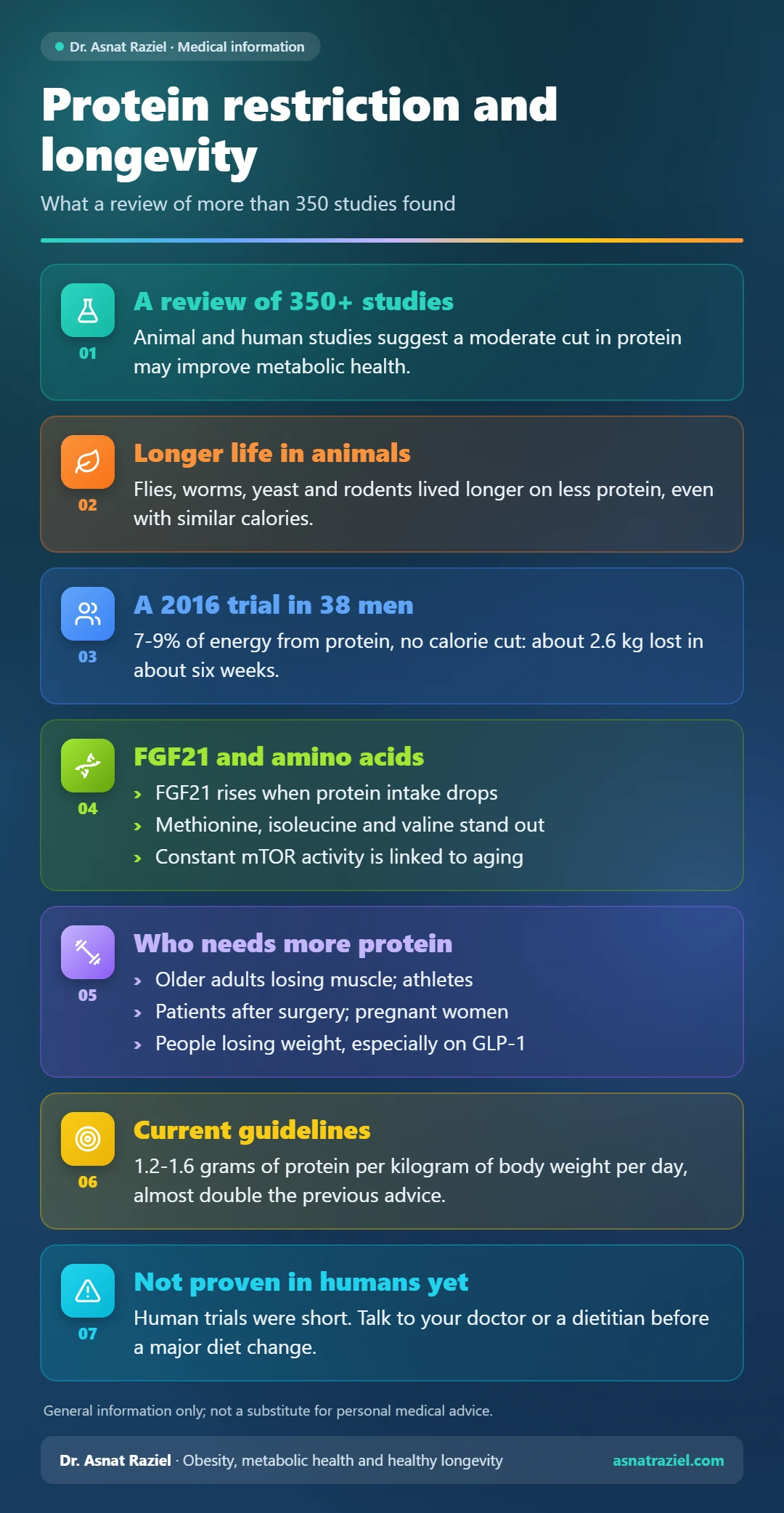
However, a broad review published in July 2026 in the journal Cell Press Blue paints a more complex picture. The researchers went through more than 350 studies in animals and humans. Their conclusion is intriguing. For many people, especially those who are not physically active, a moderate cut in protein intake may improve metabolic health and may even slow the aging process.
Not everyone needs large amounts of protein
The lead researcher, Prof. Dudley Lamming of the University of Wisconsin-Madison, does not dismiss protein. In his view, protein is clearly important for building muscle and for recovery after exercise. That said, most of the Western population is not active enough. As a result, he says, many people eat more protein than they really need. In that situation, the extra protein is not necessarily helpful, and it may even have unwanted metabolic effects.
Protein restriction as an alternative to calorie restriction
For decades, we have known that calorie restriction extends life in a wide range of animals. It also reduces diseases of aging, such as cancer, diabetes and metabolic disease. The problem is that very few people manage to stick to such a diet for years.
This is where protein restriction comes in. In many studies, flies, worms, yeast and rodents lived longer when their protein intake went down. This happened even when total calories barely changed. In other words, perhaps it is not only the number of calories that matters, but also the makeup of the diet. I wrote about meal timing as another factor in my article on when we eat and how long we live.
What happens in humans
The review also includes clinical trials. For example, a 2016 trial by Fontana, Lamming and colleagues enrolled 38 middle-aged men with excess weight. Half of them ate a diet in which protein supplied 7-9% of energy, without cutting calories. After about six weeks, they had lost about 2.6 kg. In addition, their fat mass and fasting blood sugar went down.
According to the review, other trials showed a similar picture. Participants lost weight and fat and improved their fasting blood sugar, sometimes even while eating plenty of calories overall. Still, these were short trials. Therefore, there is no proof yet that protein restriction extends life in humans.
How protein restriction may slow aging
After analyzing hundreds of studies, the researchers identified several mechanisms that come up again and again. When protein intake drops, the body shifts from a state of constant growth to a state of maintenance and repair. The effects they described include better metabolic function, a change in how cells respond to nutrients, less cell damage and preserved cell function. These are exactly the mechanisms that underlie healthy aging.
The hormone FGF21
One of the key findings in the review concerns a hormone called FGF21. When protein intake goes down, its level rises. This hormone increases energy expenditure, improves blood sugar control and reduces inflammation. In mice, high levels of FGF21 extended life, especially in males. In humans, too, eating less protein raises the level of this hormone. For instance, in the 2016 trial, it nearly doubled. Even so, it is not yet clear whether this translates into a longer life.
Not just the amount, but also the type of amino acids
Not all proteins are the same. According to the review, three amino acids stand out: methionine, isoleucine and valine. Eating too much of them may switch on growth pathways in cells. One well-known pathway in this field is mTOR, which promotes tissue building. When pathways like this are active all the time, they are linked to obesity, inflammation and diseases of aging. For this reason, researchers are now testing a moderate reduction in these amino acids as a possible longevity strategy.
The other side of protein restriction
The researchers themselves stress that the evidence is not clear-cut. In fact, many studies have shown benefits of a high protein intake. For example, protein helps preserve muscle mass during weight loss and prevents sarcopenia, the loss of muscle in older age. In addition, it improves physical function and speeds recovery after strength training.
Accordingly, the Dietary Guidelines for Americans 2025-2030 now recommend 1.2-1.6 grams of protein per kilogram of body weight per day. According to the review, this is almost double the previous recommendation. I covered the practical side of this topic in my article on protein during weight loss.
Does physical activity change the picture?
Probably, yes. Athletes sometimes eat large amounts of protein, yet they do not develop the metabolic problems seen in sedentary people. Lamming suspects that active muscles use the protein for building and repair. That way, the protein does not switch on pathways that may promote aging. So perhaps the important question is not only how much protein we eat, but also how much we exercise. You may also want to read about aerobic versus strength training.
There is no one-size-fits-all recommendation
The review emphasizes that there is no single answer. Some groups need plenty of protein:
- Older adults with declining muscle mass.
- Patients after surgery.
- Athletes.
- Pregnant women.
- Patients who are losing weight, especially on GLP-1 medications, where preserving muscle is very important.
On the other hand, for people who are not active, adding protein beyond their real needs is not necessarily helpful. For them, moderate protein restriction may actually support metabolic health.
Protein restriction through the lens of longevity medicine
The review strengthens a central trend in longevity medicine: personalized nutrition. In the future, recommendations will be based not only on age or weight. They will also take into account activity level, muscle mass, metabolic status and biological markers of aging. So instead of asking “How much protein should I eat?”, it is better to ask: how much protein does my body need at this stage of life?
The bottom line
The review does not call for avoiding protein, and protein restriction is not right for everyone. Rather, it calls on us to stop thinking that more and more protein is always better. Protein probably has an optimal range, and that range varies from person to person. For a young person who works out at the gym, a high intake may be the right choice. By contrast, for a sedentary middle-aged person, moderate protein restriction may support metabolic health. Ultimately, the future of nutrition lies in personalization, based on science, lifestyle and health goals. Before making a major change to your diet, talk to your doctor or a dietitian.
The information in this article is general and does not replace personal medical advice.
References
The hallmarks of protein and amino acid restriction in aging and longevity
Decreased consumption of branched chain amino acids improves metabolic health
Dietary Guidelines for 2025-2030: Recommendations From the USDA and HHS
Eating less protein could slow aging, major review finds
Consuming less protein could have greater health benefits and extend lifespan




