By Dr. Asnat Raziel, bariatric surgeon specializing in obesity treatment, metabolic health and healthy longevity; Director of the Multidisciplinary Center for Obesity Treatment, Assia Medical, Assuta Ramat HaChayal, Tel Aviv
Weight loss plateau: it’s not a lack of discipline
A weight loss plateau is one of the most frustrating moments in any weight loss journey. Many people know the script: the diet starts well, the weight comes off and the compliments roll in. Then, without warning, the weight loss stops. Sometimes the weight even starts creeping back up, despite effort, diligence and even stricter rules.
For many people, this is a moment of frustration, guilt and a sense of failure. Modern medicine, however, offers a completely different interpretation. When a diet stops working, it’s a sign of biology, not weakness. So the solution lies in changing the approach, not in tightening the rules.
Weight loss plateau: a predictable response from the body
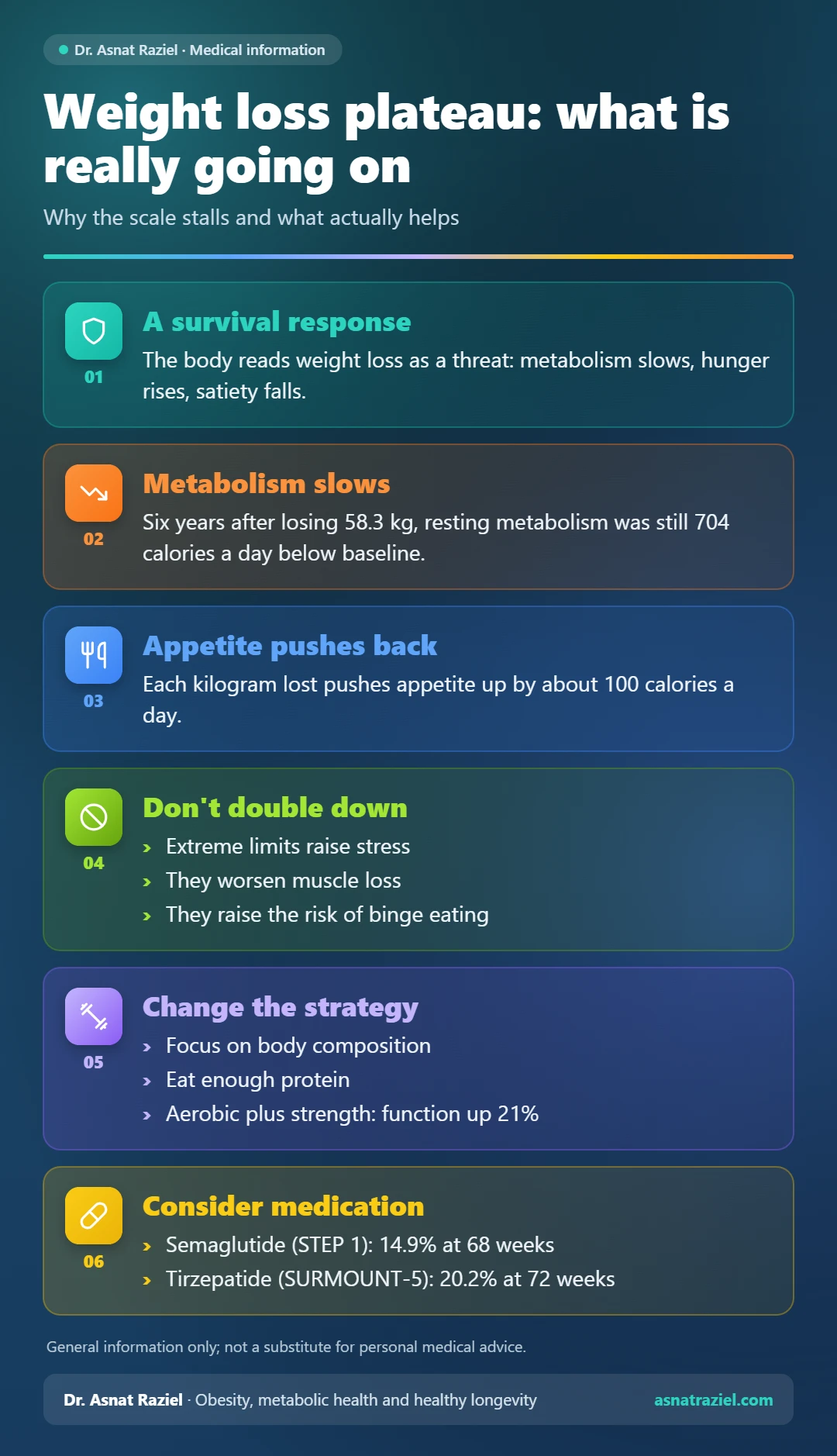
The human body is built to survive. It reads weight loss, especially rapid or large weight loss, as a threat. In response, it switches on compensation mechanisms: metabolism slows, hunger hormones rise and satiety hormones fall.
Research describes this phenomenon well. A review by Hall and Kahan describes an almost constant pattern across all treatment methods: early weight loss, then a plateau and then gradual regain. In a study of appetite hormones, participants lost 13.5 kg on average. A year later, their levels of leptin, ghrelin and other satiety hormones still had not returned to baseline, and their hunger remained high.
Why a weight loss plateau happens even when you stick to the plan
The first reason is a drop in energy expenditure. In a follow-up of contestants from the TV show The Biggest Loser, participants lost 58.3 kg on average. Their resting metabolic rate fell by 610 calories a day. Even six years later, it remained 704 calories below where they started.
The second reason is especially powerful: appetite. A study by Polidori and colleagues calculated that for every kilogram lost, appetite pushes people to eat about 100 calories a day above their starting point. That effect is more than three times larger than the slowdown in energy expenditure. In other words, the body doesn’t just save energy. It also ramps up hunger to bring the weight back.
The result is slower weight loss, even when calorie intake stays low. This is a familiar, predictable stage that research clearly supports. Yet in most cases, no one explains it to patients in time.
Why “doubling down on the diet” usually makes things worse
The intuitive response to a stall is to cut back on food even more or to ramp up exercise. But this is exactly where the risk lies. Extreme restrictions increase stress, worsen muscle loss and deepen the metabolic slowdown. In addition, they raise the risk of emotional eating, binge eating and dropping out altogether.
In other words, when biology is pressing the brakes, pressing harder on the gas doesn’t always work. Fortunately, there is a safer alternative to extreme diets.
When is a diet really “over”?
A diet stops being effective when at least one of these signs appears:
- Weight loss stalls for a long time despite sticking to the plan
- Ongoing fatigue, extreme hunger or reduced functioning
- Loss of muscle mass and declining fitness
- High emotional stress around food
These are not signs of failure. Rather, they signal that your current tool no longer fits the stage you’re at.
What to do about a weight loss plateau
The solution isn’t necessarily “another diet” but a change of strategy. First, shift from narrow calorie thinking to thinking about body composition: preserving muscle and improving fitness and function. Second, adjust your nutrition so that it is adequate, balanced and supports persistence, with enough protein.
Third, add smart physical activity, with an emphasis on strength training. In an NEJM study of older adults (aged 65 and over) with obesity, combining aerobic and strength training improved physical function by 21%. In addition, strength training reduced the loss of lean body mass. You can read about the differences between workout types in my article on aerobic vs. strength training.
Finally, consider whether you need another tool, such as medication, to rebalance the biology.
The role of medication
Sometimes diet alone can’t overcome the body’s compensation mechanisms. At this stage, medication may allow a healthy process to continue. Obesity medications are not a “shortcut.” Instead, they are a medical tool that reduces hunger, improves fullness and makes it possible to apply lifestyle changes without a constant battle against biology.
The data support this. In the STEP 1 trial, semaglutide led to an average weight loss of 14.9% after 68 weeks, compared with 2.4% on placebo. In the SURMOUNT-5 trial, tirzepatide reached a weight loss of 20.2% after 72 weeks. For many people, this is the difference between a process that breaks down and one that keeps going. I explained the mechanism in my article on how obesity medication works.
A pause can be part of the process
It’s important to understand that not every stage requires weight loss. Sometimes a period of stability, when the weight doesn’t budge but health improves, is an essential stage. Better blood sugar, blood pressure, fitness and functioning are achievements in their own right, even when the scale feels “stuck.”
What should you check at this stage? First, look at your food diary, since portions sometimes grow gradually without our noticing. In addition, short sleep, stress and certain medications can affect weight. Body fluids also cause day-to-day fluctuations. So it’s best to look at the trend over several weeks rather than at a single weigh-in.
Changing the conversation: from dieting to managing a disease
The question isn’t “which diet is the strongest” but how to manage a chronic disease wisely. Obesity is not a contest of willpower. It is a long-term process that calls for adjustment, flexibility and changing tools along the way. Just as with high blood pressure or diabetes, we adjust treatment again and again over the years. What worked in the first year won’t necessarily work in the third, and that’s perfectly fine.
The bottom line on a weight loss plateau
A weight loss plateau is not the end of the road. It is a sign to stop, think and choose the right tool. Biology isn’t the enemy but a system you learn to manage. With the right approach, professional support and a deep understanding of the process, you can keep moving forward, not by force but by working smart.
The information in this article is general and does not replace personal medical advice.
References
Maintenance of Lost Weight and Long-Term Management of Obesity
Long-term persistence of hormonal adaptations to weight loss
Persistent metabolic adaptation 6 years after “The Biggest Loser” competition
Aerobic or Resistance Exercise, or Both, in Dieting Obese Older Adults
Once-Weekly Semaglutide in Adults with Overweight or Obesity
Tirzepatide as Compared with Semaglutide for the Treatment of Obesity




