By Dr. Asnat Raziel, bariatric surgeon specializing in obesity treatment, metabolic health and healthy longevity; Director of the Multidisciplinary Center for Obesity Treatment, Assia Medical, Assuta Ramat HaChayal, Tel Aviv
Tirzepatide vs. semaglutide at the high dose: what is the question?
Tirzepatide vs. semaglutide is one of the most important comparisons in obesity treatment. Now it extends to the new 7.2 mg dose of semaglutide as well. On September 29, 2026, Eli Lilly published a new analysis, presented at the EASD meeting in Milan. According to the analysis, tirzepatide at 10 and 15 mg led to greater weight loss than semaglutide 7.2 mg.
However, the findings call for a careful reading. The comparison drew on separate studies, rather than randomly assigning patients to the two drugs in the same trial. In addition, the size of the difference and its statistical significance changed depending on the method of analysis. And there is still no head-to-head trial of the two drugs at these doses.
What exactly was compared
Mounjaro contains tirzepatide and acts on two receptors, GIP and GLP-1. By contrast, Wegovy contains semaglutide and acts on the GLP-1 receptor only. This analysis looked at a weekly 7.2 mg semaglutide injection, not the Wegovy pill or the 2.4 mg dose. The FDA approved this dose in March 2026 under the name Wegovy HD, for people who already tolerate the 2.4 mg dose well. I explain the basic differences between the two drugs in my article on the difference between Mounjaro and Wegovy.
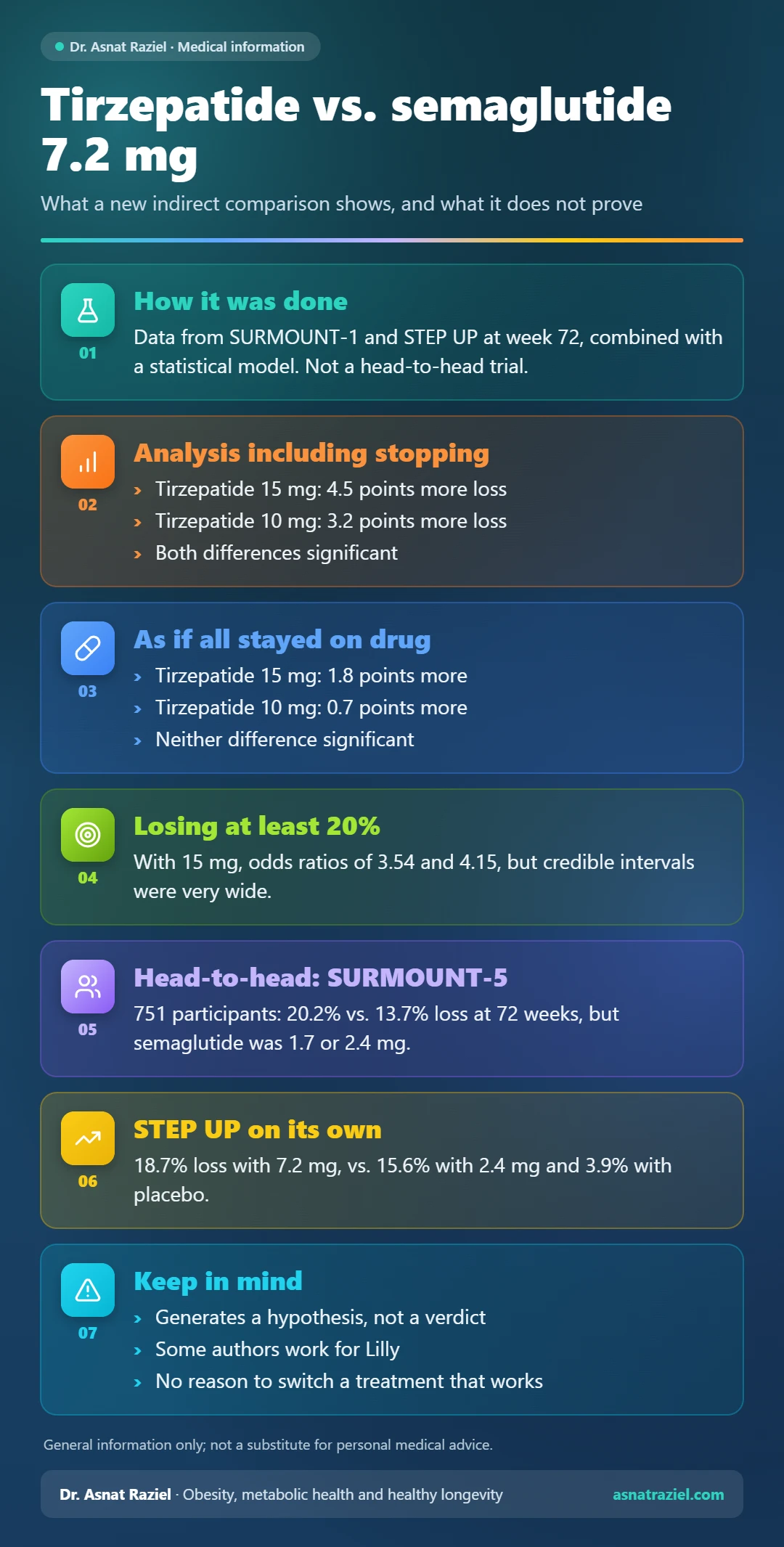
The researchers combined data from SURMOUNT-1 and STEP UP at week 72, in people with obesity without type 2 diabetes. A parallel abstract at the ENDO meeting describes the method: the entire STEP UP population, plus a subgroup of SURMOUNT-1 participants with a BMI of 30 or higher. A statistical model aimed to reduce differences between the studies, for example in the share of women and in starting BMI. Still, a model like this cannot fully reproduce a head-to-head trial.
Tirzepatide vs. semaglutide: the advantage depends on the statistical question
The company’s announcement presents two ways to estimate the effect of treatment. The first is the treatment-regimen estimand, an analysis that also includes people who stopped treatment. The second is the efficacy estimand, which estimates the effect as if everyone had stayed on the drug. Here are the results in favor of tirzepatide:
- Tirzepatide 15 mg, treatment-regimen analysis: an additional loss of 4.5 percentage points (95% credible interval: 2.8 to 6.3). The difference was significant.
- Tirzepatide 10 mg, treatment-regimen analysis: an additional loss of 3.2 percentage points (95% credible interval: 1.4 to 5.0). The difference was significant.
- Tirzepatide 15 mg, efficacy analysis: an additional loss of 1.8 percentage points. The credible interval includes zero, so the difference was not significant.
- Tirzepatide 10 mg, efficacy analysis: an additional loss of 0.7 percentage points. Here too, the credible interval includes zero, and the difference was not significant.
Note that 4.5 percentage points is not a total loss of 4.5%, nor is it a 4.5% relative advantage. As a simple arithmetic illustration only, for a starting weight of 100 kg, a gap like this equals 4.5 kg. This is not a prediction for any individual patient. The gap between the two analyses shows that the conclusion is sensitive to how stopping treatment is handled. On its own, however, it does not explain why the gap appeared.
What losing at least 20% means
With tirzepatide 15 mg, the researchers found an odds ratio of 3.54 for reaching a weight loss of at least 20% in the treatment-regimen analysis. In the efficacy analysis, the odds ratio was 4.15. However, the credible intervals were very wide: 1.05 to 11.05, and 1.02 to 15.64. By contrast, with tirzepatide 10 mg, the differences on this measure were not significant.
An odds ratio is not a ratio of probabilities. Therefore, you cannot translate this figure into a claim that your personal chance of success is three or four times higher.
Tirzepatide vs. semaglutide: what a head-to-head trial has already shown
The SURMOUNT-5 trial, published in the New England Journal of Medicine, directly compared the two drugs in 751 participants without diabetes. After 72 weeks, average weight loss was 20.2% with tirzepatide, compared with 13.7% with semaglutide. The difference was significant. You can see how this loss builds over time in my Mounjaro weight loss timeline. In that trial, though, participants received semaglutide at 1.7 or 2.4 mg and tirzepatide at 10 or 15 mg, depending on tolerability. In other words, this trial does not prove superiority over semaglutide 7.2 mg.
The high dose of semaglutide also has its own independent evidence. The STEP UP trial included 1,407 participants. In the main analysis, average weight loss was 18.7% with 7.2 mg, compared with 15.6% with 2.4 mg and 3.9% with placebo. For comparison, in the SURMOUNT-1 trial, weight dropped by 19.5% with tirzepatide 10 mg and by 20.9% with 15 mg. Even so, you cannot simply subtract numbers from different studies and call it a direct comparison. You will find more details on the new dose in my article on the STEP UP trial.
What about side effects?
According to Lilly, rates of stopping treatment because of side effects were similar in the indirect comparison. However, this is a limited measure, and it does not prove equal safety. In addition, the ENDO abstract notes that serious digestive events were too rare to compare.
In STEP UP itself, digestive side effects occurred in 70.8% of people on 7.2 mg, compared with 61.2% on 2.4 mg. Altered skin sensation (dysaesthesia) occurred in 22.9%, compared with 6.0%. But these data compare doses of semaglutide, not semaglutide with tirzepatide. You can read about the side effects of Mounjaro and how to manage them on my Mounjaro medication page.
How to read the findings
The comparison adds evidence for a possible advantage for tirzepatide, but it relies on only two trials and on statistical assumptions. The authors of the ENDO abstract wrote that they cannot rule out an effect of remaining differences between the studies. Moreover, some of the authors work for Lilly, and the announcement comes from the manufacturer. So an indirect comparison like this one is suitable for generating a hypothesis, not for settling the question. Newer drugs raise similar questions, as I explain in my article on survodutide vs semaglutide and tirzepatide. A similar question came up in the comparison between the two weight-loss pills, as I described in my article Foundayo vs. oral semaglutide.
Bottom line on tirzepatide vs. semaglutide
Clinically, an average difference in weight loss is only part of the decision. You also need to weigh tolerability, other health conditions, personal response, cost and the ability to stay on treatment. I covered costs in a separate article on the price of Wegovy and Mounjaro. Ultimately, the new data on tirzepatide vs. semaglutide help guide the conversation with your care team. But they are not a reason to switch a treatment that is working well.
The information in this article is general information and does not replace personal medical advice.
References
Tirzepatide as Compared with Semaglutide for the Treatment of Obesity
Tirzepatide Once Weekly for the Treatment of Obesity
FDA Approves Higher Dose Semaglutide (Wegovy HD) Injection 7.2 mg for Obesity
Some of the authors of the indirect comparison are employed by Eli Lilly, the maker of tirzepatide. Eli Lilly funded the SURMOUNT trials, and Novo Nordisk funded the STEP UP trial.




