By Dr. Asnat Raziel, bariatric surgeon specializing in obesity treatment, metabolic health and healthy longevity; Director of the Multidisciplinary Center for Obesity Treatment, Assia Medical, Assuta Ramat HaChayal, Tel Aviv
Semaglutide in older adults: why were doctors hesitant?
For years, semaglutide in older adults raised a lot of questions. Doctors were very cautious about treating obesity after age 65. The concerns were obvious: chronic conditions, multiple medications, the risk of side effects and loss of muscle mass. So many people asked whether GLP-1 drugs were really suitable at this age.
Now an encouraging answer has arrived. A new analysis of the STEP trials was presented at the European Congress on Obesity (ECO 2026). According to the report from the European Association for the Study of Obesity, semaglutide led to significant weight loss in people aged 65 and over, too. In addition, heart and metabolic markers improved, and the safety profile resembled that of the large trials.
Ozempic or Wegovy: what exactly was tested?
It is worth being precise from the start. The headlines talked about Ozempic, but the research tested a weekly 2.4 mg injection of semaglutide. That is the dose of Wegovy, the drug approved for obesity. Ozempic contains the same active ingredient, but it is approved for type 2 diabetes and at much lower doses. In other words, the data below apply to obesity treatment, not to diabetes treatment.
The study that looked at older patients
Prof. Luca Busetto of the University of Padua in Italy led the analysis. He worked alongside other researchers, including scientists from Novo Nordisk, the drug’s manufacturer. The abstract presented at the congress pooled data from six trials: STEP 1, 3, 4, 5, 8 and 9.
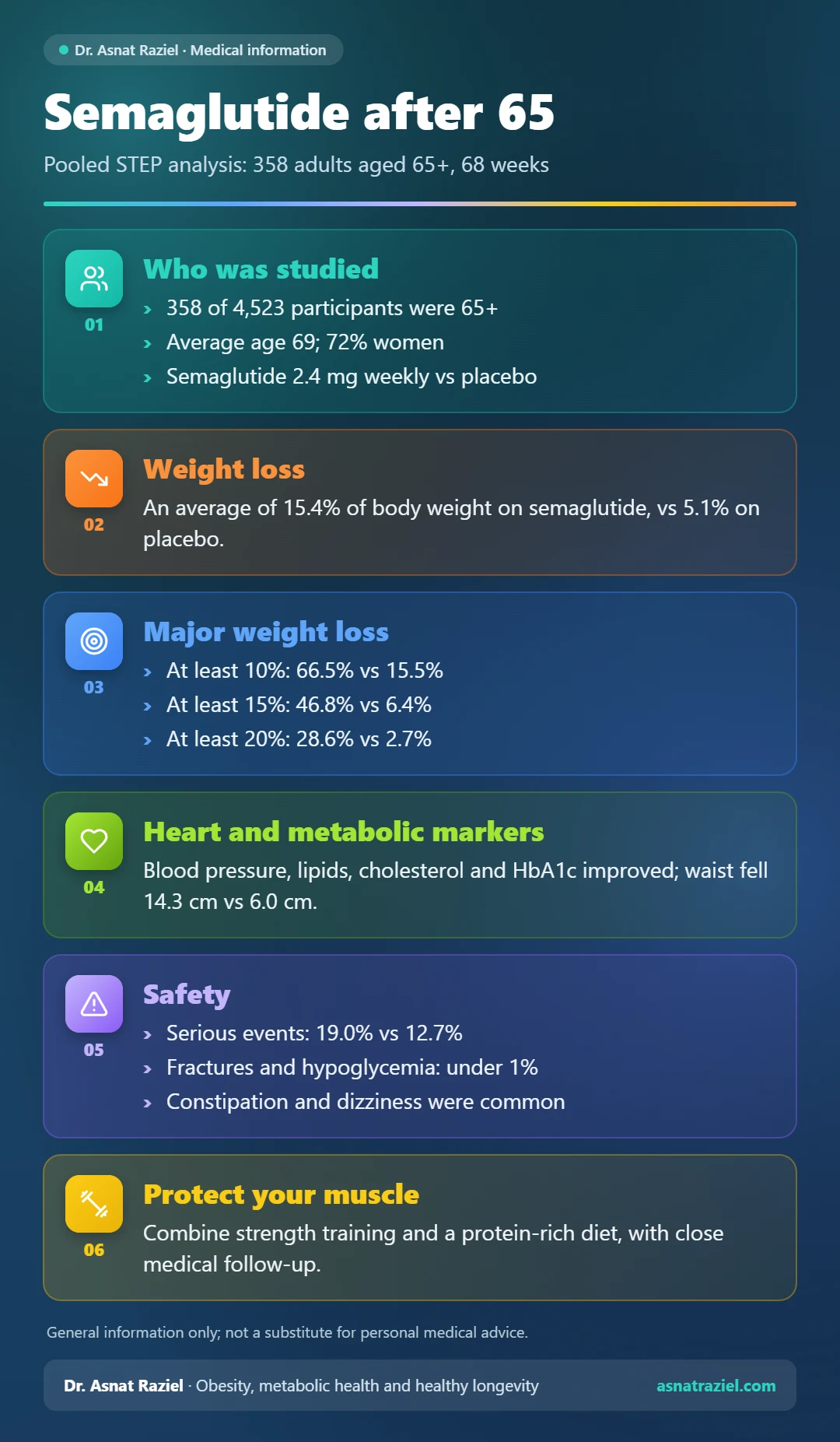
Altogether, these trials enrolled 4,523 adults with overweight or obesity and without diabetes. Of these, 358 were aged 65 or older, or 8%. Among them, 248 received semaglutide and 110 received a placebo. To take part, participants needed a BMI (body mass index) of 30 or more, or 27 or more with a related condition. All of them also received lifestyle counseling, and in STEP 3 they had intensive behavioral therapy as well. Follow-up lasted 68 weeks.
The baseline data describe a complex population. The average age was 69, and the average weight was 99 kg. The average BMI was 36.6, and the average waist circumference was 115 cm. Most participants, 72%, were women. Most of them, 90%, were between 65 and 74.
How much weight did older adults lose on semaglutide?
The key figure came after more than a year of treatment. Participants who received semaglutide lost an average of 15.4% of their body weight. By contrast, the placebo group lost only 5.1%. Weight loss like this is not a cosmetic change. It is linked to better blood pressure, healthier blood lipids and improved daily functioning.
Waist circumference also dropped markedly: 14.3 cm with the drug, compared with 6.0 cm with placebo. That means less deep belly fat, the kind of fat linked to heart disease, fatty liver and diabetes.
How many patients reached major weight loss?
The researchers also looked at how many patients reached ambitious goals. With the drug, 66.5% lost at least 10% of their weight, compared with 15.5% on placebo. In addition, 46.8% lost at least 15%, compared with 6.4%. Finally, 28.6% lost at least 20% of their weight, compared with just 2.7%.
Not just weight: heart and blood sugar markers
The analysis also examined markers that go beyond weight. In the drug group, 27.0% reached a BMI below 27 at week 68, compared with 5.5% on placebo. At the same time, 11.3% reached a waist-to-height ratio below 0.53, compared with 4.5%. For many people, that is a change in their whole medical picture, not just a number on the scale.
What’s more, metabolic markers improved. The researchers reported better blood pressure, blood lipids, cholesterol and HbA1c, the average blood sugar over the previous three months. So the treatment affected the risk factors themselves, not only body weight.
Semaglutide, the heart and age: what other studies show
This picture adds to earlier data. In March 2024, the FDA approved Wegovy to reduce the risk of major cardiovascular events in adults with obesity and heart disease. In the trial behind that approval, a major cardiac event occurred in 6.5% of patients on the drug, compared with 8% on placebo. You can read more in my article on how semaglutide protects the heart.
In addition, an age-based analysis of the SUSTAIN 6 and PIONEER 6 trials looked at people with diabetes and high cardiovascular risk. The researchers found that the drug reduced cardiac events and lowered weight in every age group. The rate of serious side effects also did not change with age.
Side effects of semaglutide in older adults
Safety matters especially at this age. Here the picture is mixed, but still encouraging. Some kind of side effect occurred in 89.1% of the drug group, compared with 84.5% on placebo. Constipation and dizziness were common in the drug group, as in earlier trials. Fractures and hypoglycemia (low blood sugar) were rare, under 1% in both groups.
However, serious adverse events occurred in 19.0% of patients on the drug, compared with 12.7% on placebo. This figure calls for close medical follow-up. A broad review of the topic appears in my article on Wegovy side effects.
What about muscle?
Beyond that, rapid weight loss can also cost muscle mass. An editorial covered by Endocrine News warned that older adults have less room for error. According to the authors, up to half of people aged 80 and over have sarcopenia, a loss of muscle mass and strength. That is why they recommended combining strength training with a protein-rich diet. It is also worth reading about how to preserve muscle during weight loss.
Limitations of the study
We should read the results with caution. This is a secondary analysis of existing trials, not a study designed in advance for older adults. In addition, the number of participants over 75 was small. The data were presented at a congress and have not yet been fully published in a journal. Finally, the drug’s manufacturer funded the trials and took part in the analysis.
Is semaglutide in older adults the start of a new era?
The main message is clear. Obesity in later life is not fate, and it is not a condition that can’t be treated. It increases the risk of heart disease, functional disability, joint pain, fatty liver and diabetes. I have also written about the unique challenges of obesity at this stage of life.
A new approach is now taking shape: controlled weight loss alongside muscle preservation. It includes tailored physical activity, enough protein and close medical supervision. This kind of approach can be part of preventive medicine for healthy aging.
The bottom line on semaglutide in older adults
The new data show that semaglutide in older adults works almost as well as in younger people. On average, patients lost 15.4% of their weight, and heart and blood sugar markers improved. On the other hand, serious adverse events were more common in the drug group, so patients need close follow-up. Ultimately, the decision should be personal, after a review of each person’s medications, muscle and function.
The information in this article is general and does not replace personal medical advice.
References
Ozempic delivers major weight loss in adults over 65, study finds
Adults Over 65 Lost Massive Amounts of Weight With Ozempic
GLP-1 Agonists and Muscle Loss: A Hidden Risk for Older Adults
The trials were funded by Novo Nordisk, the drug’s manufacturer, and company researchers took part in the analysis.




