By Dr. Asnat Raziel, bariatric surgeon specializing in obesity treatment, metabolic health and healthy longevity; Director of the Multidisciplinary Center for Obesity Treatment, Assia Medical, Assuta Ramat HaChayal, Tel Aviv
Birth control pills: what you need to know today
Birth control pills are among the most widely used medicines in the world. Millions of women take them every day, often for decades. Still, the pill raises many questions. Does it cause weight gain? Is it dangerous for your blood vessels? And what is best for a woman with polycystic ovaries?
In this article I have gathered the answers, based on studies from the past two years and leading meta-analyses. The bottom line first: for most healthy women, the pill is safe and effective. However, the risk is not the same for everyone. Age, smoking, weight, migraine and a family history of blood clots all change the picture. That is why the choice should be personal.
How birth control pills work
Most pills prevent ovulation. In other words, the ovary does not release an egg that month. In addition, the hormones thicken the mucus at the cervix, which makes it harder for sperm to pass.
With perfect use, fewer than 1 in 100 women become pregnant in a year. In real life, however, with missed and late pills, the picture is different. According to data from the US Centers for Disease Control and Prevention (CDC), about 9 in 100 women become pregnant in the first year.
Types of pills
Combined pills
The combined pill contains two hormones: an estrogen and a progestin, a synthetic version of the hormone progesterone. The usual estrogen is ethinylestradiol, most often at a low dose of 20 to 30 micrograms. The type of progestin, by contrast, varies from pill to pill, and that difference matters.
Progestins are grouped into “generations.” For example, levonorgestrel, the ingredient in Microgynon, belongs to the older generation. Desogestrel and gestodene belong to the third generation. Drospirenone, the ingredient in Yaz and Yasmin, is a newer progestin that also works against male sex hormones. There are also pills with cyproterone acetate and with dienogest.
In recent years, pills with an estrogen closer to the body’s own have also arrived: estradiol or estetrol. A laboratory-based model from 2025 suggests a milder effect on blood clotting. Even so, large population data are still missing.
The schedule also varies. Some packs have 21 pills and a one-week break, while others have 24 active pills. UK guidance also allows extended or continuous use, with no monthly break.
Progestin-only pills
This pill, sometimes called the “mini-pill,” contains no estrogen. So it also suits women who should avoid estrogen, for example while breastfeeding, with migraine with aura, or smokers over 35. Common options contain desogestrel 75 micrograms or drospirenone 4 mg. The main downside is irregular bleeding, which is much more common than with the combined pill.
Side effects of birth control pills
Most side effects appear in the first three months and then fade. The common ones are nausea, breast tenderness, headache and light bleeding between periods. For example, a Cochrane review of drospirenone pills found 3.15 times higher odds of nausea compared with placebo. The odds of bleeding between periods were 4.92 times higher, and of breast pain 2.67 times higher.
Some women report mood changes or lower sex drive. If a side effect persists, switching to a pill with a different progestin often helps. So there is no reason to suffer in silence.
Birth control pills and weight gain
This is the most common worry I hear in my clinic. The good news: a Cochrane review of combined pills and weight found no large effect on weight. However, the researchers noted that the evidence is not strong enough to rule out a small effect.
In women with polycystic ovary syndrome (PCOS), the picture is less clear. A meta-analysis of 13 controlled trials found no change in waist size. On the other hand, fat mass rose slightly. The researchers stressed that the trials varied widely, so they urged caution in reading the results.
In practice, weight gain after starting a pill can have many causes: changes in habits, sleep, stress or age. So if your weight goes up, it is worth looking at the whole picture, not only at the pill.
Obesity and the pill: why the risks add up
This point matters especially for women with excess weight. Obesity itself raises the risk of blood clots. The combined pill raises it too. When the two meet, the risks add up.
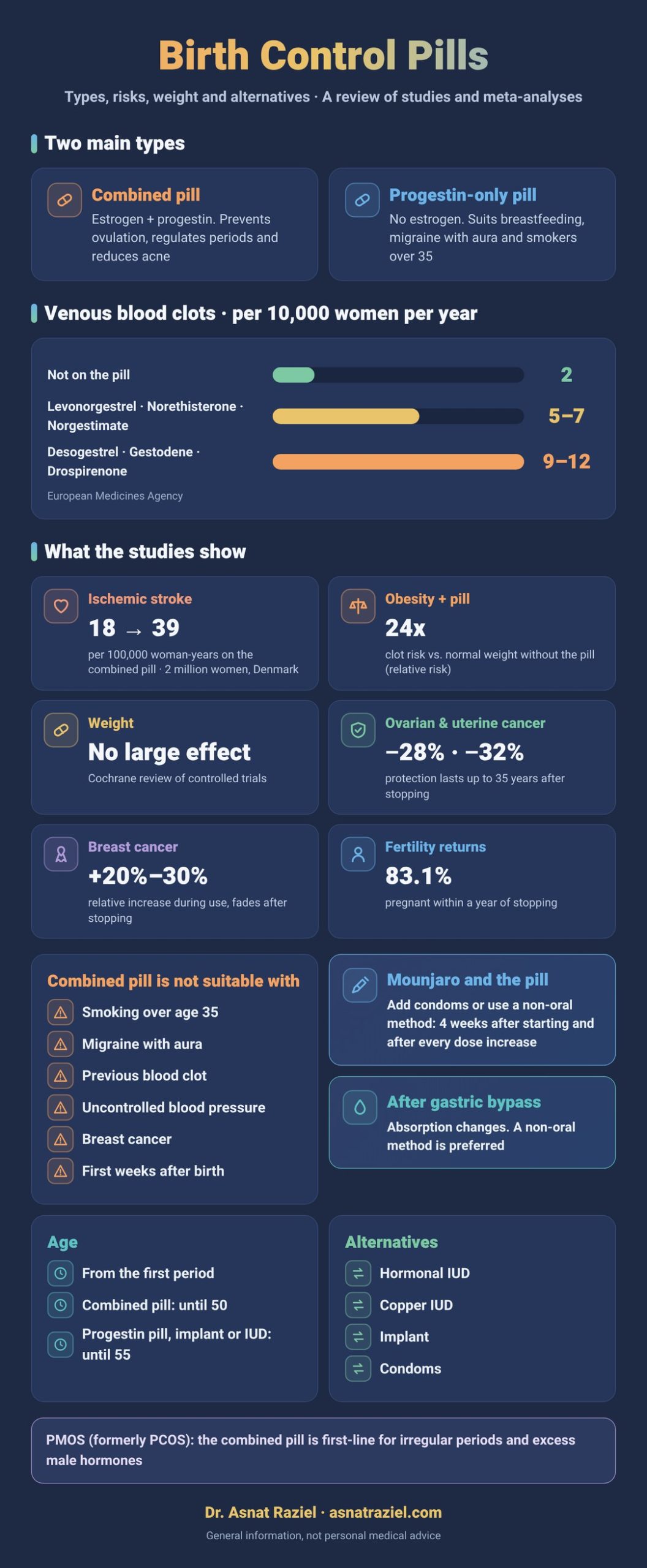
The Dutch MEGA study, a large study of risk factors for venous thrombosis, included 3,834 patients with a first blood clot. Women with obesity who took the pill had about a 24-fold higher risk, compared with normal-weight women not on the pill. Keep in mind that this is a relative risk. The absolute risk is still low, but it justifies a careful choice.
According to the CDC eligibility criteria, obesity does not rule out the combined pill. A BMI (body mass index, weight relative to height) of 30 or more falls into a category where benefits generally outweigh risks, but the decision needs thought. When other risk factors are present, an estrogen-free method is usually better.
Birth control pills and blood clots
The main complication of the combined pill is a blood clot in a vein, usually in the leg, and sometimes a clot that travels to the lung. Estrogen increases the liver’s production of clotting proteins, so the blood clots more easily. A large UK study included 10,562 women with a blood clot. The researchers found a 2.97-fold higher risk among women taking a combined pill, compared with women who were not.
Not all pills are the same
The risk depends on the type of progestin. According to a European Medicines Agency review, about 2 in 10,000 women not on the pill develop a clot each year. With pills containing levonorgestrel, norethisterone or norgestimate, the number rises to 5 to 7. With desogestrel, gestodene or drospirenone, by contrast, it reaches 9 to 12.
In the UK study, the researchers calculated 6 extra cases per year for every 10,000 women taking levonorgestrel. With desogestrel and cyproterone, they calculated 14 extra cases. In other words, the excess risk with the older pill is about half.
Moreover, the risk is highest in the first year of use. It also rises when restarting the pill after a long break. Still, it helps to keep perspective: the risk of a clot in pregnancy and after birth is higher than the risk on the pill.
Stroke and heart attack
A nationwide Danish study followed 2,025,691 women aged 15 to 49. Among women not using hormonal contraception, there were 18 ischemic strokes, meaning strokes caused by a blocked blood vessel, per 100,000 woman-years. Among combined pill users, the number rose to 39. So the risk doubled, but in practice that is about 21 extra cases per 100,000 women per year. Heart attacks showed a similar pattern: 18 versus 8.
With the progestin-only pill, the researchers saw a moderate rise in stroke risk, 1.6-fold. The hormonal IUD, by contrast, did not raise the risk of stroke or heart attack.
The pill and cancer: the worry and the full picture
On breast cancer, a UK study and meta-analysis compared 9,498 women with breast cancer with 18,171 healthy women. The researchers saw a relative increase of about 20% to 30% in risk among recent users of hormonal contraception, combined or progestin-only.
In absolute numbers, use at ages 16 to 20 added about 8 cases per 100,000 users over 15 years. Use at ages 35 to 39, on the other hand, added about 265 cases per 100,000. The excess risk fades gradually after stopping.
At the same time, the pill protects against other cancers. A study of 256,661 women in the UK Biobank, a large British health database, examined this over time. In women who took the pill, the risk of ovarian cancer was about 28% lower, and the risk of endometrial cancer about 32% lower. The protection lasted up to 35 years after stopping. The rise in breast cancer risk, by contrast, appeared only in the first two years after stopping.
The pill, mood and depression
The link between the pill and depression is still debated. A Finnish study from 2025 of women aged 15 to 49 saw no rise in depression risk. On the contrary, among users of certain combined pills the risk was about 10% to 14% lower, including in teenage girls.
On the other hand, a Danish study of 610,038 first-time mothers looked at the year after birth. Starting hormonal contraception during this period raised the risk of depression. However, the absolute risk rose only from 1.36% to 1.54%.
In addition, an American study from 2026 asked why women stop their contraception. Among those who stopped a combined hormonal method within the first six months, 21% named mood as a reason. With the progestin-only pill, the rate was 7.4%. The practical takeaway: mood complaints are real, and they are worth discussing with your doctor.
Who should not take birth control pills
According to the CDC criteria, the combined pill should usually be avoided in these situations:
Smoking over age 35: especially 15 or more cigarettes a day.
Migraine with aura: brief neurological symptoms before the headache, such as flashing lights, at any age.
A previous blood clot: or an inherited tendency to clotting.
Heart and blood vessel disease: uncontrolled high blood pressure, coronary heart disease, a past stroke, or several risk factors together, such as diabetes, smoking and high blood fats.
Breast cancer: current or recent.
Severe liver disease: such as advanced cirrhosis or certain liver tumors.
The first weeks after giving birth: when the risk of clots is especially high.
In most of these situations, except breast cancer, a progestin-only pill or an IUD is usually a good alternative. The decision is always personal and made with your doctor.
What to check before your first pill
Before a first prescription, a short conversation and a simple exam are worthwhile. These are the points I recommend checking:
Blood pressure and weight: a quick measurement in the clinic.
Smoking: how many cigarettes a day, and since when.
Migraines: especially migraine with aura.
History of blood clots: in you or a first-degree relative, especially at a young age.
Regular medicines and supplements: some epilepsy drugs, the antibiotic rifampicin and the herb St John’s wort weaken the pill.
Obesity treatment or bariatric surgery: details below.
Pregnancy plans and breastfeeding: they affect the choice of method.
A routine blood test for clotting disorders is not right for every woman. It is mainly appropriate when there is a significant family history.
How to lower the risks
Choose an older pill: when there is no reason otherwise, a pill with levonorgestrel and no more than 30 micrograms of estrogen is a good first choice.
Quit smoking: UK guidance allows a woman over 35 who stopped smoking at least a year ago to consider the combined pill again.
Lose weight: weight loss lowers the risk of clots, regardless of the pill.
Plan ahead for surgery: before major surgery involving long bed rest, tell the medical team. Sometimes the pill should be stopped about four weeks before.
Move on long flights: get up, walk around and drink water.
Know the warning signs: pain and swelling in one leg, sudden shortness of breath, chest pain, an unusual headache or weakness on one side of the body. If these occur, see a doctor or go to the emergency room right away.
Birth control pills and Mounjaro
This point is rarely discussed, yet it matters a great deal in an obesity clinic. Tirzepatide, the active ingredient in Mounjaro, slows stomach emptying. As a result, it may reduce how well the pill is absorbed.
According to a 2026 review, in the only pharmacokinetic study, a single 5 mg dose lowered the peak levels of the pill’s ingredients by 55% to 66%. Total exposure fell by 20% to 23%. The effect is strongest at the start of treatment and with dose increases.
Therefore, the Australian medicines regulator and the product label advise: women on the pill should switch to a non-oral method or add condoms. This applies for 4 weeks after starting treatment and for 4 weeks after every dose increase. By contrast, the UK College of Sexual and Reproductive Healthcare found no meaningful effect of semaglutide, the ingredient in Wegovy, on pill absorption.
In addition, vomiting or diarrhea with any treatment can weaken the pill.
After bariatric surgery
After a Roux-en-Y gastric bypass, absorption in the gut changes. So the CDC rates pills, both combined and progestin-only, as a less suitable choice after surgery that reduces absorption. After a sleeve gastrectomy, by contrast, the pill is suitable. Even so, fertility often rises as weight falls. That is why a long-acting method, such as an IUD, is often a convenient and safe choice.
Is it safe to take the pill for many years?
There is no need for “breaks” from the pill. The Royal College of General Practitioners’ study in the UK followed 46,112 women for up to 39 years. Among women who had ever used the pill, death from any cause was 12% lower, compared with women who never used it. In addition, the researchers saw no link between how long women took the pill and mortality.
Fertility also returns quickly. A meta-analysis of 22 studies found that 83.1% of women became pregnant within a year of stopping contraception. How long a woman had taken the pill did not affect the return of fertility.
Still, the years change the risk profile. A woman who started the pill at 20 is not the same patient at 42, with smoking, high blood pressure or excess weight. So it is important to review the fit every few years.
From what age, and until when?
The pill can be started from the first period. According to the CDC, from the first period until age 40 there is no restriction based on age alone. From age 40, the benefits still usually outweigh the risks, but each case is weighed on its own.
UK guidance for women over 40 prefers a pill with no more than 30 micrograms of estrogen, with levonorgestrel or norethisterone, at this age. At 50, women are advised to stop the combined pill and switch to an estrogen-free method. A progestin-only pill, an implant or a hormonal IUD can be continued until 55. By that age, natural fertility can be assumed to have ended.
It is also worth knowing that the combined pill can mask the start of menopause. The monthly bleed continues, and hormone tests are unreliable while taking it.
Polycystic ovary syndrome and birth control pills
In May 2026, the international medical community changed the name of the syndrome. The new name is PMOS, Polyendocrine Metabolic Ovarian Syndrome. The change reflects what has long been known: this is a hormonal and metabolic condition, not just “cysts” on the ovaries.
A meta-analysis that informed the international guideline supports the combined pill as a first-line treatment for irregular periods and for signs of excess male hormones, such as excess hair and acne. The guideline favors low-dose pills. Pills with cyproterone acetate, such as Diane-35, are slightly better at reducing signs of male hormones. However, the guideline does not recommend them as first-line, because of a higher risk of blood clots.
On the other hand, this syndrome often comes with insulin resistance and excess weight. These raise the risk of blood clots on their own. So the choice should also weigh weight, blood pressure and blood sugar.
Other treatment options
Lifestyle: diet, physical activity and weight loss are the foundation of care for every woman with the syndrome.
Metformin: improves insulin resistance, alone or together with the pill.
Spironolactone: a drug that blocks male hormones. A 2025 systematic review found no significant difference between it and metformin in reducing excess hair. Even so, the researchers see it as an option for women who cannot take the pill. Contraception is essential during treatment.
GLP-1 medicines: a 2026 meta-analysis found a drop of 1.38 BMI units in women with the syndrome. However, the evidence on period regularity and excess hair is still insufficient.
Birth control pills, PMS and PMDD
Premenstrual syndrome (PMS) is a set of physical and emotional symptoms in the days before a period. Its severe form, premenstrual dysphoric disorder (PMDD), involves depression, extreme irritability and impaired daily function.
The pill prevents ovulation and so reduces hormonal swings. The Cochrane review found that a pill with 3 mg drospirenone and 20 micrograms ethinylestradiol improved symptoms in women with PMDD after three months. However, placebo also had a large effect, and it is still unclear whether the pill helps milder cases.
The American College of Obstetricians and Gynecologists guideline recommends three approaches. The first is SSRIs, antidepressants that increase serotonin availability in the brain. The second is combined pills, and the third is cognitive behavioral therapy. SSRIs work quickly here. They can be taken only from about a week before the period until a few days after it starts.
Alternatives to the pill
Hormonal IUD: highly effective and works mainly locally. In the Danish study, it did not raise the risk of stroke or heart attack. It also reduces bleeding and period pain.
Copper IUD: completely hormone-free and lasts for many years. On the other hand, it sometimes increases bleeding and period pain.
Implant: a small rod in the arm that releases progestin, highly effective with nothing to remember daily.
Vaginal ring and patch: these are combined methods, so the clot risk is similar. In the Danish study, stroke risk was higher with them as well.
Progestin injection: once every three months. Guidance recommends switching at 50 because of a possible effect on bone.
Condoms: the only method that also protects against sexually transmitted infections.
Long-acting reversible contraception (LARC), such as IUDs and implants, does not depend on memory. That is why its real-world effectiveness is especially high.
The bottom line
Birth control pills are safe and effective for most women. They also lower the risk of ovarian and endometrial cancer for decades. However, the combined pill raises the risk of blood clots two- to threefold, and doubles the risk of stroke and heart attack. The absolute risk is low, but obesity, smoking, age over 35 and migraine with aura increase it.
So a wise choice starts with an open conversation with your doctor: which pill, for whom and for how long. And for women on Mounjaro or after gastric bypass, it is worth planning a non-oral method in advance.
This article provides general information and is not personal medical advice. Before starting, switching or stopping contraception, consult your doctor.
Questions and answers
Do birth control pills cause weight gain?
Reviews of controlled trials found no large effect on weight. Still, some women experience fluid retention or a small gain, and then a different type is worth trying.
Should I take a break from the pill every few years?
No. Breaks do not improve safety or fertility. On the contrary, restarting the pill after a break temporarily raises the risk of a blood clot.
What should I do when starting Mounjaro?
Add condoms or switch to a non-oral method for 4 weeks after starting and after every dose increase.
References
Studies and meta-analyses
Time-dependent effects of oral contraceptive use on breast, ovarian, and endometrial cancers
Combination contraceptives: effects on weight
Use of systemic hormonal contraception and risk of depression: a registry-based study from Finland
Postpartum Hormonal Contraceptive Use and Risk of Depression
Oral contraceptives containing drospirenone for premenstrual syndrome
Return of fertility after discontinuation of contraception: a systematic review and meta-analysis
Official guidance
Combined hormonal contraceptives – referral
Premenstrual Disorders: Guidelines From the American College of Obstetricians and Gynecologists
Updated contraception advice for Mounjaro (tirzepatide)
Guidance on oral contraceptive use with GLP-1 agonists tirzepatide and semaglutide
U.S. Medical Eligibility Criteria for Contraceptive Use, 2024: Summary of Classifications