By Dr. Asnat Raziel, bariatric surgeon specializing in obesity treatment, metabolic health and healthy longevity; Director of the Multidisciplinary Center for Obesity Treatment, Assia Medical, Assuta Ramat HaChayal, Tel Aviv
What is infrared training?
Infrared training combines physical activity with warming the body using infrared radiation. It is one of the most visible trends of recent years in the fitness and wellness world. Unlike ordinary heating of the air, the radiation warms the skin and the tissues beneath it. Many studios and wellness centers now offer this kind of workout, mainly for people looking for training that is effective, pleasant and gentle on the body.
However, alongside the benefits, exaggerated promises are also making the rounds online. So in this article, I’ll separate what the research shows from what the marketing promises.
Deep warming of the muscles
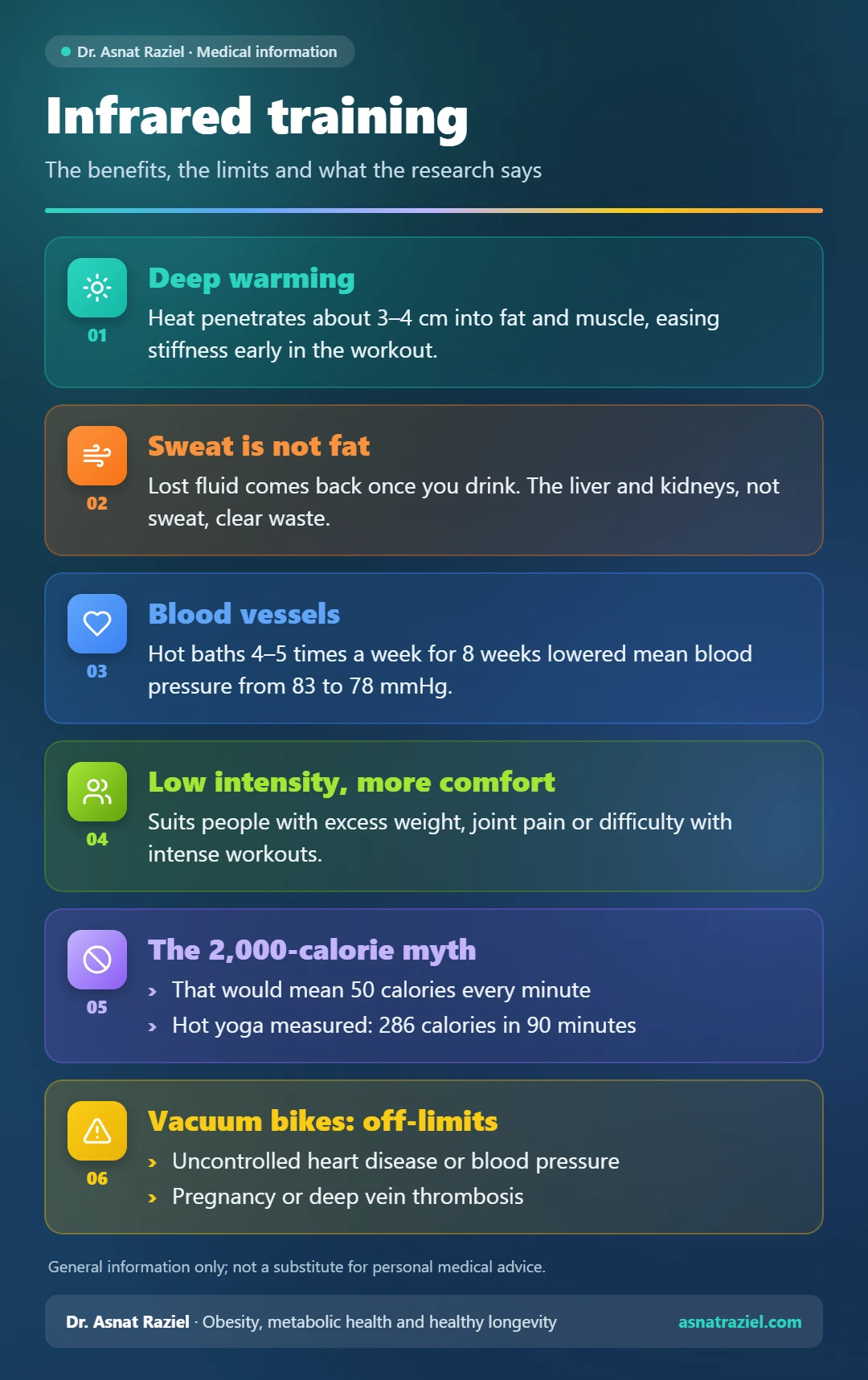
Infrared light warms the body from within, unlike ordinary ambient heating. Finnish researchers estimate that this kind of heat penetrates about 3–4 cm into fat and muscle tissue. In practical terms, the muscles warm up quickly, right from the start of the workout. In addition, heat reduces stiffness in the muscles and joints. This lowers the risk of injury while the body is still “cold.” For people who aren’t used to physical activity, or who live with chronic pain, this is an important advantage.
Sweating: what it does and what it doesn’t
The workout takes place in a warm but tolerable environment, so the body sweats a lot. Sweating adds to the feeling of lightness after the workout. Even so, two points need to be made clear. First, losing fluid is not losing fat, and the weight comes back once you drink. Second, sweat is not a major way of clearing waste from the body. That job belongs to the liver and kidneys.
At the same time, heavy sweating means you need to pay attention to hydration. Drink before, during and after the workout.
Blood flow and blood vessels
Heat widens the blood vessels, and as a result, blood flow to the muscles increases. Oxygen and nutrients reach the tissues well, and this may support recovery. What’s more, there is evidence that repeated exposure to heat improves blood vessel health. For example, in a study from the University of Oregon, inactive young adults soaked in a hot bath 4–5 times a week for 8 weeks. The function of the blood vessel lining improved, and mean blood pressure fell from 83 to 78 mmHg.
Researchers in Japan have also tested dry infrared heat in heart patients. The WAON-CHF study included 149 patients with advanced heart failure. The treatment consisted of a 60°C sauna for 15 minutes a day, for 10 days. Walking distance and symptom class improved, with no serious side effects. It’s important to stress that this was a treatment under close medical supervision, not a studio workout.
Infrared training at low intensity
One of the standout advantages of infrared training is that you can work out at a relatively low intensity and still feel comfortable. Walking, recumbent cycling or gentle exercise are especially suitable for people with orthopedic limitations, excess weight or difficulty with intense workouts. Your heart rate rises in the heat, so even light effort feels significant.
In addition, a workout that isn’t intimidating encourages people to stick with it over time. That is one of the most important ingredients in any process of health change. I wrote about the importance of combining different types of exercise in my article on aerobic versus strength training.
Pain relief and a sense of well-being
Heat is also credited with a calming effect. Many users report relief from muscle and joint pain and less physical and mental tension. In addition, many feel that this workout is less daunting than a classic fitness class. For some people, this experience is the key to getting back to regular activity.
Still, the evidence here is limited. A systematic review of dry sauna studies included 40 studies, but only 13 of them were randomized trials, and most were small. Most studies reported a benefit, but the researchers call for much higher-quality research.
Infrared training and recovery
Heat may shorten recovery time and reduce delayed-onset muscle soreness. That makes it possible to train more often and keep a routine, rather than a one-off event. A study on infrared sauna after exercise included ten active men. After a maximal endurance session, the sauna slightly improved jump height. After strength training, by contrast, there was no difference in recovery. In other words, there are encouraging signs, but no clear-cut proof.
Does infrared training burn 2,000 calories?
Social media is full of claims that you can burn 2,000 calories in 40 minutes of infrared training, sometimes combined with vacuum technology. For most people, this claim is not physiologically plausible. To reach it, you would need to burn 50 calories every minute, roughly three times as much as fast running.
Calorie burn depends on body weight, intensity, workout duration and fitness level. The updated Compendium of Physical Activities makes it possible to estimate the energy cost of each activity. Roughly speaking, brisk walking burns about 200–300 calories an hour. Intense aerobic exercise burns about 400–600 calories, and in heavier people doing very intense exercise, the figure reaches 700–800.
The heat itself doesn’t change the picture either. In a study on hot-room yoga, researchers measured energy expenditure during a 90-minute class. The average was 286 calories, even though marketing had promised up to 1,000. The confusion usually comes from equating sweating with fat burning, or from marketing calculations that are not real metabolic measurements.
Who it suits and who it doesn’t
Infrared training is especially suitable for people with obesity or overweight, for those with back or joint pain, and for beginners who are wary of regular fitness classes. It also suits people looking for an overall wellness experience, not just “burning calories.”
On the other hand, people with uncontrolled heart disease, extreme heat sensitivity or medical conditions that require limiting heat exposure should avoid it. At the very least, they should consult a doctor before starting. For more on how heat affects the body, see my article on heat waves and aging.
Infrared vacuum bikes: when they’re off-limits and when to be careful
A workout that combines infrared heat and vacuum pressure affects the blood vessels, the heart, fluid balance and the skin. Keep in mind that there are almost no high-quality studies on this combination. Do not use it in the following situations:
- Uncontrolled heart disease, heart failure or significant heart rhythm disorders.
- Uncontrolled high blood pressure.
- Deep vein thrombosis or severe vascular disease.
- Pregnancy.
- Active skin disease in the exposed area.
- An active malignant tumor, an acute illness or uncontrolled epilepsy.
Other situations call for caution and medical advice. Examples include diabetes with impaired heat sensation, chronic kidney or lung disease and significant varicose veins. Caution is also important for people prone to fainting, people with anemia, the very elderly and those taking medications that affect blood pressure and heart rate.
During the workout, stop immediately and get checked if you experience dizziness, shortness of breath, an irregular heartbeat, chest pain, extreme heat or significant nausea.
In summary: infrared training as a tool, not magic
Infrared training, including infrared vacuum bikes, can be a pleasant addition to a process of weight loss and better health. Its great advantage lies in personal tailoring and proper supervision. However, it is not a magic solution, and it doesn’t get around the laws of physiology. Exaggerated promises erode public trust. Ultimately, a healthy process rests on consistency, balance and a combination of nutrition and physical activity. And people on drug treatment for obesity will benefit especially from training that preserves muscle mass.
The information in this article is general and does not replace personal medical advice.
References
Clinical Effects of Regular Dry Sauna Bathing: A Systematic Review
2024 Adult Compendium of Physical Activities: A third update of the energy costs of human activities
The physiological responses to Bikram yoga in novice and experienced practitioners




