By Dr. Asnat Raziel, bariatric surgeon specializing in obesity treatment, metabolic health and healthy longevity; Director of the Multidisciplinary Center for Obesity Treatment, Assia Medical, Assuta Ramat HaChayal, Tel Aviv
When to treat obesity medically: the short answer
When should you treat obesity medically? The short answer is: earlier than most people think. If your weight is already affecting your health, your daily function or your quality of life, it is time to see a doctor. Also, there is no need to wait for one more failed diet or for a “scary” number on the scale.
In this article, I will explain which measures doctors check, which signs justify a visit, and what medical treatment involves today.
Obesity is a disease, not a matter of willpower
For years, people saw obesity as a problem of habits alone. Today, our understanding is completely different. Obesity is a chronic disease shaped by genetics, hormones, the brain, sleep, stress and medications. That is why even people with strong self-discipline struggle to keep weight off over time.
In January 2025, an international commission in The Lancet Diabetes & Endocrinology published a new definition. According to the commission, we should distinguish between two conditions. The first is preclinical obesity, meaning excess fat without any harm to organ function. The second is clinical obesity, in which excess fat already impairs the function of an organ or everyday activities. The commission says that people with clinical obesity should receive timely, evidence-based treatment.
When to treat obesity according to BMI
BMI is the body mass index: your weight in kilograms divided by your height in meters squared. You can easily calculate it with an online BMI calculator. According to the UK’s National Health Service (NHS), a value of 25 to 29.9 indicates overweight, and a value of 30 or higher indicates obesity.
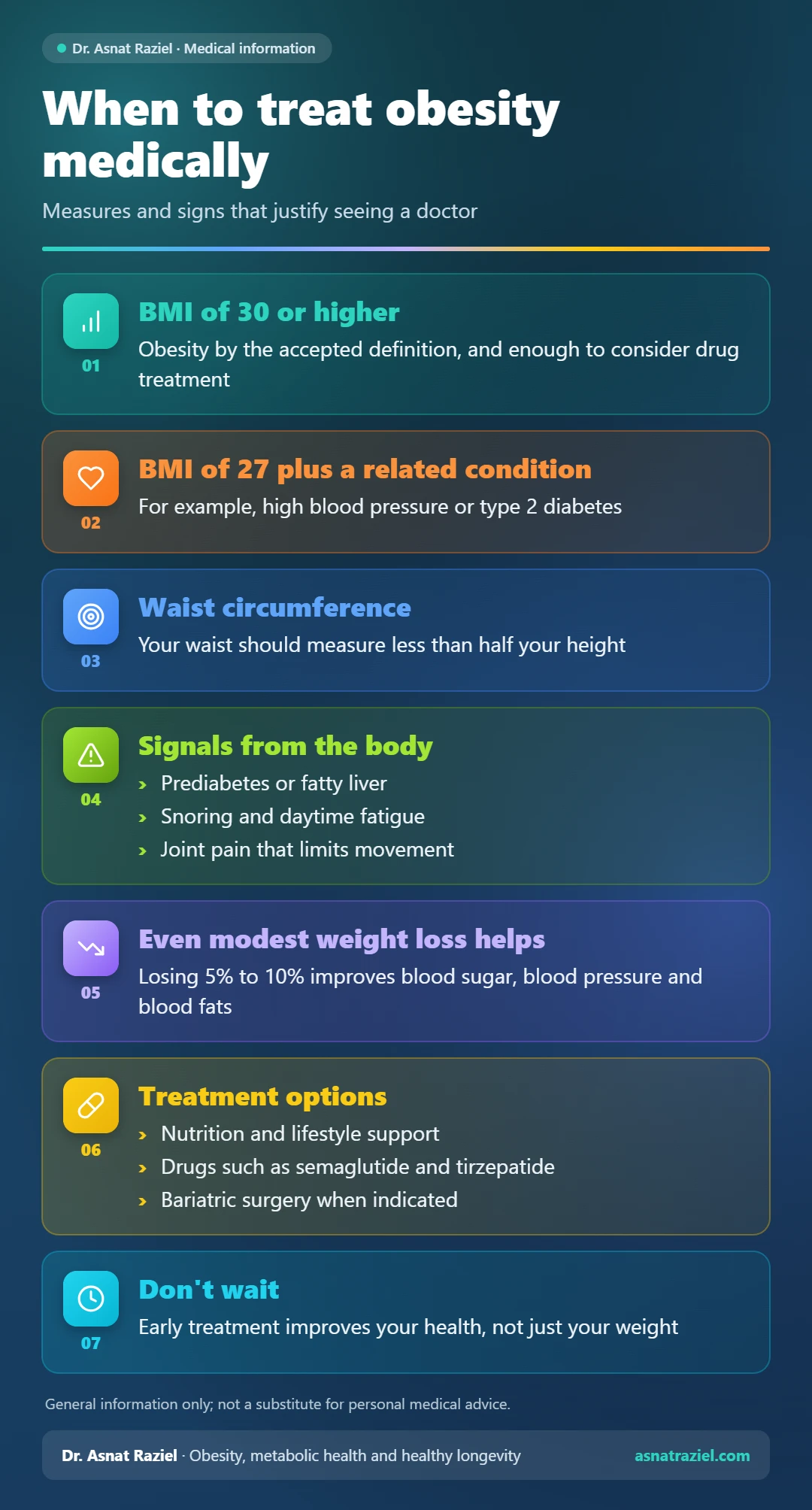
For example, according to the US National Institute of Diabetes and Digestive and Kidney Diseases (NIDDK), drug treatment is appropriate for adults with a BMI of 30 or higher. It is also appropriate for people whose BMI is 27 or higher and who have a weight-related health problem, such as high blood pressure or type 2 diabetes.
Beyond BMI: waist circumference
However, BMI alone does not tell the whole story. It does not distinguish between muscle and fat, and it does not show where the fat sits. Therefore, the international commission recommends adding a measurement of waist circumference or the waist-to-height ratio. A simple rule of thumb from the NHS: your waist should measure less than half your height. In addition, in people of Asian, Middle Eastern or African descent, risk rises even at BMI values below 30.
When to treat obesity even without a high BMI
Often, the body sends signals before the number on the scale “justifies” a visit. These are signs you should not ignore:
- Prediabetes, type 2 diabetes, or fasting blood sugar that rises from test to test.
- High blood pressure or high blood fats.
- Fatty liver on ultrasound, or elevated liver enzymes.
- Snoring, pauses in breathing during sleep, and daytime fatigue.
- Knee or back pain that limits walking and activity.
- Menstrual irregularities, difficulty getting pregnant, or polycystic ovary syndrome.
- Rapid weight gain, for example after menopause, after quitting smoking or after starting a new medication.
Each of these conditions is one of the diseases linked to obesity. Moreover, modest weight loss improves many of them. According to NIDDK, losing 5% to 10% of your starting weight can improve blood sugar, blood pressure and triglyceride levels.
When to treat obesity with medication
The new drugs have changed the picture. In the STEP 1 trial, patients who received semaglutide at 2.4 mg once a week lost an average of 14.9% of their body weight after 68 weeks, compared with 2.4% in the placebo group. In the SURMOUNT-1 trial, tirzepatide at 15 mg led to an average weight loss of 20.9% after 72 weeks.
Still, a drug is not a magic solution. It works together with nutrition, physical activity, sleep and follow-up. For this reason, we decide on medications for obesity and metabolic disease only after a full medical evaluation. In addition, according to NIDDK, if weight loss is less than 5% after 12 weeks at the full dose, your doctor will consider stopping or switching treatment. In Israel, the practical steps also include submitting a funding request to your health fund (HMO).
When to consider bariatric surgery
Bariatric surgery is still the most effective treatment for large, lasting weight loss. Under Israel’s national health basket, according to the Kol Zchut rights website, surgery is suitable for people with a BMI above 40, or above 35 with diseases caused by excess weight.
In contrast, the international ASMBS and IFSO guidelines broaden the indication. These guidelines recommend surgery from a BMI of 35 even without related diseases. In addition, doctors can consider surgery from a BMI of 30 with metabolic disease, and in people of Asian descent from 27.5.
What the first visit looks like
The first visit is not a “lecture about dieting.” First, we go over your weight history: when the gain started, which treatments you tried and what worked. Next, we look at chronic conditions, medications that may cause weight gain, sleep and emotional well-being. After that, we order blood tests and sometimes additional tests.
At the end of the visit, we build a personal plan together. At our clinic, we work as a multidisciplinary team of doctors, dietitians and mental health professionals. In this way, managing obesity treatment relies on close follow-up, not on a single appointment. If you are hesitating before taking the first step, it also helps to read about medical consultation for weight loss and about choosing the right doctor.
When to treat obesity: why not wait
Many people put off seeing a doctor out of shame or in the hope that “this time I’ll manage on my own.” However, obesity tends to progress over the years. Moreover, the more established diseases like diabetes or fatty liver become, the harder it is to reverse them. That is why early treatment improves the chances of better health, not just a lower weight.
Bottom line
When should you treat obesity medically? When your BMI is 30 or higher, or 27 or higher with a weight-related medical problem. It is also worth seeing a doctor when your weight affects your function, sleep, joints or quality of life. Today we have effective, safe treatments, and the first step is an open conversation with a doctor who specializes in the field.
The information in this article is general and does not replace personal medical advice.
Frequently asked questions
Do I need to reach a BMI of 30 to get treatment?
Not always. Even at a BMI of 27 or higher, with a problem such as high blood pressure or diabetes, drug treatment can be an option. In addition, a large waist circumference is a good reason for an evaluation.
How much weight do I need to lose to see health benefits?
According to NIDDK, losing 5% to 10% of your weight already improves blood sugar, blood pressure and blood fats. For example, for a person who weighs 100 kg, that means 5 to 10 kg.
When should I treat obesity medically after failed diets?
There is no need to wait for another failure. If you have tried several times and the weight came back, that is a sign your body needs medical support, not more willpower.
Does medical treatment mean medication or surgery?
Not necessarily. Treatment starts with an evaluation and supported lifestyle change. We add medication or surgery as needed, based on your measurements and your preferences.
Sources
Definition and diagnostic criteria of clinical obesity
Prescription Medications to Treat Overweight & Obesity
Once-Weekly Semaglutide in Adults with Overweight or Obesity