By Dr. Asnat Raziel, bariatric surgeon specializing in obesity treatment, metabolic health and healthy longevity; Director of the Multidisciplinary Center for Obesity Treatment, Assia Medical, Assuta Ramat HaChayal, Tel Aviv
Teen obesity: what parents should know
Teen obesity is a common medical condition, not a lack of discipline. Millions of adolescents around the world live with excess weight, and many already show early signs of metabolic disease. The good news is that today there is effective and safe treatment. It starts at home, with the family, and in suitable cases it also includes medication.
In this article, I explain how doctors diagnose teen obesity, why it’s better not to wait, what studies show about the new medications and what Israel’s national health basket covers. I’ll also suggest ways to talk with your son or daughter without hurting them.
Why teen obesity isn’t “just a phase”
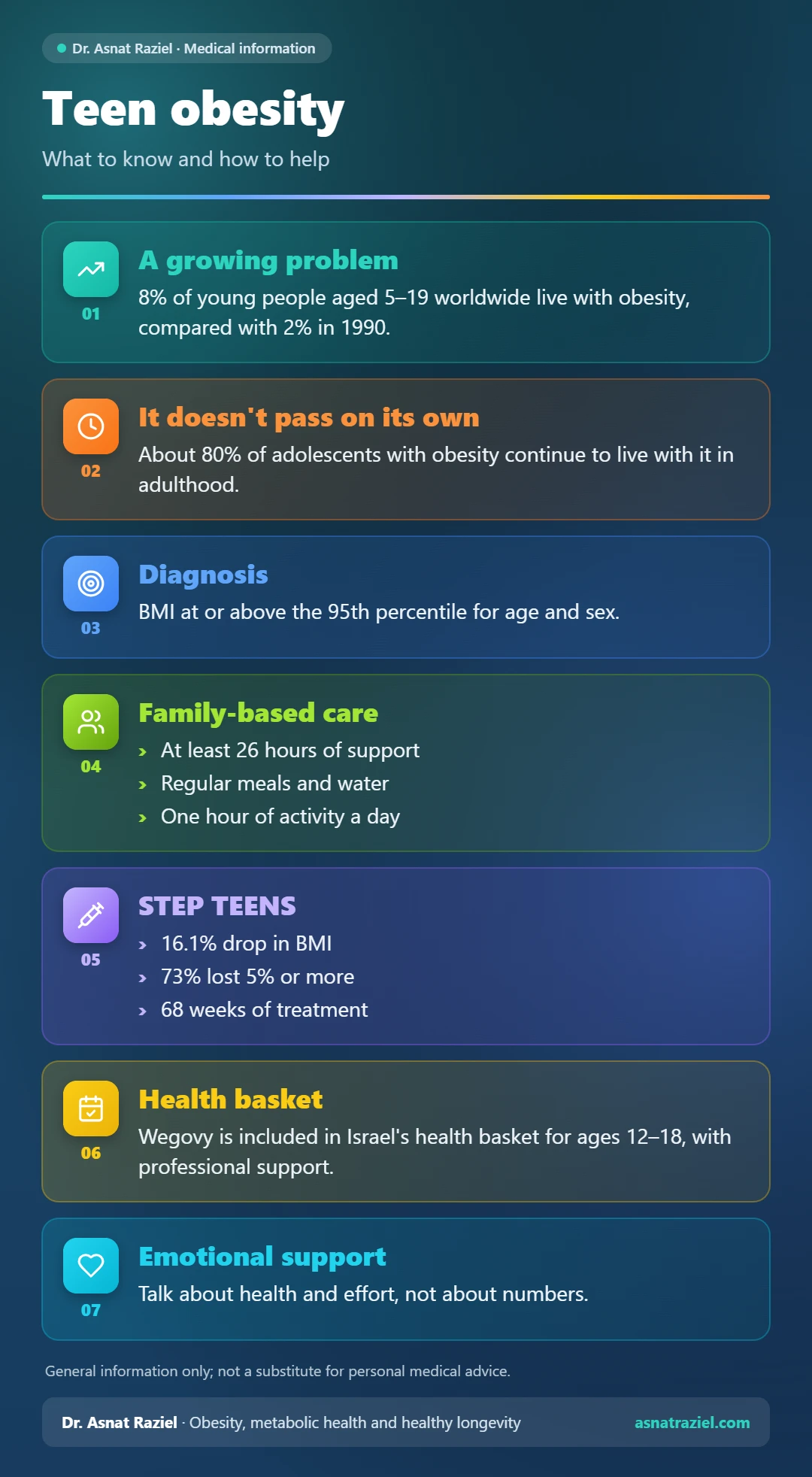
According to the World Health Organization, the rate of obesity among children and adolescents aged 5 to 19 rose from 2% in 1990 to 8% in 2024. That means about 170 million young people worldwide live with obesity. In addition, about one in five young people in this age group has overweight.
Many parents hope the weight will “sort itself out” as their child grows. However, a review of 15 cohort studies with about 200,000 participants found a different picture. About 80% of adolescents with obesity continue to live with it in adulthood. So waiting usually doesn’t help, and it’s worth starting treatment in time.
In fact, obesity in childhood and adolescence is linked, even at a young age, to fatty liver, insulin resistance, high blood pressure and sleep apnea. Beyond that, it often harms self-esteem and social life.
How it’s diagnosed: BMI by percentiles
In adults, doctors use BMI, which is weight divided by height squared. In children and adolescents, the body is still growing, so we compare BMI with growth charts by age and sex. According to the American Academy of Pediatrics guidelines, obesity is a BMI at or above the 95th percentile. Severe obesity means a BMI at or above 120% of the 95th percentile.
It’s important to remember that the number is only a starting point. The doctor also checks blood pressure, blood sugar, blood lipids and liver function. In addition, they ask about sleep, mood, emotional eating and family history.
What causes obesity in adolescence
There is no single cause. Genetics strongly affects appetite and the feeling of fullness. In addition, today’s environment is full of processed food, sweetened drinks and long hours in front of screens. Short sleep, stress and some medications also affect weight.
The modern home is full of technology, from cell phones to the TV and the computer. So it’s a good idea to agree on a few simple rules together: no phones at meals and no screens in the bedroom at night. Many teens also know the experience of food noise: thoughts about food all day long. This is a biological phenomenon, not a weakness.
Teen obesity treatment starts with the family
The guidelines recommend intensive behavioral treatment that involves the whole family. This means at least 26 hours of sessions on nutrition, physical activity and changing habits, over 3 to 12 months. What’s more, change succeeds mainly when the whole household takes part, not just the teen.
It isn’t always easy to raise the subject. Try to talk about health, energy and feeling good, not about numbers on the scale. Avoid blame and shame when you talk about treatment as a family.
Nutrition without crash diets
Teens need energy and protein to grow. That’s why I don’t recommend extreme diets at this age. Instead, focus on a few steps: regular meals, vegetables at every meal, water instead of sweetened drinks and fewer snacks at home. Also, eating meals together as a family helps a lot.
Physical activity, sleep and screens
According to the World Health Organization, about 81% of adolescents aged 11 to 17 don’t meet the physical activity recommendations. The recommendation is an average of one hour a day of moderate- to vigorous-intensity activity. Still, every small step matters: walking to school, dancing, a sports class or biking with friends. Getting enough sleep matters too, because tiredness increases hunger.
Teen obesity and medication
According to the American guidelines, doctors may offer medication to adolescents with obesity from age 12, in addition to lifestyle changes. The most studied drug in this age group is semaglutide, the active ingredient in Wegovy. It is a weekly injection that reduces hunger and increases the feeling of fullness.
What the STEP TEENS trial found
The STEP TEENS trial included 201 adolescents aged 12 to 18. Participants received semaglutide 2.4 mg or a placebo for 68 weeks, together with lifestyle support. BMI dropped by 16.1% in the drug group, compared with a rise of 0.6% in the placebo group. In addition, 73% of those on the drug lost at least 5% of their weight, compared with 18% on placebo.
The researchers also saw improvements in waist size, blood sugar, blood lipids and liver enzymes. A follow-up analysis also showed better insulin sensitivity. On the other hand, digestive side effects, such as nausea and vomiting, occurred in 62% of those on the drug, compared with 42% on placebo. Also, 5 adolescents (4%) in the drug group developed gallstones.
Wegovy for teens in Israel’s national health basket
In February 2026, Israel’s health basket committee decided to include weight loss treatment with Wegovy injections for adolescents aged 12 to 18. According to reports, patients receive the treatment with professional support, and the committee did not include Mounjaro at this stage. It’s best to check the exact eligibility criteria with your doctor and your health fund (HMO).
It’s important to know that the drug works only as long as you take it. That’s why the decision to treat is a long-term one that we make together with the parents. Studies show a similar picture in young adults with severe obesity. In contrast, new obesity pills, such as orforglipron, do not yet have approval for adolescents.
Bariatric surgery in adolescence
In cases of severe obesity, the guidelines recommend referring adolescents from age 13 for evaluation at a specialized bariatric surgery center. This treatment is for only a small share of teens. A team of several experts takes part in the decision: a surgeon, a pediatrician, a dietitian and a psychologist.
Many teens also ask about their weight ahead of military service in the IDF. For non-medical questions, for example about rights during service, it’s best to contact the appropriate army authority.
Teen obesity and mental health
Teens with excess weight often experience teasing, shame and social isolation. That’s why treatment has to be sensitive and supportive. Comments like “just eat less” hurt and don’t help. Instead, praise effort and persistence, not just results.
Also watch for signs of unbalanced eating, such as eating in secret or vomiting. In such cases, involve a mental health professional. On the other hand, gradual success builds self-confidence and a sense of control.
The bottom line
Teen obesity is a medical condition that calls for timely, sensitive, family-based care. The foundation is regular nutrition, physical activity, sleep and emotional support. In addition, medication can be considered from age 12, and in severe cases, surgery as well. In our clinic, led by Dr. Asnat Raziel, we build a personal plan for every teen together with the family.
This article provides general information and is not a substitute for personal medical advice.
Questions and answers
Does teen obesity go away on its own?
Usually not. About 80% of adolescents with obesity continue to live with it in adulthood. So it’s worth seeking treatment now.
From what age can teens be treated with injections?
Semaglutide (Wegovy) is approved for adolescents from age 12. Doctors make the decision after a medical evaluation, and always alongside lifestyle changes.
Are the injections safe for teens?
In the STEP TEENS trial, the main side effects were nausea and vomiting. Also, 4% of those treated developed gallstones. That’s why treatment requires close medical follow-up.
How do we get started?
The first step is a visit to your pediatrician or to a clinic for childhood obesity treatment. There, the team assesses the situation and builds a plan.
Sources
Obesity and overweight – WHO fact sheet
Physical activity – WHO fact sheet
Predicting adult obesity from childhood obesity: a systematic review and meta-analysis