By Dr. Asnat Raziel, bariatric surgeon specializing in obesity treatment, metabolic health and healthy longevity; Director of the Multidisciplinary Center for Obesity Treatment, Assia Medical, Assuta Ramat HaChayal, Tel Aviv
A longevity diet: a month without meat and dairy, and then what?
A longevity diet is a topic that keeps longevity medicine very busy. A report on the Israeli news site Hamal about “a month without meat and dairy” raised an old question once again. To live longer and healthier, do we need to eat less food from animals, or maybe switch to a fully plant-based diet? The answer is far more interesting than “yes” or “no.” A month of change can improve your numbers, but longevity is a story of decades.
What the Stanford twin study taught us
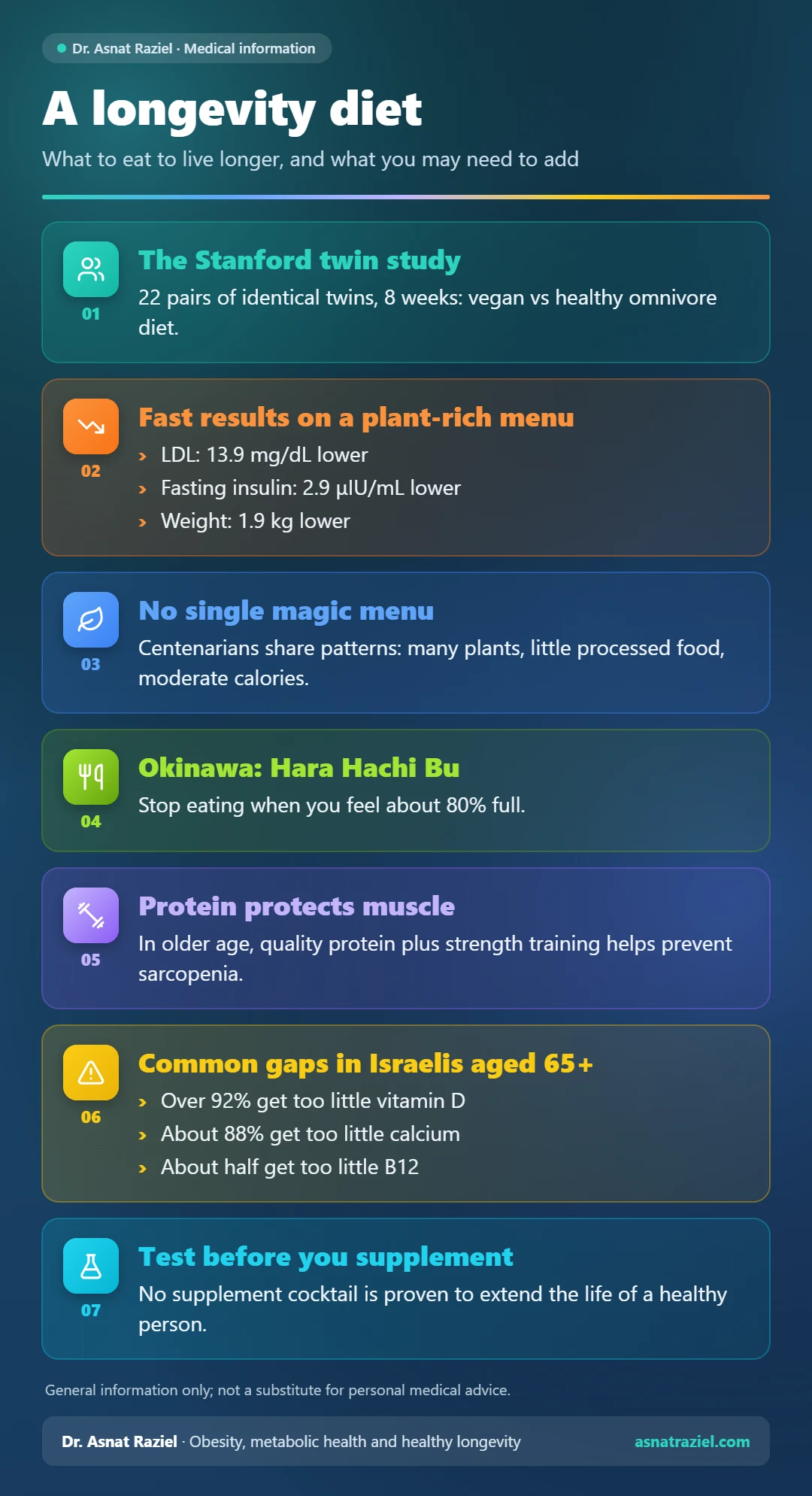
The Stanford University twin study is an excellent example. The researchers randomly divided 22 pairs of identical twins, 44 participants in total. One twin ate a healthy vegan diet, and the other ate a healthy diet that also included animal foods. The intervention lasted eight weeks. For the first four weeks, participants received prepared meals, and after that they cooked for themselves.
By the end of the study, LDL (“bad cholesterol”), fasting insulin and weight had all dropped in the vegan group compared with the other group. The difference in LDL reached 13.9 mg/dL, the difference in insulin 2.9 μIU/mL and the difference in weight 1.9 kg. However, the other group ate healthily too. In other words, the study does not prove that meat or dairy are “toxic,” nor that veganism extends life. What it does show is how quickly the body responds to a menu rich in vegetables, legumes, whole grains and nuts.
There is no single longevity diet
When you look at long-lived populations, you discover there is no single magic menu. The diet in Okinawa differs from that of Sardinia, and the Mediterranean menu is not vegan. A January 2026 review of centenarians’ diets identified several recurring patterns. These include plenty of plant foods, little processed food, a high concentration of vitamins and polyphenols (plant compounds with antioxidant activity), moderate calorie intake and a balanced lifestyle.
At the same time, we must not turn the Blue Zones, the regions where people reach 100 at high rates, into scientific proof. A review in Maturitas reminds us that the fact a long-lived population eats a certain food does not make that food the cause. Genetics, physical activity, social ties and environment are all part of the picture. So longevity does not necessarily require veganism. Instead, it requires a high-quality, plant-rich diet tailored to age, muscle and metabolic health.
The Mediterranean diet: a good starting point
If I had to choose one model that is easy to adopt for years, I would choose the Mediterranean diet. It is built on vegetables, fruit, legumes, whole grains, nuts, seeds and olive oil. Alongside these come fish and, at times, dairy, eggs and a moderate amount of animal foods. A review in Nutrients concludes that sticking to this diet is linked with less heart disease, metabolic disease, cognitive decline and fractures. Its great advantage is that it does not demand extremes.
A vegan diet: excellent, provided you plan it
A high-quality vegan menu is rich in fiber, polyphenols, legumes and whole grains. But “vegan” is not a synonym for “healthy.” You can build a menu on lentils, tofu, tempeh, nuts and olive oil. Then again, you can also live on vegan white bread, snacks and ultra-processed food. On a vegan diet, you need to pay special attention to protein, B12, iron, zinc, iodine, calcium, vitamin D and omega-3. Vitamin B12 is the clearest example. On a fully vegan diet, it usually requires fortified foods or a supplement, and in the twin study B12 intake was indeed low in the vegan group. I explain how to plan this in my guide to plant protein sources.
A mostly plant-based diet: the interesting compromise
A plant-predominant diet is not veganism. Plants take up most of the plate, and animal foods serve as a side rather than the center of the meal. For example, you eat vegetables, legumes, whole grains and olive oil every day, and add fish, yogurt, eggs and occasionally a little chicken or meat. That way you enjoy the fiber of plants, and at the same time it is easy to get protein, B12, calcium and omega-3. A review from Harvard University found that such dietary patterns are linked with lower mortality. In addition, combining a healthy diet with a healthy lifestyle may add 8 to 10 disease-free years.
The Okinawan diet and the 80% full principle
The traditional Okinawan diet was based on sweet potato, green and yellow vegetables, soy and medicinal plants. Alongside these were moderate amounts of fish and lean meat. One of the famous principles there is Hara Hachi Bu: stop eating when you feel about 80% full. In a world where food is almost always available, this is an important idea. Perhaps the secret is not only what you eat, but also the ability to avoid a chronic energy surplus.
A longevity diet and protein: where longevity meets muscle
This is one of the most complex issues in the field. In animals, cutting protein affects nutrient-sensing pathways linked to aging, such as mTOR and IGF-1. A review in Age and Ageing found that in insects and mice, a low-protein, high-carbohydrate diet extended life. But 65- or 75-year-olds are not lab mice. With age, the risk of sarcopenia, the loss of muscle mass and strength, rises. Therefore, trying to “cut protein for longevity” can do harm.
The goal is to reach age 80 with a working brain, bones and muscles. That is why a longevity diet in older age gives quality protein a central place, together with strength training. Israel’s Ministry of Health also stresses the importance of protein for preserving muscle in older age. I expanded on this in my articles on how much protein you need and on preserving muscle mass.
Feeding the microbiome, too
The next generation of longevity nutrition also deals with what we feed our gut bacteria. Fiber, resistant starch and polyphenols reach the gut and affect its bacterial populations. According to the centenarian review, such a diet increases microbial diversity and encourages beneficial bacteria such as Akkermansia and Bifidobacterium. In addition, it supports the gut barrier and immune balance. So it pays to vary your food: vegetables of different colors, different kinds of legumes, herbs, berries, nuts and fermented foods. I wrote about this link in my article on the microbiome and biological age.
What you may need to add from outside
This is where personalized medicine comes in. There is no justification for giving every person ten supplements just because they want to live to 100. On the other hand, “a good diet provides everything” is not true at every age. According to the Israeli Ministry of Health’s Mabat Zahav survey (2014–2015), more than 92% of Israelis aged 65 and over consume less vitamin D than recommended. About 88% do not reach the recommended calcium intake, and about half consume less B12 than recommended.
- Vitamin B12: essential for vegans, and sometimes for older adults too, because absorption declines.
- Vitamin D: deficiency is common even in sunny Israel. The dose is set according to background and test results.
- Calcium: important for bone. Good sources are tahini, fortified tofu, sardines and dairy products.
- Omega-3: people who eat oily fish regularly get EPA and DHA. On a vegan diet, an algae-based source is worth considering.
- Iron: not taken automatically. First, check a blood count and ferritin.
- Iodine and zinc: especially important when you avoid fish and dairy. However, excess iodine is not desirable.
And what about magnesium, creatine, NAD, resveratrol, spermidine and the other “longevity supplements”? Here the level of evidence varies widely. Some are interesting from a research standpoint, but today there is no “supplement cocktail” proven to extend the life of a healthy person.
What a longevity diet looks like on the plate
I would not build the plate around the question “meat, yes or no.” I would start with plenty of vegetables in different colors. Next, I would add legumes almost every day, nuts, seeds, olive oil, whole grains and fruit. On top of that comes protein in an amount that suits age and activity, plus fish when the diet allows. By contrast, I would cut back on processed meat, sugary drinks and ultra-processed food. Then I would ask: what is this person missing? Sometimes the answer is not a supplement, but weak muscles, little movement or poor sleep.
Bottom line: a longevity diet is a system
You can see metabolic changes within weeks, but longevity is not a one-month experiment. We want a diet we can live with for decades. It should lower cardiac and metabolic risk, feed the microbiome and protect bone, and above all preserve muscle. So the future is not “everyone goes vegan,” nor is it “protein at any cost.” Ultimately, the future is a personalized longevity diet: plenty of plants, little processed food, precise protein, quality fat and tests that reveal what is truly missing. For more on the general principles, see my guide to nutrition for healthy aging.
The information in this article is general and does not replace personal medical advice.
References
Cardiometabolic Effects of Omnivorous vs Vegan Diets in Identical Twins: A Randomized Clinical Trial
Nutrition and longevity – diet in centenarians
Diet and longevity in the Blue Zones: A set-and-forget issue?
Impact of Mediterranean Diet on Chronic Non-Communicable Diseases and Longevity
Diet strategies for promoting healthy aging and longevity: An epidemiological perspective
Healthy aging diets other than the Mediterranean: a focus on the Okinawan diet
New Horizons: Dietary protein, ageing and the Okinawan ratio




