By Dr. Asnat Raziel, bariatric surgeon specializing in obesity treatment, metabolic health and healthy longevity; Director of the Multidisciplinary Center for Obesity Treatment, Assia Medical, Assuta Ramat HaChayal, Tel Aviv
CBL-514 fat injection: what’s new in the research
Dissolving fat with an injection sounds like a marketing promise, but a new study gives the idea an early scientific basis. The CBL-514 fat injection, an investigational drug that the Taiwanese company Caliway is developing, reduced visceral fat in phase 2 trials. The researchers presented the data at the European diabetes research conference, EASD 2026. However, they do not yet prove lasting weight loss or the prevention of diabetes and heart disease.
Doctors inject the drug into the fat layer of the abdomen. Its purpose is to trigger apoptosis in fat cells, a programmed cell death in which the cell breaks down in a controlled way. In other words, the goal is to reduce the number of fat cells themselves, not just to empty them.
Two types of fat, two different questions
Subcutaneous fat sits under the skin, and you can pinch it. Visceral fat, on the other hand, lies deep in the abdomen, around the internal organs. This visceral fat is linked to insulin resistance, type 2 diabetes and heart disease. Therefore, shrinking the outer layer and shrinking the inner fat are not the same result.
What the CBL-514 fat injection did to visceral fat
The researchers analyzed MRI (magnetic resonance imaging) data from a subgroup in two phase 2 trials. Participants had a BMI (body mass index) of 22 to 30. The later follow-up included 40 participants: 23 received the drug and 17 received a placebo. Participants received the injections in the lower abdomen every three weeks, for up to 12 weeks.
Four weeks after the last treatment, average visceral fat volume fell by 12.01% in the group that received the CBL-514 fat injection. In the placebo group, by contrast, it rose by 5.68%. At follow-up 8 to 12 weeks later, there was a 10.45% decrease, compared with an 11.76% increase.
It’s important to be precise here. These are percentage changes in the fat volume measured in a defined area of the abdomen, not percentages of weight loss. In addition, the researchers presented the data at a conference, and the data have not yet gone through peer review. The group was also small and the follow-up short.
What has already been published in a scientific journal
A phase 2b trial published in 2026 in the Aesthetic Surgery Journal looked at subcutaneous belly fat. The researchers randomly assigned 108 adults to the CBL-514 fat injection or a placebo. Each participant received up to four treatments, three weeks apart.
Four weeks after the last treatment, 50% of drug recipients who had an MRI achieved a reduction of at least 20% in subcutaneous fat volume. In the placebo group, however, no one reached that mark. At 12 weeks, the rates were 36% versus 4.5%.
Injection-site reactions to the CBL-514 fat injection were common: about 73% reported pain, about 69% swelling and about 65% redness. Most events were mild or moderate. Even so, four participants in the drug group stopped treatment because of local reactions. Two serious events occurred, both fractures, one in each group, and neither was related to the treatment. Also, about 39% of participants did not complete the study, which is a limitation worth keeping in mind.
Fat-dissolving injections: what other agents are being studied?
CBL-514 is not alone in this field. The only fat-reduction injection that the FDA, the U.S. Food and Drug Administration, has approved is deoxycholic acid. This bile acid breaks down the fat cell membrane, and its approval covers only fat under the chin. Its use in large areas such as the abdomen remains unproven, and reports describe skin necrosis and nerve damage with it.
In addition, several new agents promise targeted fat reduction. RZL-012, which an Israeli company is developing, destroys fat cells in a single treatment. In a small study of 12 patients, it reduced flank fat volume by an average of 37.27 ml. A phase 2 trial of 96 participants with chin fat tested soybean phosphatidylcholine, AYP-101.
Another direction is STP705, a small RNA molecule that silences genes in the fat cell. So far, however, researchers have tested it only in a phase 1 trial of eight women. A systematic review of 25 studies, which included 3,178 patients, examined such injections outside the chin area. Most studies reported fat reduction, but the result was statistically significant in only 37.5% of them.
So what’s new about the CBL-514 fat injection? First, it targets programmed cell death rather than chemically breaking down the cell membrane. In addition, its earlier studies showed no necrosis or nerve damage. Second, researchers are testing it in a large area such as the abdomen. Finally, the new data hint at a decrease in visceral fat too, not just in the layer where it is injected.
New directions: fat cell numbers and preventing weight regain
A classic study in the journal Nature showed that the number of fat cells stays constant in adulthood, even after substantial weight loss. In other words, with weight loss the cells shrink, but they don’t disappear. The hypothesis is that fewer fat cells mean less room to store fat again.
In rats, combining CBL-514 with tirzepatide, the active ingredient in Mounjaro, was linked to less weight regain after tirzepatide was stopped. In humans, however, there is no proof of this yet. I have written in detail about ways to cope with weight regain after stopping treatment.
In August 2026, the company announced that the FDA had cleared it to start a phase 2 trial of the combination with tirzepatide. The company plans to enroll 120 participants. It will mainly examine subcutaneous fat, along with weight, visceral fat and lean mass. At the same time, enrollment has begun for a phase 3 trial. Keep in mind that clearance to start a trial is not approval to market a drug.
Another direction is improving body composition with drugs that act on the whole body. One example is bimagrumab combined with semaglutide: an antibody meant to reduce fat and promote muscle building. In a phase 2 trial of 507 adults, the high-dose combination led to a loss of 17.8 kg within 48 weeks. Semaglutide alone, by comparison, led to a loss of 14.2 kg. I wrote separately about the new biological directions in obesity treatment.
Natural fat burning: how the body does it on its own
In practice, dissolving fat means burning fat. The body has its own mechanism for this, called lipolysis, the breakdown of fat. When energy is needed, for example during exertion or between meals, fat cells release fatty acids and the muscles burn them. In fact, most of the fat we lose leaves the body as exhaled breath, in the form of carbon dioxide.
In addition, the body renews its fat cells on its own: about 10% of them turn over every year. There is also brown fat, a tissue that burns energy to produce heat. Cold is its strongest activator. However, its contribution to the body’s energy expenditure is modest.
How can we mimic these mechanisms in daily life? First, through movement. A meta-analysis of 40 controlled trials, with 2,190 participants, found that physical activity reduces visceral fat. The more calories people burned during activity, the greater the effect. A recent analysis of 60 studies found that all types of training helped, and high-intensity interval training ranked first.
Second, calorie restriction also reduced visceral fat in the same meta-analysis. That’s why a combination of aerobic and strength training, a tailored diet and good sleep remains the foundation.
Fat reduction with devices: body contouring techniques
Body contouring devices also try to damage subcutaneous fat cells without surgery. A comprehensive review describes the main methods:
Cryolipolysis (fat freezing): This method grew out of a study showing that controlled cooling damages fat cells without harming the skin. A rare complication is paradoxical growth of fat in the treated area. A meta-analysis of 28 studies estimated its incidence at 0.22%, or about one case in every 455 patients.
High-intensity focused ultrasound (HIFU) and radiofrequency (RF): Both methods heat the fat tissue to damage the cells.
Laser: According to the data reviewed by the authors of the CBL-514 study, a 1,060-nanometer diode laser reduced abdominal fat by 8.55% after 12 weeks. With low-level laser, by contrast, the results were inconsistent.
High-intensity focused electromagnetic field (HIFEM): The device contracts the abdominal muscles powerfully. According to the same researchers’ review, MRI showed an 18.6% decrease in abdominal fat thickness after two months.
Liposuction: This is already a surgical procedure. A study in the New England Journal of Medicine examined 15 women with obesity after extensive abdominal liposuction. Yet insulin sensitivity, blood pressure, blood lipids and markers of inflammation did not improve significantly.
What all these methods have in common is that they act on subcutaneous fat. As a result, they may improve the body’s contour, but no study has shown that they improve metabolic health.
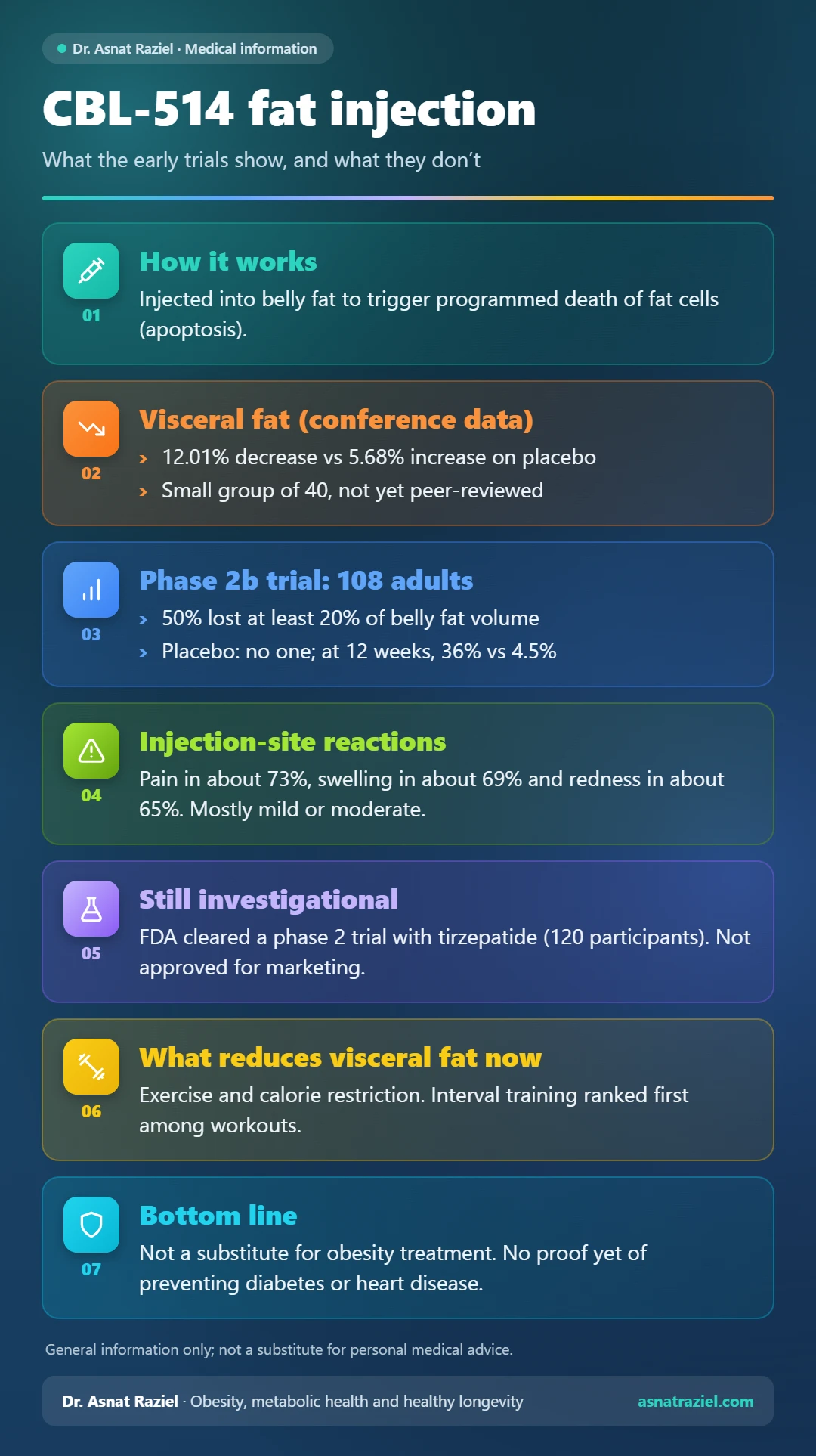
Bottom line: the CBL-514 fat injection is no substitute for obesity treatment
The CBL-514 fat injection is still in clinical development. The data do not allow us to present it as a proven substitute for obesity treatment. Moreover, they do not prove prevention of diabetes, heart attacks or stroke.
Still, the research raises an important question for the future. Could we tailor treatment to where fat is located and to body composition, and not just to the number on the scale? Answering it will require large studies, long-term follow-up and measurement of real health benefits.
In the meantime, real fat burning starts with the body’s own mechanisms. Ultimately, obesity treatment rests on a personal plan, medical follow-up and habits you can maintain over time.
The information in this article is general and is not a substitute for personal medical advice.
Sources
CBL-514 injection reduces visceral and subcutaneous fat in trials
Caliway Advances CBL-514 With FDA-Cleared Phase 2 Trial And Phase 3 Enrollment
A Systematic Review of Injectable Lipolytic Agents for Nonsubmental Fat Reduction
Tapencarium (RZL-012) for Flank Fat Reduction: A Proof-of-Concept Study
Dynamics of fat cell turnover in humans
When somebody loses weight, where does the fat go?
Brown Adipose Tissue Thermogenesis
Non-invasive Body Contouring Technologies: An Updated Narrative Review
Selective cryolysis: a novel method of non-invasive fat removal
Absence of an effect of liposuction on insulin action and risk factors for coronary heart disease
Disclosure from the sources: The phase 2b trial was funded by Caliway, and some of its authors are company employees who hold its shares. The visceral fat analysis presented at the conference was also conducted in collaboration with the company.




