By Dr. Asnat Raziel, bariatric surgeon specializing in obesity treatment, metabolic health and healthy longevity; Director of the Multidisciplinary Center for Obesity Treatment, Assia Medical, Assuta Ramat HaChayal, Tel Aviv
Habits that accelerate aging: age is more than a number
Habits that accelerate aging often hide in our daily routine, not only in our genes. We usually measure age by the number of candles on the birthday cake. However, alongside chronological age there is also biological age. To some extent, it reflects the state of our cells, tissues and body systems. As a result, two people of the same age can be in very different biological shape.
It’s not only your genes
In an August 2026 Fox News article, Dr. Will Cole points to three common factors. Cole is a functional medicine expert and co-author of the book Heal Your Cells. In his view, the factors are a poor diet, exposure to harmful environmental agents, and chronic stress, which is sometimes accompanied by isolation and a lack of belonging.
Cole uses the term “cellular noise.” This is an image, not an accepted medical term. It describes a state in which the signals that let cells function and repair damage work less well. Still, the general idea fits a central direction in longevity research. Aging is a biological process, and diet, sleep, stress, social ties and our environment all influence it.
1. Poor diet and ultra-processed food
The first factor is probably the most familiar: what we eat. A diet rich in ultra-processed food, sugar and sweetened drinks is linked to obesity, insulin resistance and chronic inflammation. In recent years, it has become clear that the link also extends to markers of aging.
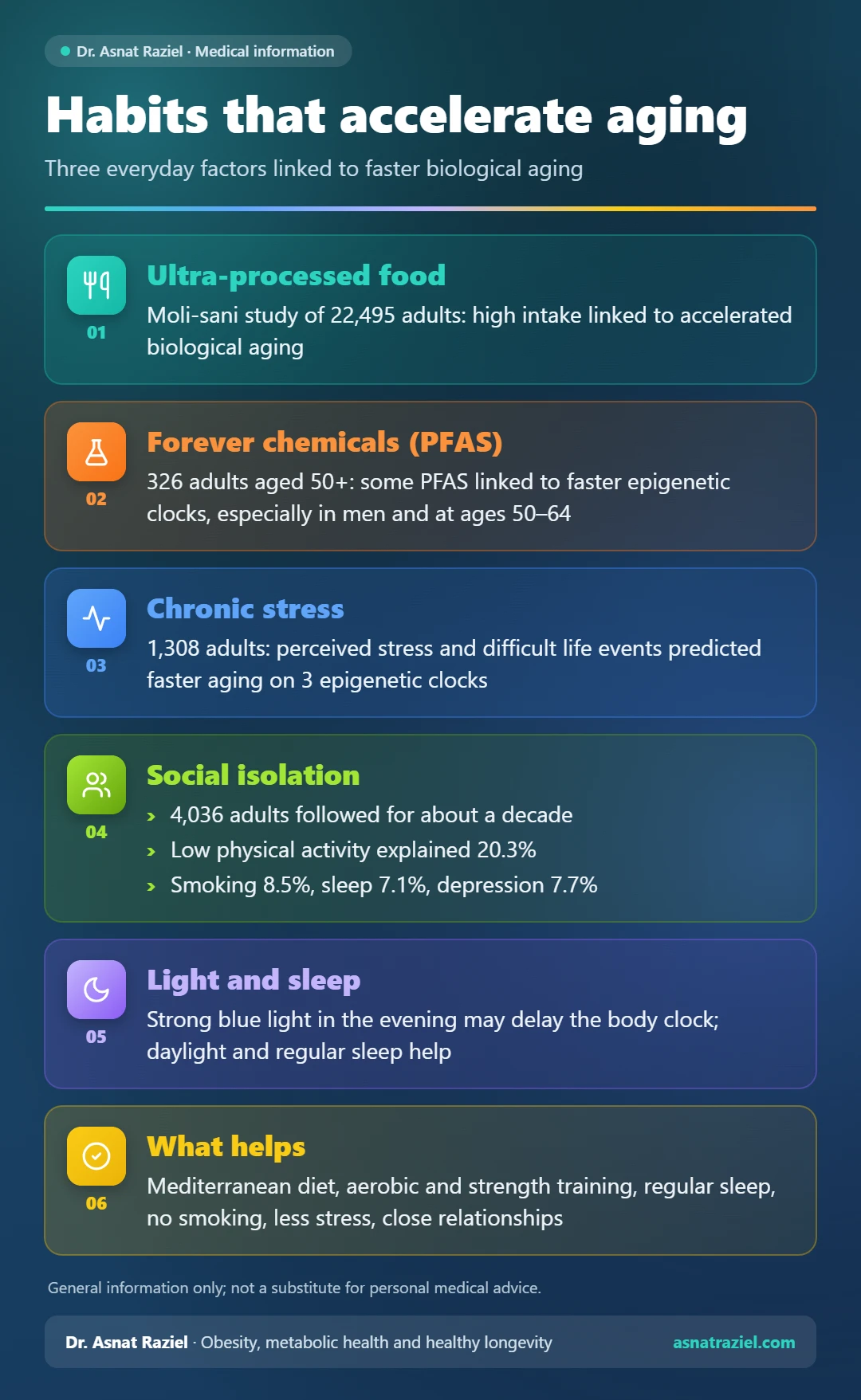
For example, the Moli-sani study from Italy examined 22,495 adults. The researchers found that a high intake of ultra-processed food was associated with accelerated biological aging. Interestingly, overall diet quality explained only a small part of the link. In addition, a 2025 American study found a similar association, and part of it was mediated by body mass index.
That said, these are observational studies. They show an association; they do not prove that every processed food directly “ages your cells.” In practical terms, the message is simple. It is worth building your menu around vegetables, fruit, legumes, whole grains, nuts, olive oil and fish. You can read more about the effects on the brain and on food policy in my article on ultra-processed food and the brain.
2. The environment gets into our biology
The second factor is environmental exposure. We live in a world of thousands of synthetic chemicals. Researchers are focusing in particular on PFAS, a group of persistent compounds nicknamed “forever chemicals.” They turn up in many products and throughout the environment.
A 2026 study examined 326 American adults aged 50 and over. The researchers found a link between some types of PFAS and acceleration of epigenetic clocks, that is, aging markers based on chemical tags on DNA. The link was especially pronounced in men and in people aged 50 to 64.
Even so, there is no reason to turn this finding into anxiety. The effect depends on the type of chemical, the level of exposure and how long it lasts. Your home environment matters too. Strong blue light in the evening may delay the body clock and disrupt sleep. In contrast, daylight and regular sleep hours support the daily rhythm. In other words, a healthy environment also includes light, sleep and habits.
3. Chronic stress and loneliness: habits that accelerate aging quietly
The third factor is less tangible, but the research around it is fascinating. Short bursts of stress are a natural part of life. The problem starts when the stress system stays switched on for months and years. A scientific review links prolonged stress to several hallmarks of aging: chronic inflammation, oxidative stress, DNA damage, epigenetic changes and cellular senescence.
Furthermore, a 2026 American study tested 1,308 adults on three epigenetic clocks: GrimAge, DunedinPACE and PhenoAge. Perceived stress and difficult life events predicted faster aging. Part of the link ran through poor sleep, a poor diet, little physical activity, smoking and alcohol. Put differently, stress changes the way we live. This creates a chain of effects. I discuss this further in my article on stress and obesity.
Social connection is part of longevity medicine
Cole also talks about social connection, community, nature and spirituality. You don’t have to be religious to benefit from connection and belonging. In fact, the research supports the importance of social ties far more strongly than the claim that any particular faith extends life.
A longitudinal study followed 4,036 adults for about a decade. Social isolation predicted accelerated biological aging. Low physical activity explained 20.3% of the link, smoking 8.5%, poor sleep 7.1% and depressive symptoms 7.7%. So meeting friends or sharing a family meal is not just “nice for the soul.” It may be part of how we age.
Can we slow the biological clock?
This may be the most important message. Genes matter, but they are not the whole story. Most of the factors that speed up aging can be changed. You don’t need an extreme anti-aging diet or exotic supplements. I look at how this plays out at a younger age in my article on accelerated aging in young adults.
The foundation is simple: a Mediterranean diet, aerobic exercise and strength training, preserving muscle mass and regular sleep. It is also important to avoid smoking, protect your metabolic health, reduce stress and nurture relationships. Beyond that, it helps to add daylight, time in nature and fewer unnecessary exposures.
It is also worth remembering that you don’t have to change everything at once. A small, consistent change, such as a daily walk or a regular family dinner, adds up over time. At the clinic, we build the process gradually, based on each person’s health and abilities. That also makes it much easier to stick with.
Bottom line on habits that accelerate aging
Ultimately, longevity is not only about adding years to life. The goal is to add healthy life to those years, with strength, a clear mind, a healthy heart and independence. Identifying the habits that accelerate aging is the first step. The good news is that much of the work starts with small decisions we make every day. You can read more about this broader approach in my article on geroscience and the longevity clinic.
The information in this article is general and does not replace personal medical advice.
Frequently asked questions
What is the difference between chronological age and biological age?
Chronological age is the number of years we have lived. Biological age is an estimate of the body’s condition based on physiological, biochemical or epigenetic markers. At present, no single test determines a person’s “true age.”
Can aging be reversed?
There is still no proof that we can “turn back the clock.” However, we can improve risk factors, fitness, muscle mass and metabolic health. Sometimes biological markers of aging improve as well.
Where should I start?
There is no single factor. The combination of a high-quality diet, physical activity, strength training, good sleep, not smoking and social ties is currently the best-supported foundation for healthy longevity.
References
3 common factors may be secretly speeding up the aging process, expert says
The role of health behaviors in links between stress and epigenetic aging




