By Dr. Asnat Raziel, bariatric surgeon specializing in obesity treatment, metabolic health and healthy longevity; Director of the Multidisciplinary Center for Obesity Treatment, Assia Medical, Assuta Ramat HaChayal, Tel Aviv
Intrinsic capacity: possibly the next big measure in longevity
Intrinsic capacity is a relatively new way to measure aging. We are used to measuring health with blood pressure, cholesterol, blood sugar, weight and blood tests. In recent years, the longevity field has also added epigenetic clocks, biological age and molecular markers. However, this approach asks a simple question: what can our body and mind still do?
The concept is now getting fresh attention. The reason is a set of new research programs in the United States, along with studies that link it to functional decline and even to mortality.
What exactly is intrinsic capacity?
The World Health Organization defined the concept back in its 2015 World Report on Ageing and Health. It was part of a shift from a disease-based view of aging to a function-based one. According to the World Health Organization, intrinsic capacity includes all the physical and mental capacities a person can draw on. In plain terms, it is not only about what we suffer from, but about how well we function.
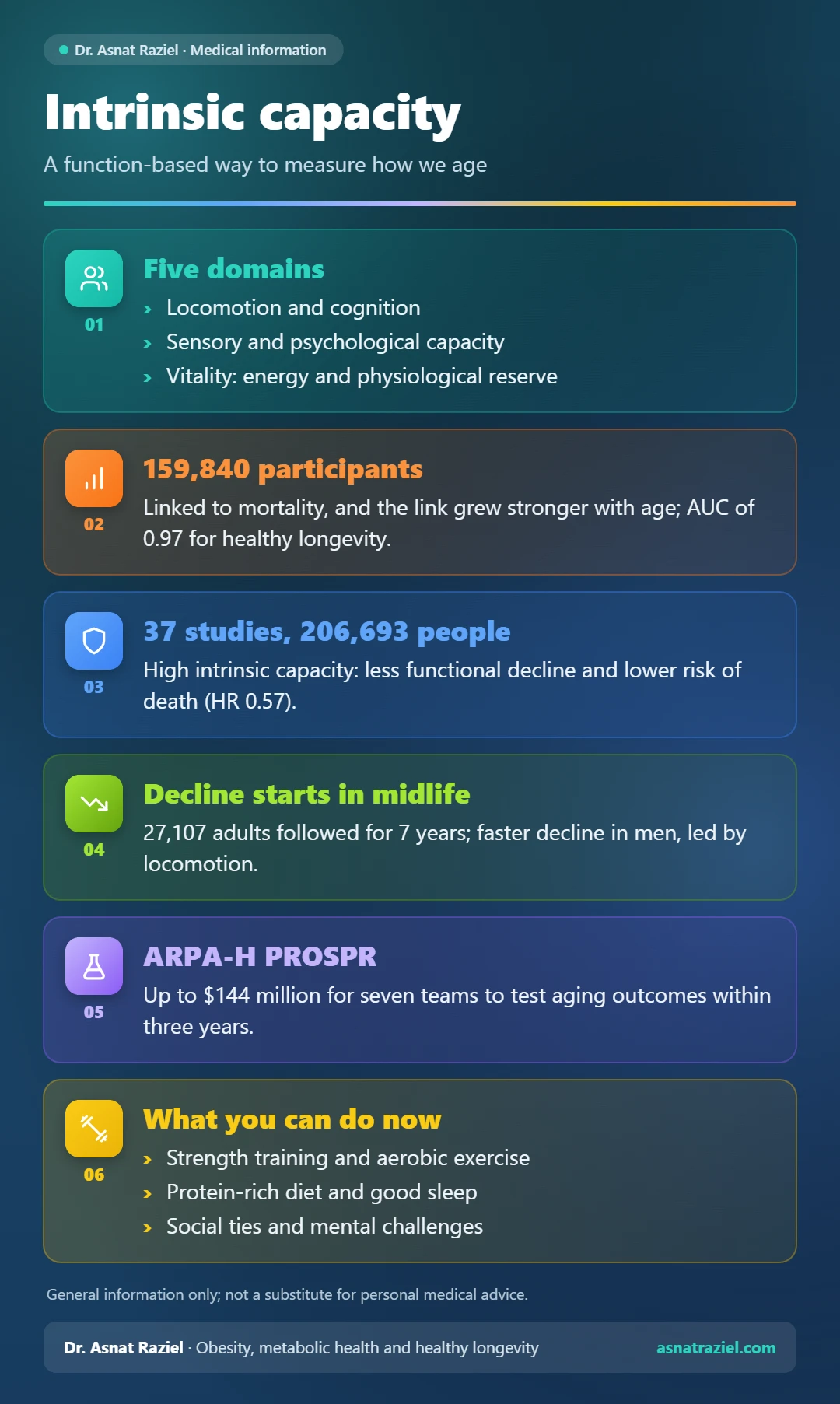
The model includes five domains:
- Locomotion: muscle strength, walking speed, balance and mobility.
- Cognition: memory, attention, orientation, language and executive function.
- Sensory capacity: mainly vision and hearing.
- Psychological capacity: mood, emotional resilience and coping with life.
- Vitality: the energy and physiological reserve that let the body withstand stress.
In population studies, researchers measure these domains with a range of tests. Examples include grip strength, rising from a chair, balance, walking speed, cognitive tests, vision and hearing.
Why chronological age is no longer enough
Two 75-year-olds can be completely different. One travels the world, works out, climbs stairs and still works. The other struggles to walk, has cognitive decline and needs help with daily life. Both have the same chronological age, yet their intrinsic capacity is very different.
This is a core idea in longevity medicine: the number of years we have lived does not tell us how we have aged. In fact, the World Health Organization stresses that there is no “typical older person.” Some 80-year-olds have abilities similar to people decades younger. Others of the same age, by contrast, need a great deal of help.
Intrinsic capacity and longevity
This is where things get especially interesting. A study published in December 2025 included 159,840 participants aged 50 and older from four large cohort studies. The researchers found a significant link between intrinsic capacity and mortality, and the link grew stronger with age. In addition, in the full model, the measure predicted healthy longevity with an AUC of 0.97. That is an impressive figure. Still, it does not mean a single “longevity test” is ready for use in the clinic.
A meta-analysis in The Lancet Healthy Longevity also supports this picture. It included 37 studies with 206,693 participants. High intrinsic capacity went along with less decline in daily function and a lower risk of death (hazard ratio 0.57). In other words, the key question may not be only how many diseases a person has, but also how fast they are losing their reserves.
Tracking the change in intrinsic capacity, not just the score
The biggest strength of this measure may actually lie in tracking it over time. Say that at 55 your grip strength is good, you walk fast, your balance is excellent and your memory is sharp. If a steady decline then starts in one of these domains a few years later, it can be spotted long before real disability sets in.
A study published in August 2026, led by researchers from the University of Haifa, followed 27,107 adults aged 50 and older in Europe for seven years. The measure declined gradually from midlife onward, and faster in men. The domain that contributed most to the decline was locomotion. Building on this, another 2026 study found that the link between intrinsic capacity and disability appears about 14 years before death.
This is an important message. Losing strength, mobility and balance is not just a matter of comfort. Rather, it is a central part of the aging process. That is why it is also worth reading about building muscle after 60.
From molecular longevity to functional longevity
The longevity world talks a lot about telomeres, DNA methylation, chronic inflammation and mitochondria. These are important areas of research. In the end, though, most people do not just want “young blood tests.”
We want to get up from a chair without help, walk briskly and keep our muscles. We also want to remember, think clearly, see and hear well, and stay independent. This measure brings the discussion right back to that point: to healthspan, the number of years we live in good health and good function.
Intrinsic capacity as a yardstick for longevity drugs?
This may be the most intriguing development of all. One of the problems in researching anti-aging drugs is time. To prove that a drug extends life, you have to follow people for decades. Therefore, researchers are looking for measures that show early on whether an intervention changes the course of aging.
In the United States, ARPA-H, the Advanced Research Projects Agency for Health, runs the PROSPR program. The program is developing measurement tools and protocols that will test aging outcomes within three years instead of decades. According to a March 2026 report, the agency set aside up to $144 million for seven research teams. One team plans a trial in healthy 60-year-olds with three approved drugs: rapamycin, an SGLT-2 inhibitor and semaglutide.
It is important to stress one point. It has not yet been proven that improving the measure with a drug extends life. That is exactly the question the new studies are trying to answer.
What about the FDA?
Today, the FDA (the US Food and Drug Administration) does not recognize aging itself as a disease. As a result, there is no simple pathway to approve a drug “to treat aging.” This is where the measure could help. Instead of claiming that a drug “treats age,” researchers could test whether it slows functional decline.
In May 2026, an expert panel convened by ARPA-H submitted a consensus statement to the FDA. The experts wrote that the measure is not yet a validated substitute for mortality or disability. For this reason, they recommended using its separate domains, such as locomotion and cognition, as endpoints in selected trials. The World Health Organization has also taken a step in this direction. The ICD-11 classification includes a code for “ageing associated decline in intrinsic capacity.”
What can you do about intrinsic capacity today?
There is still no single test you can ask your doctor for that gives an agreed-upon “longevity score.” But the idea behind the measure is already very useful. You can ask yourself a few simple questions. Am I stronger or weaker than five years ago? Do I walk at the same speed? And how are my balance, rising from a chair, muscles, memory, hearing, vision, mood and energy?
This is also why I emphasize strength training, aerobic exercise and a protein-rich diet. Likewise, good sleep, social ties and mental challenges matter just as much. The goal is not only to prevent one disease. Instead, the goal is to preserve our physical and mental reserve.
The real shift in how we think about longevity
For years, we asked how long we would live. Then we began asking what our biological age is. Perhaps the next question is much simpler: what can we still do, and how do we keep it up over time?
If intrinsic capacity passes today’s scientific tests, it will help move longevity from measuring disease and age to measuring what truly matters to us. That means going on living, thinking, moving and functioning well for many years.
The information in this article is general and does not replace personal medical advice.
Questions and answers about intrinsic capacity
What is intrinsic capacity?
It is a measure that describes all of a person’s physical and mental capacities: locomotion, cognition, sensory capacity, psychological capacity and vitality.
Can it be measured today?
Its individual components can be measured. However, there is still no single agreed-upon clinical test that gives everyone a universal score.
Does high intrinsic capacity guarantee a long life?
No. Studies show a link between it and good health outcomes and healthy longevity. Even so, it is a risk measure, not a personal prophecy.
Can intrinsic capacity be improved?
This is one of the most important research questions today. Physical activity, especially maintaining strength and mobility, is a key target. Alongside it come nutrition, mental health, treating vision and hearing problems, and managing disease.
Are GLP-1 drugs longevity drugs?
It is still too early to say. Some of these drugs have proven benefits for metabolic and heart health. Now researchers are testing whether they also improve broader measures of healthspan and intrinsic capacity.
References
The Most Important Longevity Term You’ve Probably Never Heard Of
Healthy ageing and functional ability
Intrinsic Capacity as a Predictor of Healthy Longevity: Insights From Four Cohort Studies
Intrinsic Capacity Framework for Geroscience and Healthspan Trials: A Consensus




